

Open a can of tuna and many cats suddenly appear from nowhere.
The smell is strong, the flavor is appealing, and it is easy to understand why cat parents start wondering:
Can cats eat tuna every day?
The short answer is no—tuna made for human consumption should not become your cat’s everyday main food.
Fish can be part of feline nutrition, and tuna may also appear as an ingredient in nutritionally complete commercial cat foods. But a can of tuna from your kitchen and a complete cat food containing tuna are not the same thing.
The important question is not simply:
“Does my cat like tuna?”
It is:
Does the complete diet provide the nutrients my cat needs in the right proportions?
Can Cats Eat Tuna?
Cats can encounter tuna in several different forms:
- tuna used as an ingredient in complete commercial cat food,
- canned tuna made for people,
- tuna-flavored treats,
- complementary foods,
- and fish-based supplements.
Those products should not automatically be treated as nutritionally interchangeable.
A complete cat food is formulated around the nutritional needs of cats.
A can of tuna intended for people is simply a human food product.
That distinction is important.
Why Tuna Should Not Replace Complete Cat Food
Cats require more than protein.
Their diets must supply the appropriate balance of:
- amino acids,
- fatty acids,
- vitamins,
- minerals,
- calories,
- and other nutrients.
Cats also have species-specific nutritional requirements.
For example, taurine is an essential nutrient for cats.
A food can therefore contain plenty of animal protein while still not being appropriate as the sole long-term diet.
If you want to understand why taurine matters within the complete feeding plan, read our Taurine for Cats: A Practical Nutrition Guide.
Human Tuna vs. Complete Tuna-Based Cat Food
This is one of the most useful distinctions to understand.
Tuna made for humans
A standard can or pouch of tuna from the grocery store is intended for people.
It is not automatically formulated to provide all of the nutrients a cat requires in the appropriate proportions.
It may also contain:
- added salt,
- oil,
- seasonings,
- or other ingredients depending on the product.
The package should always be checked before sharing any human food with a pet.
Complete cat food containing tuna
A commercial cat food may use tuna, fish, or seafood as part of its ingredient formula.
What matters is whether the finished food is labeled as nutritionally complete and balanced for cats and the appropriate life stage.
The ingredient “tuna” by itself does not determine whether the complete food is nutritionally appropriate.
What Does “Complete and Balanced” Mean?
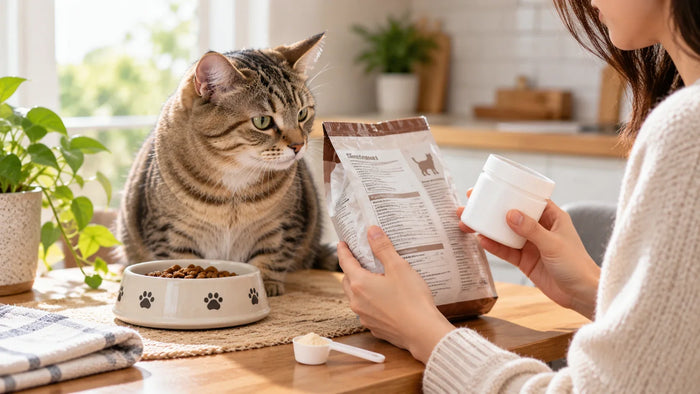
When looking at cat food, one of the most useful pieces of information is the nutritional adequacy statement.
It tells you whether the food is intended to provide complete and balanced nutrition and the life stage for which it is designed.
For example, the food may be intended for:
- kittens,
- adult maintenance,
- growth and reproduction,
- or all life stages.
This tells you much more about the nutritional role of the product than an attractive ingredient on the front of the package.
For additional label and feeding context, see Cornell University College of Veterinary Medicine — Feeding Your Cat and AAFCO — Selecting the Right Pet Food.
A picture of tuna does not make a food complete.
The complete formulation matters.
Is Tuna a Good Source of Omega-3?
Fish is commonly associated with omega-3 fatty acids, but the word “fish” does not tell you the exact fatty-acid profile of a finished food or supplement.
Omega-3 is a family of fatty acids.
When comparing an omega-3 product, useful label information may include:
- the source,
- the named fatty acids,
- EPA,
- DHA,
- amount per serving,
- complete ingredients,
- serving directions,
- and storage instructions.
For a more detailed explanation, see our Omega-3 for Cats: A Practical Nutrition Guide.
Do not assume that feeding extra tuna is the same as using a clearly labeled omega-3 product.
Can Cats Eat Canned Tuna in Water?
The absence of oil does not turn human tuna into complete cat food.
Plain tuna in water may look simple, but it is still a food intended for humans rather than a nutritionally complete feline diet.
If you occasionally share human food with your cat, discuss appropriate amounts with your veterinarian and always check the ingredient list first.
Do not allow an occasional extra to gradually replace the cat’s normal complete diet.
What About Tuna in Oil?
Oil-packed tuna introduces additional fat and calories.
Some products may also contain added salt, flavorings, or other ingredients.
For this reason, the fact that your cat enjoys the smell does not mean the product belongs in the daily feeding routine.
The safest starting point is still the same:
Use complete and balanced cat food as the nutritional foundation.
Can Kittens Eat Tuna?
Kittens have nutritional needs related to growth and development.
Their food should be appropriate for the growth life stage or otherwise labeled for their nutritional needs.
A favorite human food should not displace a properly formulated kitten diet.
If you are feeding a kitten and are unsure whether a food is appropriate, look at the nutritional adequacy statement and speak with your veterinarian.
Can Tuna Cause a Cat to Become a Picky Eater?
Cats can develop strong food preferences.
Highly palatable foods offered frequently may make some cats less interested in their normal meals.
That does not mean every cat given tuna will suddenly reject its usual food.
But it is another reason not to build the entire feeding routine around one highly appealing human food.
Consistency matters.
If your cat suddenly refuses its normal food, do not simply keep replacing meals with tuna.
Loss of appetite or a sudden change in eating behavior may deserve veterinary attention.
What Should You Look for on a Cat Food Label?
Instead of choosing a food because the front says “tuna,” “salmon,” or “fish,” check the complete label.
Ask:
1. Is this food made for cats?
Cats and dogs do not have identical nutritional requirements.
2. What life stage is it designed for?
Look for kitten, adult maintenance, or other appropriate life-stage information.
3. Is it complete and balanced?
Find the nutritional adequacy statement.
4. What are the feeding directions?
Even an appropriate food needs to be fed in an appropriate amount.
5. What else is your cat eating?
Remember to include:
- treats,
- toppers,
- human foods,
- supplements,
- and complementary products.
Nutrition is about the complete daily routine, not one ingredient.
Fish Ingredients Are Not Automatically Better—or Worse
Cat-food marketing can make ingredients sound like a simple ranking system.
Fish sounds healthy.
Chicken sounds natural.
One ingredient may appear more premium than another.
But feline nutrition is not that simple.
The nutritional quality of the complete diet depends on:
- formulation,
- nutrient balance,
- appropriate life stage,
- feeding amount,
- and the individual cat.
It is more useful to ask whether the finished food is appropriate than to judge it from one ingredient name.
What About Fish-Oil or Omega-3 Supplements?
A supplement is a separate question from feeding tuna.
If you are considering an omega-3 supplement, start by reviewing what your cat already receives through the normal diet.
Then compare the exact product label.
Kittysum’s Omega-3 Supplement for Cats is designed as a mealtime powder, but it is intended to complement an appropriate diet—not replace complete cat food.
Review the current product page and package label for the latest ingredients, active amounts, serving directions, and storage instructions.
If your cat has a health condition or takes medication, speak with a licensed veterinarian before introducing a new supplement.
When Should You Talk to a Veterinarian?
General feeding information cannot account for every individual cat.
Contact a veterinarian if your cat:
- stops eating normally,
- loses or gains significant weight,
- vomits repeatedly,
- develops persistent diarrhea,
- has an existing medical condition,
- takes medication,
- requires a therapeutic diet,
- or is eating a homemade or highly restricted diet.
A veterinarian can evaluate the whole feeding plan rather than focusing on one ingredient.
Frequently Asked Questions
Can cats eat tuna every day?
Human tuna should not be used as a cat’s everyday main diet. A cat’s nutritional foundation should be food formulated to provide complete and balanced feline nutrition.
Is tuna in cat food okay?
Tuna may be an ingredient in commercial cat food. Check whether the finished product is complete and balanced for your cat’s life stage.
Can cats eat tuna from a can?
Human canned tuna is not equivalent to complete cat food. Check the ingredients and avoid allowing it to replace your cat’s balanced diet.
Is tuna good for cats because it contains omega-3?
Fish can contain omega-3 fatty acids, but the word “tuna” alone does not tell you how much EPA or DHA a food provides. Check the exact product information.
Should I give my cat fish-oil supplements instead?
Do not automatically add a supplement because your cat eats little fish. Start with the complete diet and review the exact supplement label. Ask your veterinarian when individual health, medication, or diet questions are involved.
The Practical Takeaway
Tuna is a good example of why ingredients and complete nutrition are not the same question.
Your cat may love the smell.
A commercial cat food may contain tuna.
An omega-3 supplement may use marine ingredients.
But none of those facts alone tells you whether your cat’s complete nutritional needs are being met.
Start with a food that is appropriate for cats and the correct life stage.
Read the nutritional adequacy statement.
Treat human foods as extras rather than nutritional foundations.
And when considering additional nutrition products, review the complete feeding plan first.
Continue learning with:
Taurine for Cats: A Practical Nutrition Guide
Omega-3 for Cats: A Practical Nutrition Guide
Educational information only. This article is not veterinary advice and does not diagnose, treat, cure, or prevent disease.