Key takeaways
- Cats can have fish oil, but they make little EPA and DHA on their own, so the source matters.
- No safe upper limit for EPA and DHA has been set for cats, so your vet should set the dose.
- The best evidence is for itchy skin and for diets used in joint and kidney care.
- Side effects include loose stool, weight gain and, at high doses, clotting changes.
- Skip cod liver oil: it can push vitamin A and D to toxic levels in cats.
Fish oil for cats can be a safe source of omega-3 fats. The key is to choose the right product and keep the dose modest.
So the short answer to "can cats have fish oil?" is yes. However, it works best as a planned addition to a complete diet, not as a cure.
This guide sorts what the research shows from what labels promise. In addition, it shows you how to plan a dose with your vet.
In this guide
- What Is Fish Oil for Cats?
- Why Fish Oil for Cats Beats Plant Oils
- 7 Proven Facts About Fish Oil for Cats
- Fish Oil for Cats: Benefits Researchers Studied
- How Much Fish Oil for Cats Is Safe?
- Fish Oil for Cats: Side Effects and Who Should Avoid It
- Cod Liver Oil and Human Fish Oil
- How to Add Fish Oil for Cats: A Step-by-Step Plan
- Fish Oil for Cats vs Other Omega-3 Sources
- Signs That Fish Oil for Cats Is Helping
- Key Terms Explained
- A Quick Owner Checklist
What Is Fish Oil for Cats?
Fish oil for cats is oil pressed from oily fish, such as anchovy, sardine or salmon. Its main value is two omega-3 fats called EPA and DHA.
The Ontario Veterinary College explains the split well. ALA is a short-chain omega-3 from plants. EPA and DHA, by contrast, are long-chain omega-3s.
That difference matters a lot for cats. Plant oils like flax mostly give ALA, while fish oil gives EPA and DHA directly.
| Term | What it means | Where it comes from |
|---|---|---|
| ALA | Short-chain omega-3 | Flax, chia and other plant oils |
| EPA | Long-chain omega-3 | Fish oil, krill oil, some algae |
| DHA | Long-chain omega-3 | Fish oil, algal oil |
| Vitamin E | Antioxidant that guards fats | Added to most good fish oils |
| Vitamins A and D | Fat-soluble vitamins | High in cod liver oil |

Why Fish Oil for Cats Beats Plant Oils
Cats are poor at turning ALA into EPA and DHA. A 2020 safety study in cats states that cats "have limited capacity" to make these long-chain fats.
WikiVet gives the reason. Cats have low activity of a liver enzyme called delta-6 desaturase.
As a result, a flaxseed oil will not do the same job as fish oil. The Ontario team adds that pets make too little EPA and DHA from ALA to see real benefits.
That is why most vets point to fish oil for cats or to algal oil. Plant oils, by contrast, rarely make the list.
Is fish oil for cats already in most foods?
It is in many cat foods. AAFCO even sets a level for growth and reproduction foods.
According to Today's Veterinary Practice, that level is 0.012% EPA and DHA, or 3 mg per 100 kcal.
So check your cat's food first. Some foods, especially therapeutic diets, already contain a lot of fish oil.
7 Proven Facts About Fish Oil for Cats
Here are seven facts, each tied to a source you can read. Together, they answer most of the questions owners ask.
- Cats make little EPA and DHA. They rely on preformed sources, so fish oil is a direct route.
- No upper limit is set for cats. The NRC has not set a safe upper level for EPA and DHA in cats.
- Itchy skin has the best support. Merck says 50% of cats with allergic itch show some improvement.
- Joint diets show promise. A 2010 trial of a diet rich in EPA and DHA raised activity in cats with joint pain.
- Kidney diets use EPA. In one study, cats lived longest on the renal diet with the most EPA.
- Side effects exist. These include loose stool, weight gain and changes in clotting.
- Cod liver oil is risky. It is a common cause of vitamin A poisoning in cats.
Fish Oil for Cats: Benefits Researchers Studied
Fish oil for cats is not a magic oil. Still, there are three areas where the evidence is worth knowing.
Fish oil for cats with itchy skin
The Merck Veterinary Manual says 50% of cats with allergic itch show some improvement on fatty acids.
That also means half do not respond. Similarly, Cornell warns that fatty acid supplements "are not 100 percent effective."
For dry, flaky skin, see our guide on cat dandruff and dry skin. Fish oil is one of several steps there.
Joints and mobility
In a 2010 trial by Lascelles and colleagues, 40 cats with painful joints took part. Each cat ate either a test diet or a control diet.
The test diet was high in EPA and DHA. It also had green-lipped mussel, glucosamine and chondroitin.
According to a Petfood Industry summary, activity rose in the test diet group.
Even so, the diet mixed several ingredients. So we cannot credit fish oil for cats alone.
Kidney diets
The Today's Veterinary Practice review describes a study of cats with chronic kidney disease.
In it, cats lived longest on the renal diet with the most EPA, at 200 mg per 100 kcal.
That was a full renal diet under vet care, though. It does not mean fish oil can treat kidney disease at home.

How Much Fish Oil for Cats Is Safe?
There is no single safe dose printed in the research for every cat. In fact, the 2020 algal oil study says no safe upper level has been set by the NRC.
A dvm360 summary of a 2013 review agrees. It says there is not enough data to set a safe upper limit in cats.
For dogs, by contrast, the NRC safe upper limit is 280 mg per 100 kcal. That number is for dogs only, so do not apply it to your cat.
What vets work from
The veterinary nutritionists who wrote the fish oil dosing review give an estimate.
For cats with kidney disease or arthritis, they estimate about 112 or 120 mg per kilogram. That figure is combined EPA and DHA.
Those are targets for cats under treatment, though, not a daily routine for healthy cats. Your vet will weigh your cat's food, weight and health before setting a dose of fish oil for cats.
Read EPA and DHA, not "fish oil"
A label that says "1,000 mg fish oil" does not tell you the omega-3 dose. Instead, look for the EPA and DHA per serving.
Then add what the food already gives. This total is what your vet needs to know.
| Label line | Why it matters | What to do |
|---|---|---|
| EPA mg per serving | Main active omega-3 | Share with your vet |
| DHA mg per serving | Second active omega-3 | Add to EPA for the total |
| Vitamin E | Protects the oil from going rancid | Prefer products that include it |
| Vitamin A or D | High in cod liver oil | Avoid for cats unless your vet says so |
| Other added actives | Can cause overdose or harm | Choose a plain product |
| Calories per serving | Adds to daily intake | Count it in your cat's food plan |
Fish Oil for Cats: Side Effects and Who Should Avoid It
Most cats handle a modest dose well. Still, side effects do happen, and some cats need extra care.
The fish oil dosing review lists altered platelet function, stomach upset and slower wound healing. It also lists weight gain from extra calories.
Merck adds that large doses may cause weight gain or diarrhea. Pancreatitis has also been reported, though rarely.
- Loose stool: start low and build up over one to two weeks.
- Weight gain: fish oil is fat, so count its calories.
- Clotting changes: tell your vet before any surgery.
- Vitamin E loss: oxidized oil can cause signs of vitamin E deficiency.
- Contaminants: the Ontario team notes fish oils may contain trace heavy metals.
Cats that need a vet check first
First, talk to your vet if your cat has a bleeding problem or a sensitive stomach.
Similarly, check first if your cat had pancreatitis or is due for surgery. The same goes for cats on prescription diets, since many already contain fish oil.
Cod Liver Oil and Human Fish Oil
Not every fish oil is a good fish oil for cats. Cod liver oil is the main one to avoid.
VCA Animal Hospitals says vitamin A poisoning most often follows diets of raw liver or cod liver oil. Cats are also more sensitive to it than dogs.
Too much vitamin D is a problem as well. A 2021 case series tied excess vitamin D3 in food to high blood calcium in five cats.
What about the fish oil in my cupboard?
Human fish oil capsules are not made for cats. Some contain added vitamins or flavors that a cat does not need.
The University of Illinois notes that human supplements make up about 16.5% of poison control calls. It lists cod liver oil among the risky ones.
So if you use a human fish oil for cats, show the label to your vet first. Then choose a plain oil with no added vitamins A or D.

How to Add Fish Oil for Cats: A Step-by-Step Plan
Use this plan to bring in fish oil for cats calmly. Each step keeps your vet in the loop.
- Ask your vet. Share the reason, your cat's weight and the food you use.
- Read the label. Note the EPA and DHA per serving, plus vitamin A and D.
- Start low. Begin with a small part of the target and mix it into wet food.
- Watch closely. Check stool, appetite and weight each week.
- Review. After about eight weeks, ask your vet whether to keep going.
Storage tips
Fish oil goes rancid over time. Therefore, close the lid tightly and keep the product cool and dry.
If the oil smells sharp or sour, throw it out. Rancid oil uses up vitamin E and can upset the stomach.
Fish Oil for Cats vs Other Omega-3 Sources
Fish oil for cats is the most common choice. However, it is not the only one.
| Source | EPA and DHA | Notes for cats |
|---|---|---|
| Fish oil | Yes | Most studied; check for added vitamins |
| Krill oil | Yes | Usually lower dose per serving |
| Algal oil | Mostly DHA, some EPA | Tested in a 2020 kitten growth study |
| Cod liver oil | Yes | Risk of vitamin A and D excess |
| Flaxseed oil | No, ALA only | Cats convert little ALA to EPA or DHA |
| Omega-3 powder | Depends on label | Easy to mix; read EPA and DHA per scoop |
For more on the wider omega-3 topic, read our omega-3 for cats guide. It covers the five main benefits and safe use.
Also, if you feed tuna as a treat, see can cats eat tuna. Fish-heavy diets bring their own risks.

Also, cod liver oil is not the same as fish oil for cats. Because it adds vitamins A and D, read our cod liver oil for cats guide before you buy. In short, fish oil for cats is the simpler choice. So ask your vet which one fits.
Looking for an easy omega-3 to discuss with your vet?
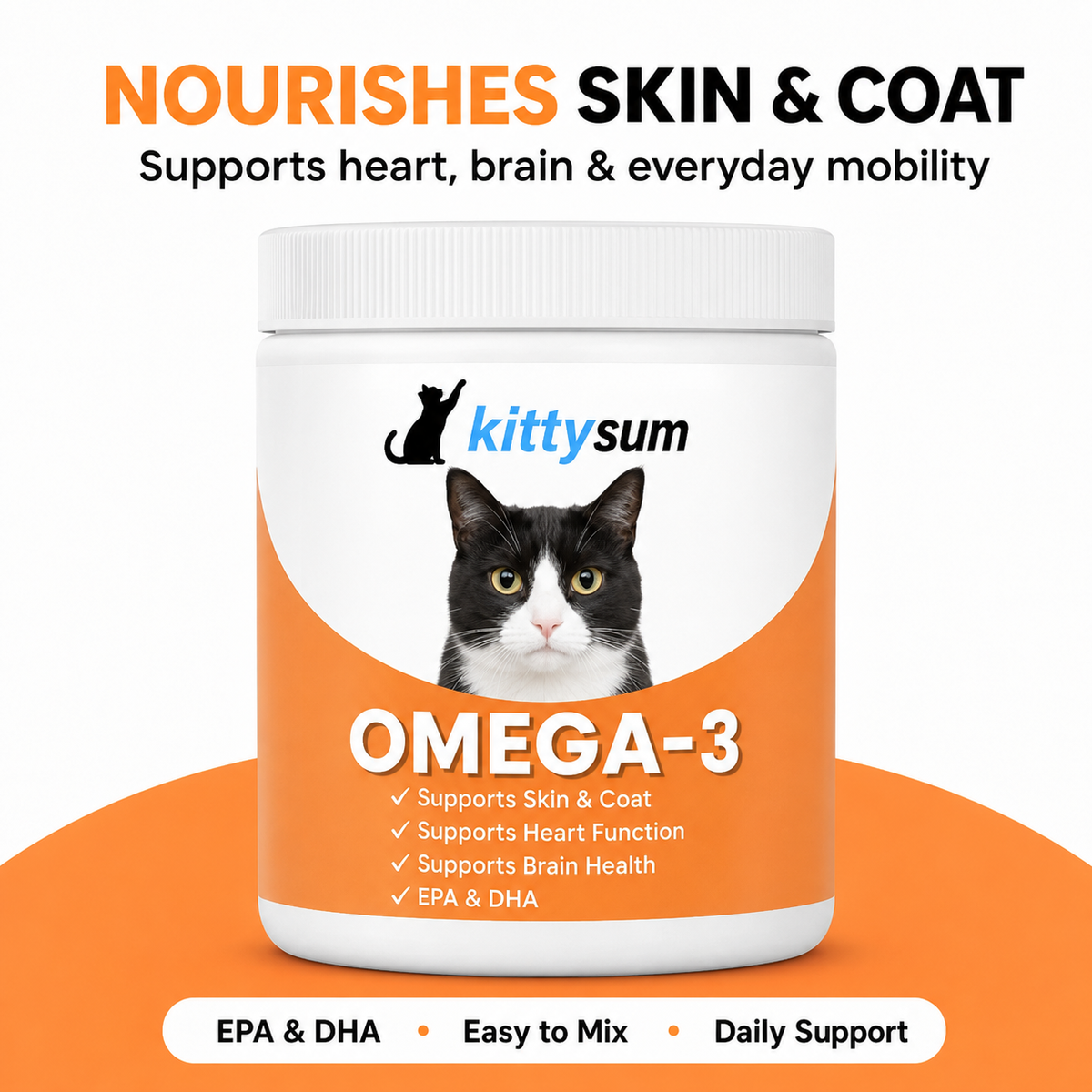
Kittysum Omega-3 is a cat supplement powder made as daily nutrition support, not as a treatment. Read the label for EPA and DHA per scoop, and ask your vet before you start. See the label and serving directions →
Signs That Fish Oil for Cats Is Helping
Because results are slow, it helps to know what to watch. Then you can judge the oil on facts, not hope.
For skin, look for less scratching and fewer flakes after several weeks. For joints, watch whether your cat jumps up more easily.
On the other hand, some signs mean you should pause. For example, stop and call your vet if you see ongoing diarrhea, vomiting or unusual bruising.
Also, keep a simple log. Note the date, the dose, the stool and any change in itch or activity.
In short, a log turns a vague feeling into clear notes. Your vet can then decide whether fish oil for cats is worth keeping.
| What to watch | Good sign | Call your vet if |
|---|---|---|
| Skin | Less scratching, fewer flakes | Itch gets worse or sores appear |
| Activity | Easier jumps and stairs | Limping or pain continues |
| Stool | Normal and formed | Diarrhea lasts more than a day or two |
| Weight | Stable | Steady gain or loss |
| Bleeding | None | Bruising or slow-healing cuts |
Key Terms Explained
- EPA: eicosapentaenoic acid, a long-chain omega-3 found in fish oil for cats.
- DHA: docosahexaenoic acid, a long-chain omega-3 that supports the eyes and brain.
- ALA: alpha-linolenic acid, a plant omega-3 that cats convert poorly.
- Delta-6 desaturase: a liver enzyme that is weak in cats.
- Steatitis: painful fat inflammation linked to low vitamin E and high fish fat.
- Safe upper limit: the most a pet can take without harm; none is set for cats.
A Quick Owner Checklist
Before you buy, run through this short list. It keeps fish oil for cats simple and safe.
- My vet knows why I want to add an omega-3.
- I know the EPA and DHA per serving.
- The product has no added vitamin A or D.
- I have counted the extra calories.
- I will watch stool and weight for eight weeks.
Fish Oil for Cats: Frequently Asked Questions
Can cats have fish oil every day?
Yes, many cats take fish oil daily under vet guidance. Because no safe upper limit is set for cats, ask your vet for a dose based on EPA and DHA.
Is human fish oil safe for cats?
It can be, if it is plain fish oil with no added vitamins A or D, xylitol or other actives. Show the label to your vet before you use it.
What are the side effects of fish oil for cats?
Common ones are loose stool and weight gain. High doses may change clotting, and oxidized oil can lower vitamin E.
Is cod liver oil good for cats?
It is a poor choice. VCA says cod liver oil is a common cause of vitamin A poisoning in cats. Also, cats are more sensitive to it than dogs.
How long does fish oil take to work in cats?
It often takes weeks. So plan a review with your vet after about eight weeks, and judge it on clear signs.
References
- Ontario Veterinary College Pet Nutrition. The ABCs of Omega-3s. 2024.
- Raditic DM, Gaylord L. Fish Oil Dosing in Pet Diets and Supplements. Today's Veterinary Practice. 2020.
- Safety of algal oil containing EPA and DHA in cats during gestation, lactation and growth. J Anim Physiol Anim Nutr. 2020.
- dvm360. Journal scan: omega-3 fatty acids, how much is too much? 2013.
- WikiVet. Omega-3 Fatty Acids - Nutrition.
- Merck Veterinary Manual. Essential Fatty Acids for Integumentary Disease in Animals.
- Cornell University College of Veterinary Medicine. The Challenge of Skin Disorders.
- Petfood Industry. Therapeutic diet for feline joint disease.
- VCA Animal Hospitals. Vitamin A Poisoning in Cats.
- Frontiers in Veterinary Science. A case series linked to vitamin D excess in pet food. 2021.
- University of Illinois CVM. Pharmacist's Corner: Human Supplements and Toxicity to Animals. 2026.
- AAFCO. Supplements.
This article is for general education and is not veterinary advice. These statements have not been evaluated by the Food and Drug Administration. Kittysum products are not intended to diagnose, treat, cure or prevent any disease.