Key takeaways
- Can kittens eat eggs? Yes, a tiny taste of plain, fully cooked egg after weaning is fine for most kittens.
- Nursing kittens should never get egg; they need their mother's milk or a kitten milk replacer.
- Raw egg is unsafe for kittens because of germs and the biotin-blocking protein in raw white.
- Keep egg to a fingertip or half-teaspoon taste; growth food must stay the main diet.
- Egg supplies little taurine, which growing kittens need from a complete growth food.
Can kittens eat eggs? Yes, once they are weaned, most kittens can try a tiny taste of plain, fully cooked egg. However, a kitten's small stomach and fast growth make portion size and food quality more important than for adult cats.
This guide explains the right age to start, how much to offer, why raw egg is off the table and why a complete growth food must come first. We wrote it for new kitten owners, fosters and rescue volunteers.
For adult cats, see our guide on can cats have eggs.
Table of contents
- The short answer
- Right age
- Egg by age
- Nursing kittens
- Raw egg risks
- How much
- How to prepare
- Growth food first
- Eggs and taurine
- Orphan kittens
- Sensitive tummies
- Allergies
- Homemade diets
- Warning signs
- Every day?
- Scrambled or boiled?
- Egg treats
- Older kittens
- Shared homes
- Myths
- Mistakes
- Questions for a vet
- FAQ
- References
Can Kittens Eat Eggs? The Short Answer
In short, yes, with limits. Weaned kittens can have a small taste of plain, fully cooked egg now and then. For example, Purina notes that cooked eggs can be an occasional treat for cats. However, kittens have tiny stomachs and high nutrient needs, so every bite of egg replaces a bite of growth food.
Therefore, the better question is not only can kittens eat eggs, but how little egg they need to enjoy it safely. As you will see, the answer is very little.

At What Age Can Kittens Eat Eggs?
Generally, kittens finish weaning by about 8 weeks, which decides the answer to can kittens eat eggs. Before then, they should not get egg at all. After weaning, and once they eat a complete kitten food well, a tiny taste of cooked egg is fine.
- Under 4 weeks: mother's milk or kitten milk replacer only.
- 4 to 8 weeks: weaning onto kitten food; no egg yet.
- 8 weeks and older: occasional tiny tastes of plain cooked egg.
- 6 months and older: the same small treat portions as a young adult, scaled to size.
In short, can kittens eat eggs at any age? No; wait until weaning is complete.
Can Kittens Eat Eggs at Each Age? A Quick Guide
Here is a simple guide by age and form.
| Age | Egg allowed? | Notes |
|---|---|---|
| 0 to 4 weeks | No | Milk or kitten milk replacer only |
| 4 to 8 weeks | No | Focus on weaning to kitten food |
| 8 weeks to 6 months | Tiny taste | Plain, fully cooked, rarely |
| 6 to 12 months | Small treat | About half to one teaspoon |
| Any age, raw egg | No | Germ and biotin risks |
In other words, age and cooking decide the answer.

Nursing Kittens
Importantly, nursing kittens get everything they need from their mother. Meanwhile, orphaned kittens need a kitten milk replacer, never cow's milk or egg mixtures. Maddie's Fund offers guidance on common feeding problems in orphaned kittens. So can kittens eat eggs while nursing? No; milk is the only food they should have, and can kittens eat eggs only becomes a real question after weaning.
Why Raw Egg Is Unsafe for Kittens
However, raw egg poses extra risks for young kittens. First, raw eggs can carry Salmonella and other germs, and kittens have developing immune systems. Both the FDA and the AVMA warn about raw animal foods for pets, and the ASPCA lists raw eggs among foods to avoid.
Second, raw egg white contains avidin, which binds the vitamin biotin, as Chewy's vet team explains. Fortunately, cooking solves both problems. Therefore, can kittens eat eggs raw? Never.
How Much Egg Can Kittens Eat?
Above all, keep it tiny. A large egg has roughly 70 calories, which is a big share of a small kitten's daily needs. So offer only a fingertip-sized taste at first, then no more than about half a teaspoon at a time for young kittens.
- Offer egg no more than once or twice a week.
- Keep all treats under about 10 percent of daily calories.
- Never let egg replace a kitten meal.
As a result, your kitten tries something new without missing growth nutrition. So can kittens eat eggs in bigger portions as they grow? Only gradually, and never at the expense of kitten food.
How to Prepare Egg for a Kitten
- First, scramble or hard-boil the egg until fully set.
- Next, keep it plain, with no butter, oil, milk or salt.
- Then let it cool completely.
- After that, mash it very finely so it is easy to eat.
- Finally, offer a tiny taste on a fingertip or mixed into a little kitten food.
Our guide to cooked eggs for cats compares cooking methods.
Why Growth Food Comes First
Notably, kittens grow fast and need more protein, energy and certain nutrients than adults. According to VCA, kittens should eat a food made for growth. Also, the AAFCO cat food nutrient profiles set separate growth standards. So a complete kitten food covers these needs, while egg covers only some of them.
Therefore, can kittens eat eggs as part of their diet? Only as a tiny extra beside a complete growth food. Our guide to taurine for kittens explains growth needs.
Can Kittens Eat Eggs Instead of Meat? The Taurine Question
Importantly, eggs contain far less taurine than meat, heart or shellfish. Yet kittens need taurine for heart muscle, vision and development, as VCA Animal Hospitals explains. Moreover, Merck notes that plant protein contains none.
Also, low taurine causes serious disease. For example, the landmark 1987 Pion study linked heart failure to low blood taurine, and taurine shortfalls can also affect the retina and growth. In short, egg cannot stand in for the meat-based nutrition kittens need.
Orphan and Rescue Kittens
Similarly, rescue kittens may arrive thin or with unknown diets. In that case, a vet visit comes first, then a complete kitten food in small, frequent meals. Also, avoid adding egg until the kitten eats its kitten food well and has normal stools; only then can kittens eat eggs as a treat. Our guide to taurine for rescue cats explains the first weeks after adoption.
Sensitive Tummies
Often, kittens have delicate digestion, and new foods can cause soft stools. So introduce egg in a tiny amount and wait a day before offering more. Also, change only one thing at a time, so you can tell what caused any upset. Then stop egg if stools turn loose. For a kitten with a sensitive tummy, the answer to can kittens eat eggs may simply be not yet.
Egg Allergies in Kittens
Occasionally, cats develop food allergies, and egg is one possible trigger. Signs include itchy skin, over-grooming, vomiting or diarrhea. Therefore, watch your kitten for a day or two after the first taste. In addition, keep a simple note of new foods, which helps your vet if problems appear later. If your kitten reacts, the answer to can kittens eat eggs becomes no for that kitten.
Homemade Diets for Kittens
In contrast, homemade diets for kittens are risky without expert help. Growing kittens need precise amounts of calcium, phosphorus, taurine and other nutrients. So only use a recipe from a veterinary nutritionist. Also, a UC Davis study found cooking lowers taurine in meat, so recipes need taurine added after cooking.
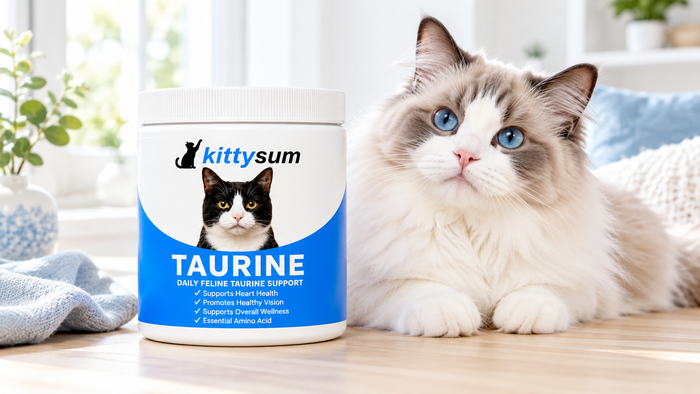
For homemade feeders working with their vet, Kittysum Taurine is a daily taurine powder in a 200 g tub with a measuring scoop, blended with chicken liver for a meaty smell. You can read the label and serving guide here. Our guide to taurine for homemade cat food explains safe amounts.

Warning Signs After Eating Egg
Even so, kittens can become ill quickly. So call your vet if you notice these signs.
- Vomiting or repeated diarrhea
- Low energy or refusing food
- A swollen or painful belly
- Itchy skin or facial swelling
Overall, quick action matters more for kittens than for adult cats, so can kittens eat eggs safely depends on watching closely after each taste.

Can Kittens Eat Eggs Every Day?
In short, no. Daily egg would crowd out growth food and add calories a small kitten does not need. Instead, offer a taste once or twice a week at most. Meanwhile, keep every other meal on complete kitten food. As a result, can kittens eat eggs regularly becomes a clear yes only when the portions are tiny and the schedule is occasional.
Can Kittens Eat Eggs Scrambled or Boiled?
Both work, as long as the egg is fully cooked and plain. For example, scrambled egg made in a non-stick pan without butter is soft and easy to mash. Meanwhile, hard-boiled egg is handy for batch prep, but mash it very finely so a kitten cannot gulp a large piece. Also, skip fried egg, since the added fat can upset a young stomach. Thus, can kittens eat eggs in any cooked form? Yes, except fried or seasoned versions.
Can Kittens Eat Eggs in Treats and Kitten Food?
Also, many kitten foods list egg or dried egg product as an ingredient. In that case, the egg is part of a balanced recipe, so it counts as food rather than a treat. However, freeze-dried egg treats for cats count toward the treat allowance. Therefore, check the label says it suits kittens. Our guide to cat food with egg explains how to read those labels, which is often the easiest way kittens eat eggs safely.
Can Kittens Eat Eggs Between 6 and 12 Months?
Later in the first year, kittens grow more slowly and eat larger meals. So a half to one teaspoon of plain cooked egg is reasonable as an occasional treat. Still, keep a complete growth or all-life-stages food until your vet suggests switching to adult food, usually around 12 months. In addition, spayed and neutered kittens can gain weight easily, so watch portions. Overall, can kittens eat eggs at this age? Yes, in small, occasional amounts.
Kittens in Homes With Adult Cats
Likewise, kittens often share a home with older cats. For instance, a kitten may steal an adult cat's egg topper or adult food. So feed kittens separately when you offer egg, and give each cat its own portion. Then pick up bowls after meals. Consequently, each cat gets the right food, and the kitten does not overeat rich extras.
Myths About Whether Kittens Can Eat Eggs
- "Egg and milk make a good kitten formula." Use a kitten milk replacer instead.
- "Raw egg builds strong kittens." It carries germ and biotin risks.
- "Egg can replace kitten food." It lacks enough taurine and other nutrients.
- "More protein is always better for growth." Balance matters more than extra egg.
Clearing up these myths keeps the answer to can kittens eat eggs safe and simple.
Common Mistakes
- Offering egg before weaning. Wait until about 8 weeks.
- Serving runny or raw egg. Cook it fully.
- Giving a large portion. A tiny taste is enough.
- Using egg mixtures for orphans. Use a kitten milk replacer.
- Cooking homemade kitten food without a recipe. Work with a vet nutritionist.
Avoiding these mistakes keeps egg a safe, occasional treat.
Questions to Ask a Vet
- Is my kitten old enough to try egg?
- How much egg is safe for my kitten's weight?
- Which complete kitten food suits my kitten?
- Does my kitten need any supplement?
Finally, bring your kitten's food label to the first visits. For context, a 1991 Waltham study found cats need at least 39 mg of taurine per kg of body weight a day on canned food, the Companion Animals Extension notes retinal changes may appear 5 to 6 months into a deficiency, the WSAVA guide offers diet advice, and Merck explains the heart disease linked to low taurine.
Feeding a kitten a homemade diet with your vet?
Kittysum Taurine is a daily taurine powder blended with chicken liver in a 200 g tub with a measuring scoop, free shipping on orders over $50 and a 30-day return policy. Ask your vet to confirm the amount. Shop Kittysum Taurine →
Key Terms Explained
- Weaning: the move from mother's milk to solid food, usually completed by about 8 weeks.
- Growth food: a complete cat food labeled for growth or all life stages.
- Kitten milk replacer: a formula made for kittens; never use cow's milk instead.
- Avidin: a raw egg white protein that blocks biotin; cooking inactivates it.
- Treat allowance: the share of daily calories, usually about 10 percent, that can come from extras.
Frequently Asked Questions
Can kittens eat eggs?
Yes, weaned kittens can have a tiny taste of plain, fully cooked egg occasionally, with a complete kitten food as the main diet.
At what age can kittens eat eggs?
After weaning, usually from about 8 weeks, once they eat kitten food well.
Can kittens eat raw eggs?
No. Raw eggs can carry Salmonella, and raw egg white contains avidin, which blocks the vitamin biotin.
How much egg can a kitten eat?
A fingertip-sized taste at first, then no more than about half a teaspoon once or twice a week for young kittens.
Can I mix egg with milk for an orphan kitten?
No. Orphaned kittens need a kitten milk replacer, never cow's milk or egg mixtures.
References
- VCA Animal Hospitals. Taurine in Cats.
- VCA Animal Hospitals. Lysine.
- Earle KE, Smith PM. Dietary taurine content and plasma taurine in the cat. Br J Nutr. 1991.
- Pion PD, et al. Myocardial failure in cats with low plasma taurine. Science. 1987.
- Spitze AR, et al. Taurine in animal feed ingredients. 2003.
- Kanakubo K, et al. Protein and amino acids in vegetarian pet diets. 2015.
- AAFCO. Cat Food Nutrient Profiles.
- Merck Veterinary Manual. Nutritional Requirements of Small Animals.
- Merck Veterinary Manual. Dilated Cardiomyopathy.
- WSAVA. Selecting a pet food for your pet.
- Companion Animals Extension. Taurine Requirement of Cats.
- AVMA. Dietary supplement law not applicable to products for animals.
- Purina. Can Cats Eat Eggs?.
- Chewy. Can Cats Eat Raw Eggs?.
- VCA. Feeding Growing Kittens.
- Maddie's Fund. Orphaned Kittens: Common Feeding Issues.
This article is for general education and is not veterinary advice. These statements have not been evaluated by the Food and Drug Administration. Kittysum products are not intended to diagnose, treat, cure or prevent any disease.