Key takeaways
- Is lysine good for cats? As a nutrient, yes. Cats need lysine, and meat-based diets supply it.
- As a supplement for feline herpes, the evidence is weak. A 2015 systematic review found no proof that it works.
- One small 2003 study found less viral shedding in one stress test, but shelter studies did not show a benefit.
- Adult cats in one study handled high lysine intake without lowering arginine.
- Talk to your vet before you start, and never use lysine in place of vet care for eye or breathing signs.
Is lysine good for cats? It is one of the most common questions cat owners ask. The honest answer has two parts. Lysine is an essential nutrient that every cat needs. But extra lysine as a supplement has much weaker support than many labels suggest.
Most interest in lysine comes from feline herpesvirus, or FHV-1. This virus can cause sneezing and eye problems, and many cats carry it for life. So owners hope lysine will help.
In this guide, we look at 6 key studies, explain what they found and help you decide, with your vet, whether lysine fits your cat.
Table of contents
- Is lysine good for cats as a nutrient
- Why owners ask whether lysine is good
- Is lysine good for cats? What 6 key
- Is lysine good for cats? Study
- Is lysine good for cats in terms of
- How to decide if lysine is good for
- Is lysine good for cats with eye
- Is lysine good for cats that sneeze
- Is lysine good for cats and kittens
- Is lysine good for cats as daily
- Powder, gel or chew
- 4 common myths
- What helps cats with FHV-1 more
- When to see your vet
- Key terms
- FAQ
- References
Is lysine good for cats as a nutrient
Is lysine good for cats as part of food? Yes. Lysine is an essential amino acid, which means the body cannot make enough of it. Cats must get it from food.
Normal cat diets usually cover this need. A 2024 review of amino acids in the natural felid diet found that natural prey meets the minimum lysine need. Complete and balanced cat foods are also made to meet it.
So, is lysine good for cats in the diet? Absolutely. The real question is whether extra lysine, on top of a complete food, adds anything. That is where the research comes in.

Why owners ask whether lysine is good for cats
First, the idea goes back to how herpesviruses grow. Lab work suggested that lysine might compete with arginine, another amino acid the virus uses. If so, more lysine could slow the virus.
As a result, that theory made lysine popular for cats with FHV-1. Many owners use it for cats that sneeze, have watery eyes or get flare-ups when stressed. For more on sneezing causes, see our guide to why cats sneeze.
But a good theory still needs proof in real cats. So let us look at what the studies found.
Is lysine good for cats? What 6 key studies found
Here are the main studies in plain words, so you can judge for yourself. We link each one so you can read the abstract yourself.
- Maggs and others, 2003: in cats that carry FHV-1, 400 mg of lysine once daily went along with less viral shedding after a change in housing. However, it did not reduce shedding after a steroid test. It caused no side effects and did not change arginine levels.
- Maggs and others, 2007: in a shelter study of cats with upper respiratory disease, the authors said their data did not permit a firm conclusion on whether dietary lysine helps.
- Rees and Lubinski, 2008: in a shelter, oral lysine did not prevent upper respiratory infection.
- Drazenovich and others, 2009: in a shelter, dietary lysine did not control respiratory disease and went along with more severe disease at some time points.
- Cave and others, 2014: in the lab, normal body levels of lysine did not slow FHV-1 growth when arginine was present.
- Bol and Bunnik, 2015: a systematic review concluded that lysine is not effective for preventing or treating FHV-1 and recommended stopping its use.
Taken together, is lysine good for cats with herpes? The evidence leans against it as a treatment. One small positive finding has not held up in larger and later work.

Is lysine good for cats? Study comparison table
This table sums up the studies above. It shows why vets now answer "is lysine good for cats" with more caution.
| Study | Setting | Main finding |
|---|---|---|
| Maggs 2003 | Cats carrying FHV-1 | Less shedding after a housing change, not after a steroid test |
| Maggs 2007 | Shelter cats | No firm conclusion |
| Rees 2008 | Shelter cats | Did not prevent infection |
| Drazenovich 2009 | Shelter cats | No control of disease, more severe signs at times |
| Cave 2014 | Lab cell study | Did not slow the virus at normal levels |
| Bol 2015 | Systematic review | No evidence it works |
So, is lysine good for cats with herpes? Based on these results, it is not a proven treatment. Your vet has better tools for flare-ups, and a 2016 review covers antiviral drugs and other compounds for FHV-1.
Is lysine good for cats in terms of safety
Safety and benefit are different questions, so it helps to keep them apart. A product can be safe and still not help.
So is lysine good for cats from a safety view? For healthy adult cats, the data are mostly reassuring. In the 2003 study, 400 mg once daily caused no side effects. A separate study found that excess dietary lysine did not cause lysine-arginine antagonism in adult cats.
However, the 2007 shelter study saw lower arginine and higher lysine in supplemented cats. And the 2009 shelter study saw more severe disease at some points. So "safe" does not mean "no reason for caution".
- Ask your vet before you start, especially for kittens or cats with health conditions.
- Stop and call your vet if you see vomiting, diarrhea or a change in appetite.
- Never use lysine in place of a vet visit for eye pain, squinting or breathing trouble.
Our guide to lysine side effects in cats covers this in more detail.
How to decide if lysine is good for your cat
- See your vet for any eye, nose or breathing signs.
- Follow the treatment your vet suggests for the cause.
- Ask your vet whether lysine has a place, given the evidence.
- If you both agree to try it, use the amount your vet suggests and give it with food.
- Set a review date, and stop if you see no clear benefit.
This way, you answer "is lysine good for cats" for your own cat, not cats in general. It may be part of a daily routine for some owners, but it should never delay real care.
Is lysine good for cats with eye problems
Eye signs are the main reason owners reach for lysine. Squinting, watery eyes and redness can all come with FHV-1. So, is lysine good for cats with eye problems? The studies above do not show that it treats them.
Eye pain also needs fast care. Some eye problems, such as ulcers on the surface of the eye, can get worse in days. Because of this, see your vet the same day if your cat squints or holds an eye shut.
Your vet may suggest eye drops, antiviral medicine or other care. If you also ask "is lysine good for cats like mine", your vet can explain how it fits, if at all.
Is lysine good for cats that sneeze
Sneezing is the other common reason owners ask whether lysine is good for cats. Many things cause sneezing, including viruses, dust, dental disease and nasal problems. So the first step is to find the cause.
Is lysine good for cats that sneeze from FHV-1? The shelter studies, which looked at sneezing and other respiratory signs, did not find a clear benefit. In one, supplemented cats had more severe signs at some points.
That does not mean every owner who tried lysine saw nothing. But it does mean the research cannot promise a result. In short, is lysine good for cats that sneeze? It is not a proven fix.
Is lysine good for cats and kittens alike
Is lysine good for cats when they are very young? Kittens are a special case. They grow fast, their needs differ and shelter kittens often meet FHV-1 early. Yet most of the research above looked at adult cats or mixed shelter groups.
So is lysine good for cats and kittens alike? We do not have strong kitten data either way. Because of this, ask your vet before giving any supplement to a kitten. Our guide to lysine for kittens covers the details.
Is lysine good for cats as daily support
Is lysine good for cats as daily support? Some owners still choose it as daily nutrition support, often after talking with their vet. That is a personal choice. However, it is best made with clear eyes.
The AAFCO supplement guide notes that healthy cats on a complete and balanced diet generally do not need supplements. It also warns that adding them can push some nutrients past safe limits, and it urges owners to talk to their vet first.
- If your cat is healthy and eats complete food: lysine is optional, not needed.
- If your cat has FHV-1 signs: see your vet first, since lysine is not a proven treatment.
- When you choose to use it: pick a clear label, follow your vet's dose and review after a set time.
Our guides to lysine dosage for cats and the best lysine for cats can help if you go ahead.

Powder, gel or chew
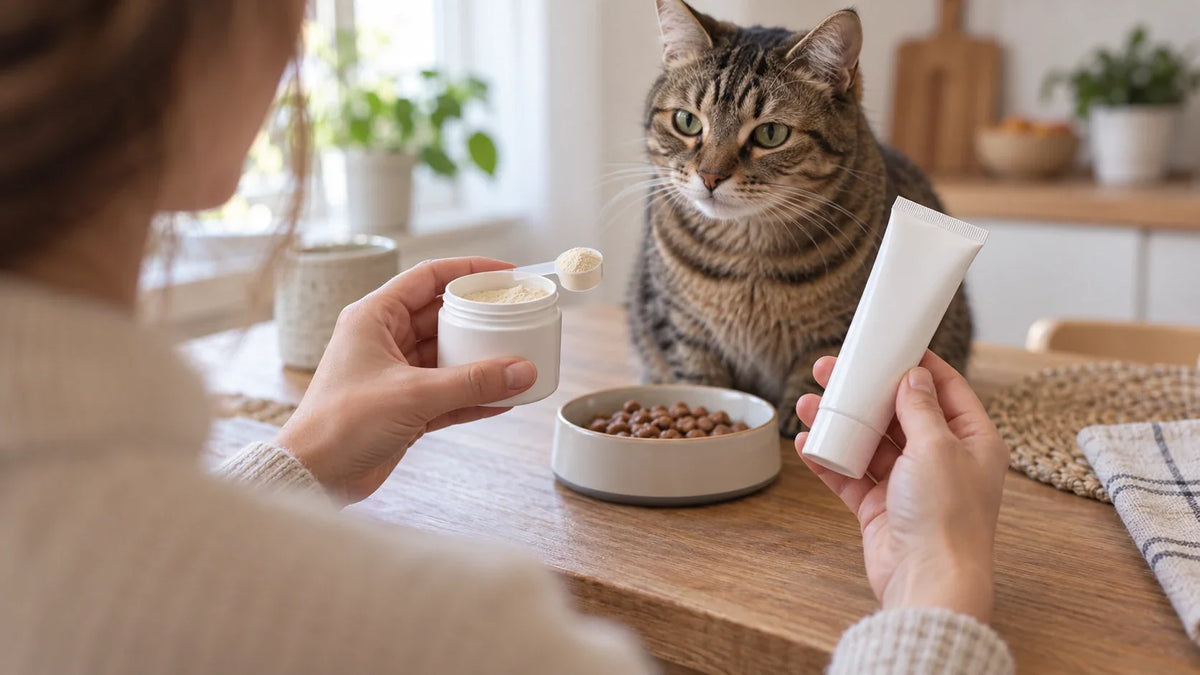
Next, lysine comes in powders, gels and chews. The form does not change the answer to "is lysine good for cats", but it can change how easy it is to give.
- Powder: mixes into wet food and is easy to measure with a scoop.
- Gel: you can give it by mouth or on a paw, but some cats dislike the texture.
- Chew: easy for treat-loving cats, but count it in daily calories.
Whatever the form, check the amount of lysine per serving. Also check for added flavors or sugars, and ask your vet about the right amount for your cat's size.
4 common myths
- "Lysine cures cat herpes." No study shows that. The 2015 review found no evidence that it works.
- "More lysine is better." Extra amounts have not shown extra benefit.
- "Lysine replaces eye drops or vet care." It does not. Eye pain and squinting need a vet.
- "Every cat needs a lysine supplement." Complete foods already supply lysine.
Clearing up these myths helps you answer "is lysine good for cats" with a calm, informed choice. It also keeps the focus on what helps most: vet care, low stress and good hygiene.
What helps cats with FHV-1 more
Instead, the shelter studies point to other steps. For example, the 2008 authors suggested shelters focus on lowering stress, infection control and limiting spread on hands and objects.
At home, a calm routine comes first, and the research suggests it matters more than any powder. Keep feeding times steady, give hiding spots and plan changes slowly. Then work with your vet on any flare-ups.
- Keep routines predictable.
- Give each cat its own food, water and litter area.
- Clean bowls and bedding often.
- Book a vet visit early when signs flare.

When to see your vet
- Your cat squints, has a cloudy eye or holds an eye shut.
- There is thick or colored discharge from the eyes or nose.
- Your cat stops eating, or breathes with effort.
- Sneezing lasts more than a few days.
- A kitten, senior or sick cat shows any signs.
So, is lysine good for cats? As a nutrient, yes. As a herpes treatment, the evidence says no. Your vet can help you decide what fits your cat, and the WSAVA Global Nutrition Guidelines support a diet review at every visit.
Prefer a simple powder after talking with your vet
Kittysum L-Lysine Supplement for Cats is an unflavored powder made as daily nutrition support, not as a treatment for herpes or any disease. Each 100 g tub comes with a measuring scoop.
Key Terms
- Lysine: an essential amino acid that cats must get from food.
- Arginine: another essential amino acid; cats are very sensitive to low arginine.
- FHV-1: feline herpesvirus type 1, a common cause of sneezing and eye problems in cats.
- Viral shedding: when an infected cat releases virus that can spread to others.
- Systematic review: a study that pulls together all the research on one question.
Frequently Asked Questions
Is lysine good for cats with herpes
The evidence says it is not a proven treatment. A 2015 systematic review found no evidence that lysine prevents or treats FHV-1, so see your vet for flare-ups.
Is lysine safe for cats
In healthy adult cats, studies found no side effects at the amounts used, and high intake did not lower arginine. Still, ask your vet first, especially for kittens or sick cats.
Do cats need lysine supplements
Most do not. Cats need lysine as a nutrient, and complete and balanced foods supply it.
Why do vets still mention lysine
Some vets see it as a low-risk option that owners ask about. Many now explain that the evidence is weak and focus on other care first.
References
- Maggs DJ, et al. Efficacy of oral supplementation with L-lysine in cats latently infected with feline herpesvirus. Am J Vet Res. 2003.
- Maggs DJ, et al. Effects of dietary lysine supplementation in cats with enzootic upper respiratory disease. J Feline Med Surg. 2007.
- Rees TM, Lubinski JL. Oral supplementation with L-lysine did not prevent upper respiratory infection in a shelter population of cats. J Feline Med Surg. 2008.
- Drazenovich TL, et al. Effects of dietary lysine supplementation on upper respiratory and ocular disease in shelter cats. Am J Vet Res. 2009.
- Cave NJ, et al. Effects of physiologic concentrations of L-lysine on in vitro replication of feline herpesvirus 1. Am J Vet Res. 2014.
- Bol S, Bunnik EM. Lysine supplementation is not effective for the prevention or treatment of feline herpesvirus 1 infection in cats. BMC Vet Res. 2015.
- Fascetti AJ, et al. Excess dietary lysine does not cause lysine-arginine antagonism in adult cats. J Nutr. 2004.
- Thomasy SM, Maggs DJ. A review of antiviral drugs and other compounds with activity against feline herpesvirus type 1. Vet Ophthalmol. 2016.
- Sun M, et al. Considerations on amino acid patterns in the natural felid diet. Front Vet Sci. 2024.
- AAFCO. Supplements.
- WSAVA. Global Nutrition Guidelines.
This article is for general education and is not veterinary advice. These statements have not been evaluated by the Food and Drug Administration. Kittysum products are not intended to diagnose, treat, cure or prevent any disease.