Key takeaways
- Lysine is an essential amino acid, so every cat needs it from food.
- The main lysine benefits for cats people discuss relate to feline herpesvirus, but the research is mixed.
- One small 2003 study saw less viral shedding after stress. Larger shelter trials saw no benefit.
- Lysine does not replace a vet exam, vaccines or prescribed treatment.
- If your vet agrees to a trial, track signs for several weeks.
Most owners ask about lysine benefits for cats after a sneezy flare-up. The honest answer is short. Lysine is a vital nutrient, yet studies on extra lysine for herpes signs disagree.
So this guide sorts the claims from the evidence. First, we explain what lysine does in the body. Then we review six key studies and show where a trial may still make sense.
Along the way, you will see a simple decision chart, a table of the research and a plain list of questions for your vet.
Table of contents
- What Lysine Does in a Cat's Body
- Feline Herpesvirus: Why Owners Look at Lysine
- Lysine Benefits for Cats: What Six Studies Found
- What Shelter Trials Say About Lysine Benefits for Cats
- The Systematic Review and the Arginine Question
- Lysine Benefits for Cats at a Glance
- Real Lysine Benefits for Cats vs Common Myths
- Who Might Still Try Lysine With Vet Approval
- How to Get Lysine Benefits for Cats Safely
- Side Effects That Outweigh Lysine Benefits for Cats
- Choosing a Product for Lysine Benefits for Cats
- Questions to Ask Your Vet
- Key Terms Explained
- Frequently Asked Questions
- References
What Lysine Does in a Cat's Body
Lysine is one of the amino acids that build protein. Cats cannot make it, so it must come from the diet. Meat, fish and eggs supply plenty of it.
Because complete cat foods already contain lysine, a healthy cat rarely runs short. In fact, the Cornell Feline Health Center notes that supplements are usually not needed with a balanced and complete diet.
So when people talk about lysine benefits for cats, they rarely mean basic nutrition. Instead, they mean extra lysine given on top of food, usually for eye and nose flare-ups.
Why lysine benefits for cats link to herpes
The idea began with lab work on herpes viruses. These viruses need another amino acid, arginine, to copy themselves. Researchers hoped extra lysine would crowd out arginine and slow the virus.
However, cats differ from people here. A 2004 study by Fascetti and colleagues found that excess dietary lysine did not cause lysine and arginine antagonism in adult cats. That finding weakens the original theory.

Feline Herpesvirus: Why Owners Look at Lysine
Feline herpesvirus type 1 (FHV-1) is very common. The Cornell Feline Health Center says up to 97% of cats meet the virus in their lifetime.
Also, the virus stays in the body for life in up to 80% of exposed cats. Of those, up to 45% shed it from time to time, usually when stressed.
That is why flare-ups often follow a move, a new pet or a stay in boarding. Owners then search for something gentle they can add at home. As a result, lysine benefits for cats become a hot topic in every flare-up season.
Common flare-up signs
- Sneezing and a runny nose
- Watery or squinting eyes
- Red, puffy tissue around the eyes
- Low appetite when the nose is blocked
These signs overlap with other infections, so a vet visit comes first. Our guide on why your cat is sneezing explains which signs need a same-day call.
Lysine Benefits for Cats: What Six Studies Found
Now let's look at the research itself. The table below lists six studies that shape the debate about lysine benefits for cats.
| Study | Cats or setting | Main finding |
|---|---|---|
| Maggs et al., 2003 | 14 cats with latent FHV-1, 400 mg once daily | Less viral shedding after rehousing; no clear effect after steroid-triggered flare |
| Fascetti et al., 2004 | Adult cats on high-lysine diets | Excess lysine did not cause lysine and arginine antagonism |
| Maggs et al., 2007 | 50 shelter cats, 52 days | Supplemented group had more disease and more FHV-1 DNA detections |
| Drazenovich et al., 2009 | 261 shelter cats, 4 weeks | No benefit; more moderate to severe disease in week 4 |
| Cave et al., 2014 | Cell culture with FHV-1 | Lysine had no effect on cell death and little effect on viral load |
| Bol and Bunnik, 2015 | Systematic review of 7 cat studies | Concluded lysine is not effective for prevention or treatment |
In short, the strongest early signal for lysine benefits for cats came from one small study. Meanwhile, the larger trials did not repeat it.
The 2003 study in detail
Maggs and colleagues gave 400 mg of L-lysine once daily for 30 days. Fewer cats showed eye signs, and signs started about 7 days later. However, those differences were not statistically significant.
Still, the lysine group shed less virus after a housing change. The dose also did not change plasma arginine or cause side effects.

What Shelter Trials Say About Lysine Benefits for Cats
Shelters are where URI spreads fastest, so they make a tough test of lysine benefits for cats. Two trials added lysine to the whole diet instead of giving a separate dose.
In the 2009 trial, 261 adult cats ate food with 1.7% or 5.7% lysine for four weeks. Plasma lysine rose in the treated cats, so the cats did absorb it.
Even so, mild disease rates did not differ. In fact, more treated cats developed moderate to severe disease in week 4, and FHV-1 DNA was found more often in week 2.
Similarly, the 2007 trial fed 50 cats a ration with 11 or 51 g of lysine per kg for 52 days. The supplemented group had a higher disease score, although the authors linked part of this to stress from fighting cats in one cage.
Why the method matters
Both shelter trials mixed lysine into the food. Sick cats often eat less, so their lysine intake dropped right when disease peaked. That detail helps explain why results can differ from bolus dosing studies. It also reminds us that lysine benefits for cats depend on steady intake.
The Systematic Review and the Arginine Question
In 2015, Bol and Bunnik reviewed seven cat studies and ten human studies. They concluded that lysine is not effective for preventing or treating FHV-1 in cats.
Also, they pointed out a safety issue. Cats cannot make arginine, and a true arginine shortage can cause high ammonia levels. So lowering arginine would be a bad goal anyway. Any lysine benefits for cats must come from another route.
Interestingly, the same review noted that over 90% of vets in cat hospitals recommended lysine at the time. That gap between habit and evidence is the heart of this topic.
Do lysine benefits for cats still exist?
Possibly, but only in narrow terms. Lysine is safe for most cats at studied amounts, and one study suggests less shedding after stress. Beyond that, strong proof is missing.
For a full look at all the studies, read our main guide to L-lysine for cats.
Lysine Benefits for Cats at a Glance
Here is the short version for busy owners. Lysine benefits for cats fall into two groups: proven nutrition and possible extra help.
Proven: lysine as a nutrient
Every cat needs lysine to build protein. A complete and balanced food covers this need, so healthy cats rarely need more.
Possible: lysine during stress
One small study linked 400 mg a day with less viral shedding after a housing change. That is the clearest sign of lysine benefits for cats beyond basic nutrition.
Not supported: lysine as a cure
Larger trials and a systematic review did not support lysine for treating or preventing herpes. So treat bold promises with care.
Also, keep the order right. A vet exam comes first, then any agreed plan, and only then a supplement trial. That way, you judge lysine benefits for cats with a clear starting point.
Finally, track results in writing. A simple note of sneezes, eye signs and appetite each day shows whether lysine benefits for cats appear in your home.
Real Lysine Benefits for Cats vs Common Myths
Online claims about lysine benefits for cats often stretch the evidence. Here is a quick reality check on what lysine can and cannot do.
- Myth: lysine kills the herpes virus. Fact: the review found lysine has no direct antiviral action.
- Myth: lysine boosts the immune system. Fact: no cat study we found shows this.
- Myth: more lysine works better. Fact: the shelter diets used high levels and saw no benefit.
- Myth: lysine replaces vet care. Fact: eye ulcers and fever need a vet, not a supplement.
Also, be wary of labels that promise to cure or prevent disease. AAFCO explains that such claims are drug claims, and they misbrand an animal feed product.
So the most honest way to describe lysine benefits for cats is modest daily nutrition support. That is exactly how we describe our own powder.

Who Might Still Try Lysine With Vet Approval
Some vets still suggest a trial, especially for cats with a known herpes history. They see lysine benefits for cats as possible but unproven. Typically, they consider it for cats that flare after predictable stress.
Who may see lysine benefits for cats
- Adult cats with a vet-confirmed FHV-1 history
- Cats that flare after boarding, travel or a move
- Owners who want a low-risk add-on alongside vet care
Cats that need a vet plan first
- Kittens, which need a tailored plan
- Pregnant or nursing cats, where VCA advises caution
- Cats with kidney or liver disease
- Cats on oral calcium or arginine products
For kittens, see our guide to lysine for kittens. It covers age limits and safer routines.
How to Get Lysine Benefits for Cats Safely
VCA Animal Hospitals notes that lysine comes as powder, crushed tablets, chewables or a paste or gel. It is given by mouth, ideally with a small amount of food.
- First, ask your vet for the right amount for your cat.
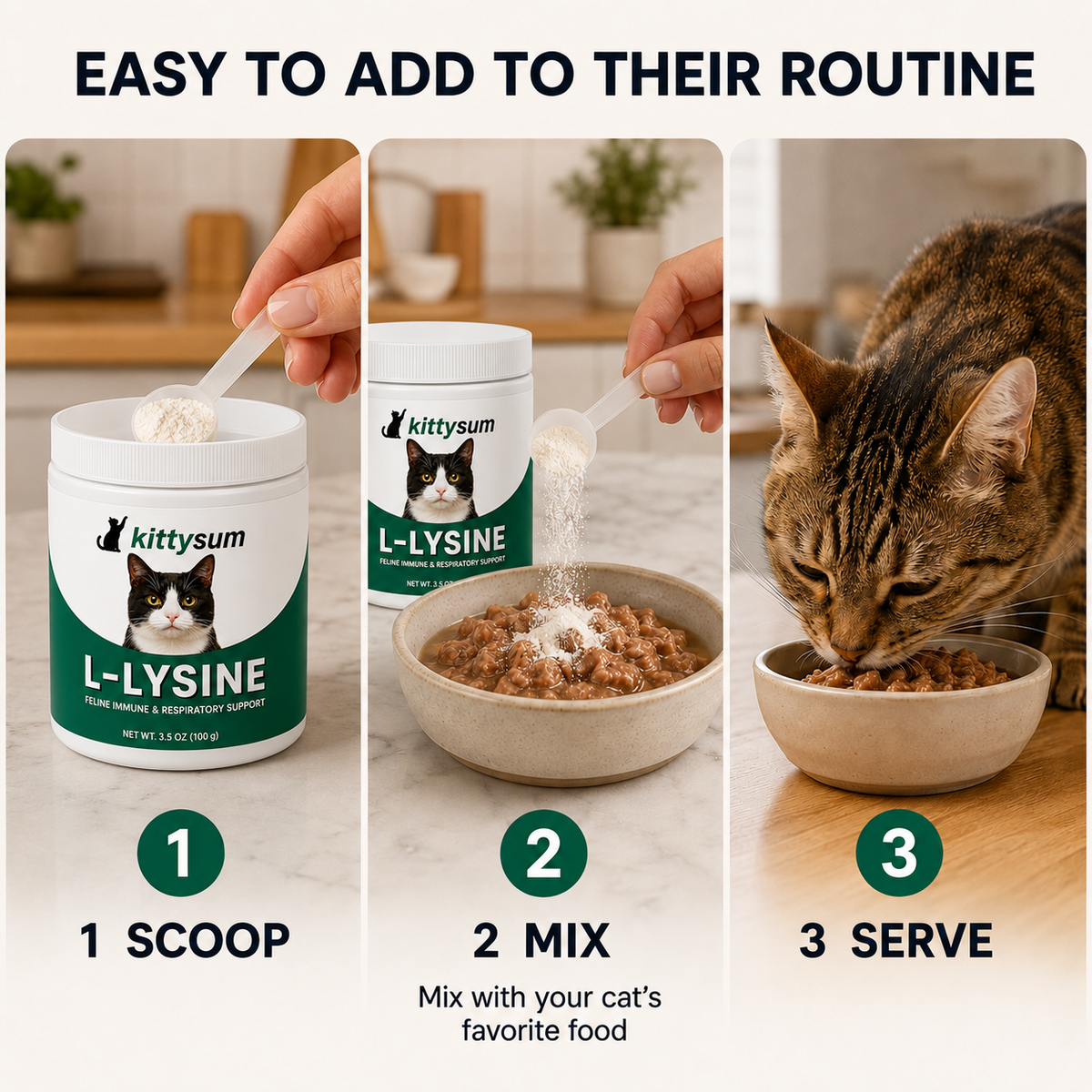
- Next, mix the powder into a spoonful of wet food.
- Then, give it at the same time each day.
- Also, keep fresh water available.
- Finally, note any change in stool, appetite or signs.
According to VCA, it may take a few weeks for full effect, although gradual change may appear within days. If you miss a dose, skip it rather than doubling up.
For amounts by weight, see our lysine dosage guide. For trial length, read how long to give cat lysine.
Side Effects That Outweigh Lysine Benefits for Cats
Lysine is usually well tolerated, which is part of its appeal. Still, VCA lists diarrhea as a possible side effect. Sensitivities can also develop later, even after early doses go smoothly.
- Stop and call your vet if you see vomiting, diarrhea or itching.
- Call promptly if eye signs worsen or your cat stops eating.
- Seek same-day care for a cloudy eye, squinting or fever.
Also, tell your vet about every product your cat takes. VCA advises caution when lysine is given with arginine or oral calcium supplements.
Our article on lysine side effects in cats covers each sign in more detail.
Choosing a Product for Lysine Benefits for Cats
If your vet supports a trial, the product matters less than the routine. Steady use is what gives lysine benefits for cats a fair test. Even so, a few label checks help you avoid surprises.
- Clear L-lysine content per scoop or serving
- A short ingredient list with no added sweeteners
- Powder or another form your cat accepts
- Lot number and storage directions
Also, remember that supplement rules differ for pets. The AVMA supports the FDA view that the 1994 human supplement law does not apply to animal products.
Kittysum L-Lysine powder is an unflavored powder in a 100 g tub with a measuring scoop. We position it as daily nutrition support, used with your vet's guidance.

Questions to Ask Your Vet
A short list helps you get clear answers about lysine benefits for cats in one visit. Bring notes on recent flare-ups, triggers and diet.
- Are these signs from herpes or something else?
- Does my cat need eye drops or other treatment?
- Is a lysine trial worth trying for my cat?
- What amount should I use, and for how long?
- Which signs mean I should stop the trial?
Because stress drives many flare-ups, ask about calm routines too. Hiding spots, steady feeding times and slow introductions all help.
Planning a vet-approved trial?
Kittysum L-Lysine Supplement for Cats is an unflavored powder with a measured scoop that mixes into wet food.
Key Terms Explained
- Lysine: an essential amino acid that cats must get from food.
- Arginine: another essential amino acid; cats cannot make it and need it to clear ammonia.
- FHV-1: feline herpesvirus type 1, a common cause of sneezing and eye signs.
- Viral shedding: release of virus from the eyes or nose, often after stress.
- Systematic review: a study that gathers and weighs all published research on one question.
Frequently Asked Questions
What are the main lysine benefits for cats?
Lysine is an essential amino acid that supports normal protein building. Extra lysine for herpes signs has mixed evidence, and a 2015 review found it was not effective for prevention or treatment.
Is lysine safe for cats every day?
At amounts used in studies, lysine was generally well tolerated. VCA lists diarrhea as a possible side effect, so ask your vet before daily use.
Does lysine cure feline herpes?
No. Lysine has no direct antiviral action, and FHV-1 stays in the body for life. Flare-ups need a vet exam and, when needed, prescribed treatment.
How long before lysine works in cats?
VCA notes full effect may take a few weeks, with gradual change sometimes seen within days. Agree a trial length and review date with your vet.
References
- Bol S, Bunnik EM. Lysine supplementation is not effective for the prevention or treatment of feline herpesvirus 1 infection in cats: a systematic review. BMC Vet Res. 2015.
- Maggs DJ, Nasisse MP, et al. Efficacy of oral supplementation with L-lysine in cats latently infected with feline herpesvirus. Am J Vet Res. 2003.
- Drazenovich TL, Fascetti AJ, et al. Effects of dietary lysine supplementation on upper respiratory and ocular disease in a cat shelter. Am J Vet Res. 2009.
- Maggs DJ, Sykes JE, et al. Effects of dietary lysine supplementation in cats with enzootic upper respiratory disease. J Feline Med Surg. 2007.
- Cave NJ, Dennis K, et al. Effects of physiologic concentrations of L-lysine on in vitro replication of feline herpesvirus 1. Am J Vet Res. 2014.
- Fascetti AJ, Maggs DJ, et al. Excess dietary lysine does not cause lysine-arginine antagonism in adult cats. J Nutr. 2004.
- VCA Animal Hospitals. Lysine.
- Cornell Feline Health Center. Respiratory Infections.
- AAFCO. Supplements.
- AVMA. Dietary supplement law not applicable to products for animals.
- Cornell Feline Health Center. Feeding Your Cat.
This article is for general education and is not veterinary advice. These statements have not been evaluated by the Food and Drug Administration. Kittysum products are not intended to diagnose, treat, cure or prevent any disease.