Lysine diarrhea in cats is a common worry, but published cat studies do not point to lysine as a usual cause of loose stool. In most cases, a diet change, stress or an illness explains it better. So pause the powder, watch your cat and call your vet if signs last more than a day or two.
This guide answers a question many owners ask: can lysine cause diarrhea in cats? We walk through the research, the other likely causes and a simple plan you can follow today.
Key takeaways
- Lysine diarrhea in cats is possible in theory, but the cat studies we read do not describe diarrhea as a side effect.
- A sudden food change, stress or a new illness can cause loose stool on its own, even without any powder.
- If diarrhea lasts more than a day or two, or your cat also stops eating, vomits or seems tired, see your vet.
- Since research shows lysine does not prevent or treat feline herpes, ask your vet whether your cat needs it at all.
- If you restart lysine, add it slowly to a food your cat already eats well, and keep a short daily log.
Table of contents
- Lysine diarrhea in cats: the short answer
- What studies show about lysine diarrhea in cats
- Other causes that look like lysine diarrhea in cats
- How to tell if lysine is behind the loose stool
- Lysine diarrhea in cats compared with other causes
- A 5-step plan for lysine diarrhea in cats
- When lysine diarrhea in cats needs a vet visit
- Kittens, seniors and sensitive stomachs
- How to restart lysine after loose stool
- Why the arginine question matters
- Does your cat need lysine at all
- Myths about lysine diarrhea in cats
- Food first: the base of a calm gut
- Key Terms
- Frequently Asked Questions
- References
Lysine diarrhea in cats: the short answer
Lysine is an amino acid. Cats need it every day, and meat-based foods supply plenty of it. Many owners also add extra lysine as a powder or gel.
So can lysine cause diarrhea in cats? The honest answer is that it rarely seems to. In the cat studies we reviewed, the published summaries do not list diarrhea as a side effect, even at large doses.
Still, every cat is different. A new powder, a new taste or a change in how you feed can upset a sensitive gut. Because of that, lysine diarrhea in cats is worth taking seriously, even if lysine itself is rarely the cause.
In short, treat loose stool as a sign to look closer. Then work through the causes one by one, starting with the simplest.

What studies show about lysine diarrhea in cats
To judge lysine diarrhea in cats, start with the research. Several teams have fed extra lysine to cats. Their goal was to test it against feline herpesvirus, not to study the gut. Even so, their reports tell us something useful about safety.
- A 2003 study gave 14 cats 400 mg of L-lysine once a day for 30 days. The authors saw no adverse clinical effects, and blood arginine stayed the same.
- A 2007 study fed 50 cats a diet with 11 or 51 g of lysine per kg for 52 days. Food intake fell in both groups around the peak of their illness, so the drop was not limited to the lysine group.
- A 2009 shelter study fed 261 cats a diet with 1.7% or 5.7% lysine for four weeks. The higher-lysine group had more moderate to severe respiratory disease in week four.
- A 2004 report found that excess dietary lysine did not cause lysine-arginine antagonism in adult cats.
None of these summaries describe lysine diarrhea in cats as an observed effect. That said, these trials were small and short. Also, they tracked the eyes and nose more closely than the litter box.
As a result, the best reading is this: lysine diarrhea in cats is not a well-documented problem, but no one has ruled it out in every cat.
Other causes that look like lysine diarrhea in cats
When loose stool shows up the same week you start a powder, it is easy to blame the powder. However, many other things change at the same time, and they can mimic lysine diarrhea in cats.
The Cornell Feline Health Center explains that a sudden diet change can cause diarrhea for a few days. Stress, such as a long car trip or a weekend at the clinic, can also bring on a short bout.
- New food or new treats: owners often switch foods when they start a supplement.
- Stress: a move, a new pet or a vet visit can upset the gut.
- Illness: cats that need lysine advice are often sick with a cold, and sick cats may eat less or eat oddly.
- Food reactions: in cats, vomiting and diarrhea are the signs most often reported with adverse food reactions.
- Carrier foods: the tuna, broth or treat you use to hide the powder may be the real trigger.
Cornell also notes that kittens may face a higher risk while their gut adjusts to solid food. In addition, ongoing diarrhea can point to problems outside the gut, so it always deserves a vet check.

How to tell if lysine is behind the loose stool
You can sort out most cases of suspected lysine diarrhea in cats with a simple, careful approach. The key is to change only one thing at a time.
- First, write down the date you started lysine and any other change that week.
- Next, pause the lysine and keep the main food the same.
- Then, watch the litter box for a few days and note the stool each day.
- If stool firms up, talk with your vet before you restart anything.
- If stool stays loose after the pause, the powder is unlikely to be the main cause.
This approach works because it isolates one variable, so you learn whether you are really seeing lysine diarrhea in cats. However, it is not a reason to wait if your cat seems unwell. A cat that is weak, refuses food or keeps vomiting needs care today.
Lysine diarrhea in cats compared with other causes
This table compares common causes of loose stool with lysine diarrhea in cats. Use it as a starting point, not a diagnosis.
| Possible cause | Typical timing | Clues at home | What to do |
|---|---|---|---|
| New lysine powder | Within days of starting | Only change was the powder | Pause it, then ask your vet |
| Sudden food change | Within a few days | New brand, flavor or texture | Return to the old food, switch slowly |
| Stress | After travel, a move or a vet stay | Hiding, less play, short bout | Keep a calm routine, monitor |
| Food reaction | Often recurs over weeks | Itchy skin, vomiting or both | Ask your vet about a diet trial |
| Infection or illness | Any time | Fever, low appetite, tiredness | See your vet promptly |
| Carrier food (tuna, broth) | Right after new treats | Started a new topper | Use the usual food as the carrier |
Notice how many rows involve a change that is not the powder. Many cases blamed on lysine diarrhea in cats fit another row better. That is why a written log matters so much.
A 5-step plan for lysine diarrhea in cats
Here is the plan we suggest when owners ask us about lysine diarrhea in cats. It keeps your cat safe and gives your vet clear notes.
- Pause the lysine as soon as you notice loose stool.
- Check for red flags such as blood, vomiting, tiredness or refusing food.
- Keep the main food steady and avoid new treats for now.
- Call your vet if diarrhea lasts more than a day or two, or sooner with red flags.
- Restart lysine only if your vet agrees, and at a smaller amount.
When lysine diarrhea in cats needs a vet visit
Most short bouts settle on their own, and that includes most suspected lysine diarrhea in cats. In fact, a 2026 review notes that most acute diarrhea in dogs and cats is self-limiting and responds to supportive care such as fluids and food.
Even so, some signs mean you should not wait. Cornell advises a prompt vet visit if diarrhea lasts more than a day or two and comes with appetite loss, tiredness or vomiting.
- Blood in the stool or black, tarry stool.
- Repeated vomiting or refusing food.
- Weakness, hiding or a cat that seems in pain.
- A kitten, a senior cat or a cat with a known illness.
Also, do not give human anti-diarrhea medicine. Cornell warns that some over-the-counter products can harm cats.
Kittens, seniors and sensitive stomachs
Young kittens and older cats have less room for error, so lysine diarrhea in cats is a bigger concern at these ages. A kitten can lose fluid quickly, and a senior cat may have hidden kidney or thyroid problems.
For this reason, we suggest extra care with any supplement in these groups. Ask your vet first, and read our guide to lysine for kittens before you add anything to a young cat's bowl.
Cats with a history of loose stool also deserve a slower start. For example, you might mix a tiny pinch into one meal for several days before you move to the full label amount.

How to restart lysine after loose stool
After an episode of lysine diarrhea in cats, a restart needs care. If your vet agrees that lysine is still worth a try, a slow restart lowers the risk of another upset. It also helps you see whether lysine diarrhea in cats is really the issue for your cat.
- Start with a small part of the label amount, as your vet advises.
- Then increase it slowly over several days if stool stays normal.
- After that, use the full amount your vet suggests, and no more.
- Always mix it into a food your cat already tolerates well.
If loose stool returns at any step, stop again and tell your vet. Our lysine dosage guide explains how label amounts are usually set, and our guide on how long to give a cat lysine covers when to stop.
Why the arginine question matters
Lysine and arginine are both amino acids. Years ago, people thought extra lysine might lower arginine and slow the herpes virus. That idea shaped much of the advice you still see online.
Cats are unusual here. A classic 1979 kitten study found that a diet with only 0.33% arginine caused vomiting and extreme lethargy within four hours. In other words, cats depend on arginine from food.
Fortunately, the 2004 report found that excess lysine did not cause lysine-arginine antagonism in adult cats. So in healthy adults on a complete food, extra lysine does not seem to drain arginine. Still, this is one more reason to avoid very high or unplanned doses, which could also raise the risk of lysine diarrhea in cats.
Does your cat need lysine at all
This is the bigger question behind lysine diarrhea in cats. If a supplement is not helping, even a small risk may not be worth it.
A 2015 systematic review concluded that lysine supplementation is not effective for preventing or treating feline herpesvirus 1. The Cornell page on respiratory infections also calls lysine quite controversial and notes that some studies suggest it may worsen signs.
Meanwhile, AAFCO explains that healthy cats on a complete and balanced diet generally do not need supplements. Cornell's feeding guide adds that supplements should never be given without a vet's approval.
So if your cat has loose stool on lysine, this is a good moment to ask your vet whether to stop for good. Our honest review, is lysine good for cats, covers the evidence in more depth.

Myths about lysine diarrhea in cats
A few ideas about lysine diarrhea in cats come up again and again. Here is what the evidence says about each one.
- Myth: more lysine works better. Research does not support higher doses for herpes, and more of any supplement can upset the gut.
- Myth: natural means harmless. Cornell notes that supplements can be harmful and need a vet's approval.
- Myth: loose stool means the cold is clearing. Diarrhea is not a sign of healing, so report lysine diarrhea in cats to your vet.
- Myth: any powder is the same. Carriers, flavors and fillers differ, and they may matter more than the lysine itself.
For a wider view of possible reactions, see our guide to lysine side effects in cats. You can also read about lysine overdose in cats and lysine allergy in cats.
Food first: the base of a calm gut
Lysine diarrhea in cats is often a food story in disguise. A steady, complete diet is the best base for a healthy gut, and it already supplies the lysine a cat needs.
The WSAVA global nutrition guidelines encourage vets to take a full diet history at every visit. So bring a list of every food, treat, topper and supplement your cat gets.
Also, keep in mind that beef, fish and chicken are the most common food allergens reported in cats. If a fish broth or tuna topper hides the powder, that topper may be the real trigger.
Finally, change foods slowly over several days, and change only one thing at a time. That simple rule prevents a lot of confusion about lysine diarrhea in cats. That habit makes any future upset much easier to trace.
Prefer a simple powder after talking with your vet
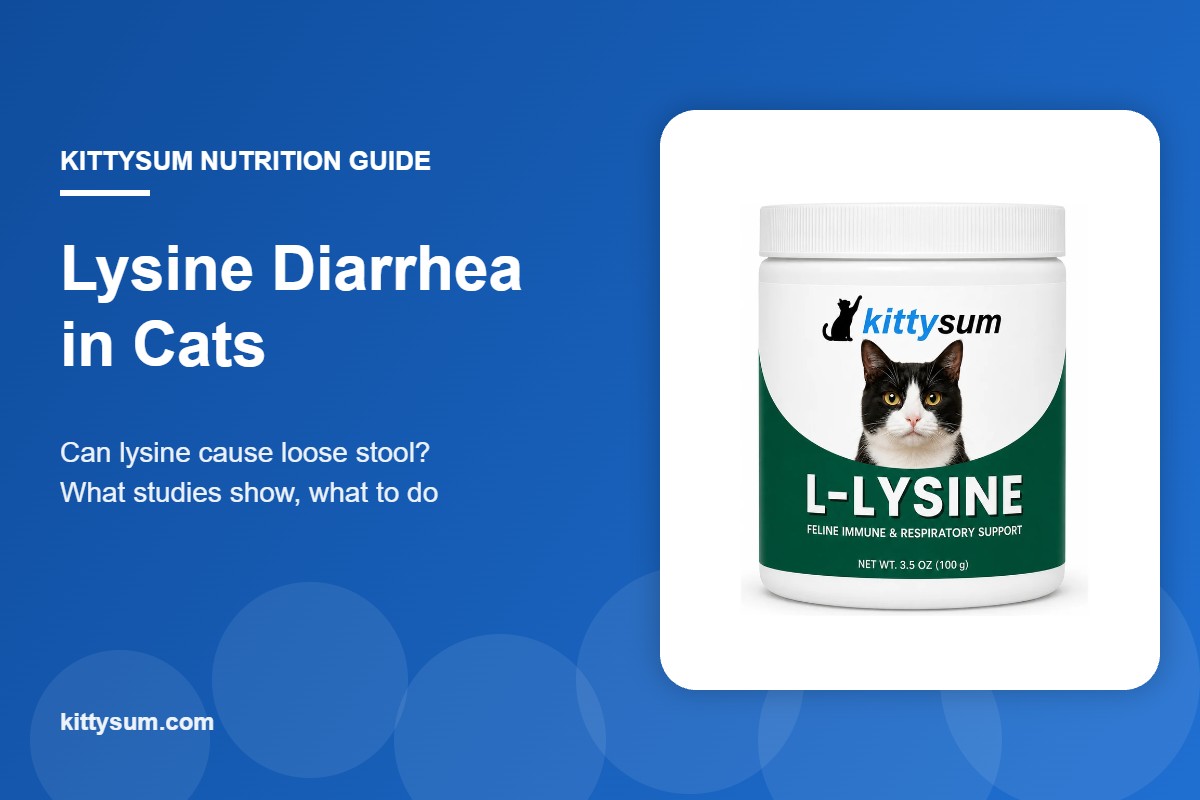
Kittysum L-Lysine Supplement for Cats is an unflavored powder made as daily nutrition support, not as a treatment for herpes, diarrhea or any disease. Each tub comes with a measuring scoop.
Key Terms
- Lysine: an essential amino acid that cats must get from food.
- Arginine: another essential amino acid that cats cannot make in large enough amounts.
- Diarrhea: loose, watery or frequent stool.
- Self-limiting: a problem that clears up on its own with basic care.
- Adverse food reaction: any bad reaction to a food, including allergy and intolerance.
- Carrier food: the food or treat used to hide a powder or pill.
Frequently Asked Questions
Can lysine cause diarrhea in cats
It is possible, but the cat studies we read do not list diarrhea as a lysine side effect. Diet changes, stress and illness are more common causes, so pause the powder and call your vet if signs last.
How long does lysine diarrhea in cats last
If lysine is the cause, stool should improve soon after you stop it. If loose stool lasts more than a day or two, or your cat seems unwell, see your vet.
Should I stop lysine if my cat has diarrhea
Yes, pausing it is a sensible first step. Keep the main food the same, watch for red flags and ask your vet before you restart.
Is lysine gel or powder better for a sensitive stomach
There is no study comparing them for diarrhea. Some gels and treats contain extra flavors or fats, so a plain powder in a familiar food may be easier to track.
References
- Cornell Feline Health Center. Diarrhea. Read the source.
- Cornell Feline Health Center. Feeding Your Cat. Read the source.
- Cornell Feline Health Center. Respiratory Infections. Read the source.
- AAFCO. Supplements. Read the source.
- WSAVA. Global Nutrition Guidelines. Read the source.
- Maggs DJ, et al. Efficacy of oral supplementation with L-lysine in cats latently infected with feline herpesvirus. Am J Vet Res. 2003. Read the source.
- Maggs DJ, et al. Effects of dietary lysine supplementation in cats with enzootic upper respiratory disease. J Feline Med Surg. 2007. Read the source.
More studies and guides
- Drazenovich TL, et al. Effects of dietary lysine supplementation on upper respiratory and ocular disease in shelter cats. Am J Vet Res. 2009. Read the source.
- Fascetti AJ, et al. Excess dietary lysine does not cause lysine-arginine antagonism in adult cats. J Nutr. 2004. Read the source.
- Anderson PA, et al. Lysine and arginine requirements of the domestic cat. J Nutr. 1979. Read the source.
- Bol S, Bunnik EM. Lysine supplementation is not effective for feline herpesvirus 1: a systematic review. BMC Vet Res. 2015. Read the source.
- Mueller RS, Olivry T. Non-cutaneous signs of adverse food reactions in dogs and cats. BMC Vet Res. 2018. Read the source.
- Amirsultan S, Odunayo A. A practical guide to acute diarrhea in veterinary patients. Vet Clin North Am Small Anim Pract. 2026. Read the source.
- Mueller RS, et al. Common food allergen sources in dogs and cats. BMC Vet Res. 2016. Read the source.
This guide is general nutrition information for cat owners. It is not a diagnosis or treatment plan, so please talk with your veterinarian about your own cat.
This article is for general education and is not veterinary advice. These statements have not been evaluated by the Food and Drug Administration. Kittysum products are not intended to diagnose, treat, cure or prevent any disease.