
Search for an L-lysine supplement for cats and the choices can start to look surprisingly similar.
Powders, gels, pastes and chews may all feature the same ingredient name while making very different claims.
So how do you compare them?
The best place to start is not the biggest number on the container or the boldest promise on the front.
Start with four things:
the reason you are shopping, the complete ingredient list, the amount supplied by the stated serving, and the directions on the exact product.
L-lysine is an essential amino acid, but its nutritional role does not automatically mean every cat needs a standalone supplement.
And a supplement should not be used as a shortcut for diagnosing respiratory, eye or other symptoms.
Here is a practical way to compare your options.
Start With the Reason You Are Shopping
Before comparing brands, ask a simple question:
Why am I considering L-lysine?
Maybe you saw lysine mentioned online.
Maybe another cat owner recommended it.
Maybe you noticed it in a pet store.
Or perhaps your veterinarian discussed a supplement in the context of your individual cat.
Those situations are not interchangeable.
If your cat has sneezing, eye discharge, nasal discharge, appetite changes, breathing difficulty or another symptom, the first job is not choosing the most appealing supplement.
It is determining why the symptom is happening.
A supplement label cannot diagnose your cat.
If you are simply comparing nutritional products for an otherwise healthy cat, you can move on to the label.
What Is L-Lysine?
L-lysine is an amino acid.
Amino acids are used by the body in protein-related processes, and lysine is considered essential because it needs to come from the diet.
That does not mean:
essential nutrient = essential supplement.
Those are different statements.
Cats normally obtain amino acids through their diet.
A standalone L-lysine product adds a concentrated supplemental source, so the useful question is not merely whether cats need lysine.
The useful question is whether a particular supplement makes sense within the cat's complete feeding plan.
For the broader nutrition background, read L-Lysine for Cats: What Cat Parents Should Know.
Food Lysine vs Supplement Lysine
Seeing the word “lysine” on a supplement can create the impression that normal food is missing something.
That conclusion does not automatically follow.
Complete cat foods are formulated to provide an overall nutrient profile appropriate for their stated purpose.
A supplement is different.
It adds one or more concentrated ingredients to an existing feeding routine.
Before buying one, review:
- your cat's main food
- treats
- toppers
- other supplements
- medications
- any veterinary diet instructions
This gives you a much better picture than evaluating one tub in isolation.
Powder vs Gel vs Chew: Which Format Is Better?
There is no universally best L-lysine format.
The best format is one you can use correctly and consistently when supplementation is appropriate.

Powder
Powder can be mixed into food.
For cats that reliably finish their meals, this can make supplementation part of an existing routine.
But you still need to know:
- the stated serving
- the concentration
- the measuring method
- whether your cat actually consumes the full portion
Gel or Paste
A gel or paste uses a different measuring system.
Do not assume that one milliliter of one product is equivalent to a scoop of another.
The concentration can differ substantially between formulas.
Chews
Chews may be convenient for cats that willingly eat them.
But a chew is still a formulated product.
Check its complete ingredients rather than focusing only on the L-lysine printed on the front.
Tablets or Capsules
These formats can make the amount per unit easy to identify, but administration may be less convenient for some cats.
Do not crush or alter a product unless its directions allow it or your veterinarian recommends doing so.
The takeaway is simple:
format is about administration; it is not proof of effectiveness.
How to Read an L-Lysine Supplement Label
Turn the package around.
The back label usually tells you more than the front.
Look for the following.
1. Exact Product Name
Confirm that you are looking at the product intended for cats.
Do not automatically substitute a human product because the ingredient name appears identical.
2. L-Lysine Amount or Concentration
Find out exactly what the stated number represents.
Is it:
- L-lysine per serving?
- L-lysine per gram?
- a percentage of the powder?
- the total weight of the entire formula?
Those measurements are not interchangeable.
3. Serving Size
Find the manufacturer's stated serving.
Then determine how that serving is measured.
For example:
- scoop
- gram
- tablet
- chew
- pump
- milliliter
A product can have a large-looking number on the front while using a larger serving to reach that number.
4. Complete Ingredient List
L-lysine may not be the only ingredient.
Check for:
- flavoring ingredients
- other amino acids
- vitamins
- carriers
- texture ingredients
- additional active components
This becomes especially important if your cat already receives other supplements.
5. Directions and Warnings
Read the actual directions rather than copying instructions from a different product.
Check whether the manufacturer provides information about:
- serving
- frequency
- mixing
- storage
- age restrictions
- cautions
- veterinary consultation
Why Concentration and Serving Size Are Different
Imagine two powders.
Product A lists a high percentage of L-lysine.
Product B lists an amount per scoop.
You cannot reliably decide which supplies more from those two front-facing numbers alone.
You first need to convert them to the same comparison:
How much of the relevant ingredient does the stated serving actually provide?
The same principle applies to gels and chews.
Never compare one scoop vs one pump without checking what those units actually contain.
This is also why copying another brand's serving instructions is a poor idea.
Do Not Copy Another Brand's Dose
Two L-lysine products can differ in:
- concentration
- formulation
- scoop size
- serving instructions
- additional ingredients
- intended use
If Product A says “one scoop,” that tells you nothing about the correct serving of Product B.
Use the directions on the exact product you purchased.
For Kittysum, use the current Kittysum label rather than a dose from a competitor, forum, old screenshot or unrelated product.
If a veterinarian has provided individualized instructions, follow that professional guidance.
Be Careful With Feline Herpesvirus Claims
This is one of the most important parts of shopping for L-lysine.
Cat owners frequently encounter L-lysine while searching for information about feline herpesvirus, sneezing, conjunctivitis or upper-respiratory signs.
But the evidence around supplemental lysine in cats has not produced a simple, universal conclusion.
Different studies have reported different results under different conditions.
For example, some earlier research investigated potential effects in experimentally or latently infected cats, while research in shelter populations did not find supplementation prevented upper-respiratory infection.
That is exactly why a shopping guide should not turn into a treatment protocol.
Do not assume that an L-lysine product:
- treats feline herpesvirus
- prevents respiratory infection
- stops viral shedding
- cures conjunctivitis
- replaces veterinary treatment
If your cat has recurring eye or respiratory symptoms, involve a veterinarian.
The diagnosis matters more than the supplement category.
Does a Bigger L-Lysine Number Mean a Better Product?
No.
More is not automatically better.
A larger amount may simply reflect:
- a different concentration
- a different serving
- a different formulation
- a different label presentation
A useful comparison looks at the whole product:
ingredient → concentration → serving → complete formula → directions → individual cat
rather than ranking products by the largest number.
Should You Choose a Cat-Specific Product?
A cat-specific product can make administration and label interpretation easier because its format and directions are designed around feline use.
But “made for cats” should still not be treated as proof of a medical outcome.
Check the same fundamentals:
- ingredients
- amount
- serving
- instructions
- cautions
- storage
A cat image on the label is not a substitute for transparent product information.
Can L-Lysine Be Mixed With Wet Food?
Some powder products are designed to be mixed with food.
If the exact product directions allow it, this can make a supplement part of an ordinary mealtime routine.
But there is a practical consideration:
your cat needs to eat the food containing the measured portion.
If a powder causes your cat to reject the entire meal, repeatedly adding more powder is not a useful solution.
Follow the product directions and monitor whether your cat continues eating normally.
A sudden or persistent loss of appetite deserves veterinary attention rather than increasingly complicated food masking.
What If My Cat Takes Other Supplements?
Write down everything your cat receives.
That includes:
- complete food
- treats
- toppers
- powders
- oils
- chews
- medications
- therapeutic diets
Then compare the ingredient lists.
This is especially useful when several products contain overlapping vitamins, amino acids or other nutritional ingredients.
Do not assume that several individually reasonable products automatically create a better combined routine.
If your cat takes medication, follows a veterinary diet or has a medical condition, ask your veterinarian before combining supplements.
How Kittysum L-Lysine Fits
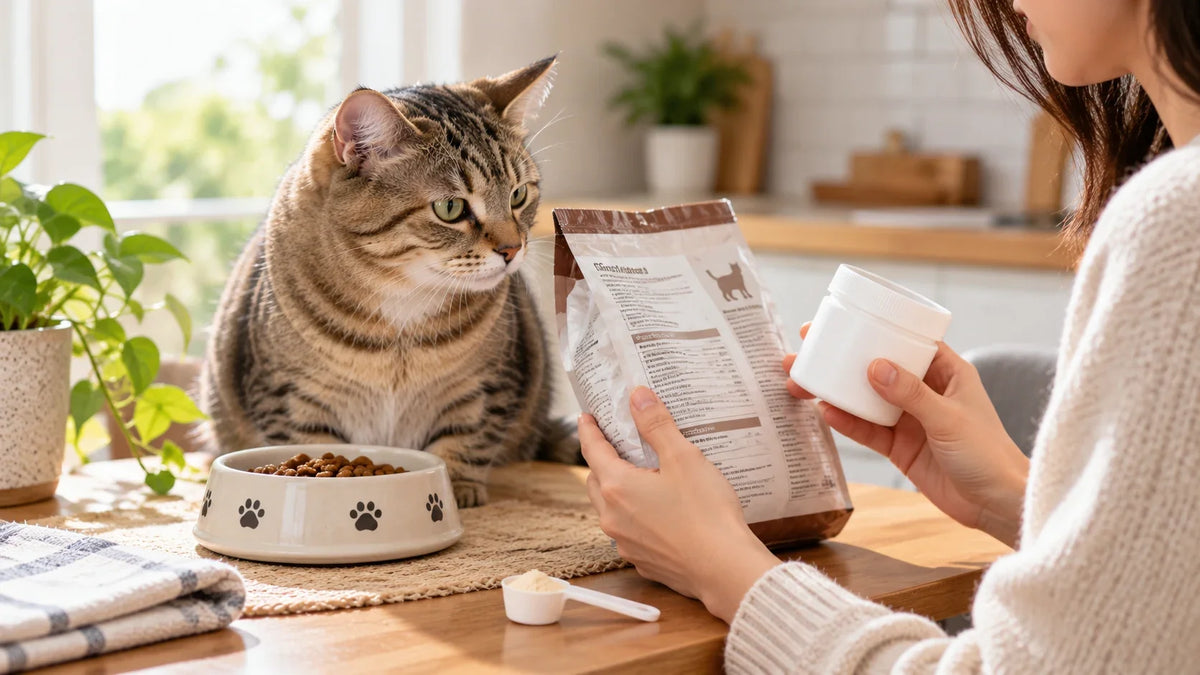
The current Kittysum L-Lysine Supplement for Cats is a flavored powder designed to mix into a cat's food.
The current product information identifies L-lysine along with additional amino acids and vitamins, and the product includes measuring scoops.
That does not change the evaluation process.
Before using it:
- read the current Kittysum label
- check the complete ingredients
- use only the current product's serving directions
- measure using the specified method
- make sure your cat continues eating normally
- involve a veterinarian when symptoms, medication or a medical condition are part of the decision
Kittysum L-Lysine is a nutritional supplement.
It is not a substitute for complete cat food, diagnosis or veterinary treatment.
Questions to Ask Before Buying
Before adding an L-lysine product to your cart, ask:
Why am I buying it?
Nutrition shopping and symptom treatment are different decisions.
What exactly is in it?
Read the complete ingredient list.
How much L-lysine does the stated serving provide?
Do not rely on the largest number on the front.
How is the serving measured?
Scoop, gram, pump, chew and tablet are different units.
Will my cat accept the format?
A product is difficult to use consistently if your cat refuses the meal containing it.
Am I already giving overlapping supplements?
Compare every product in the routine.
Am I trying to treat a symptom?
If yes, involve a veterinarian rather than diagnosing through a supplement purchase.
Frequently Asked Questions
How do I choose an L-lysine supplement for cats?
Compare the exact ingredient list, L-lysine amount or concentration, stated serving, measuring method, directions and cautions. Do not choose solely by the largest number or strongest marketing claim.
Is L-lysine powder better than gel for cats?
Neither format is automatically better. Powder and gel differ mainly in administration and formulation. Compare the exact labels and choose a format that can be used correctly when supplementation is appropriate.
Can I use human L-lysine for my cat?
Do not automatically substitute a human supplement for a cat-specific product. Concentration, ingredients and directions may differ. Ask your veterinarian about the exact product if you are considering a substitution.
How much L-lysine should I give my cat?
Use the directions on the exact product label or individualized veterinary guidance. Do not copy a dose from another brand or an online dosage table.
Does L-lysine treat feline herpesvirus?
Do not treat L-lysine as a replacement for diagnosis or veterinary treatment. Research findings regarding supplemental lysine and FHV-1 have been mixed, and respiratory or eye symptoms should be evaluated by a veterinarian.
Can I mix L-lysine powder into wet food?
If the exact product's directions allow mixing with food, follow those instructions and ensure your cat continues eating normally.
The Practical Takeaway
Choosing an L-lysine supplement for cats should be a label-reading exercise, not a contest for the boldest claim.
Use this sequence:
reason for use → complete diet → ingredient list → concentration → serving → measuring method → directions → individual cat
And remember the most important distinction:
L-lysine is an essential amino acid.
That fact alone does not prove that every cat needs an L-lysine supplement or that supplementation treats a particular disease.
Start with your cat's complete diet.
Use the exact product label.
Do not borrow another product's dose.
And when symptoms are the reason you are shopping, bring the veterinarian into the decision.
Continue with L-Lysine for Cats: What Cat Parents Should Know for the broader nutrition and evidence framework.
If you are comparing a mealtime powder, review the current Kittysum L-Lysine Supplement for Cats label and product information before deciding.
Browse more evidence-aware articles in the Kittysum Cat Nutrition Journal.
Educational information only. This article is not veterinary advice and does not diagnose, treat, cure or prevent disease.