Key takeaways
- Can cats have eggs? Yes, plain cooked eggs are a safe occasional treat for most cats.
- Raw eggs carry a germ risk, and raw egg white can block the vitamin biotin.
- Keep egg treats small: a whole egg holds a large share of a cat's daily calories.
- Eggs contain far less taurine than meat, heart or shellfish, so they cannot replace a complete diet.
- Skip butter, oil, salt, onion and garlic, and stop if your cat shows stomach upset.
Can cats have eggs? Yes, most cats can enjoy a little plain, fully cooked egg as an occasional treat. Eggs are rich in protein, but they also carry a few risks, and they do not supply the nutrients cats need most in large amounts.
This guide explains which eggs are safe, how much to offer, why raw eggs are risky, how eggs compare with meat for taurine and how to serve them. We wrote it for owners who want a quick, honest answer before sharing breakfast.
New to cat nutrition? Start with our guide to taurine for cats.
Table of contents
Can Cats Have Eggs? The Short Answer
In short, yes. For example, Purina notes that cats can eat cooked eggs as an occasional treat. However, the egg should be plain and fully cooked, and the portion should stay small.
Also, cats are obligate carnivores, and Merck explains that they need nutrients found in animal tissue. Eggs come from animals, so the answer to can cats have eggs is friendlier than for many human foods. Still, the real question behind can cats have eggs is how much, how often and in what form.

Benefits: Why the Answer to Can Cats Have Eggs Is Yes
Eggs offer a few real benefits when you serve them correctly.
- High-quality protein: eggs supply amino acids in a form cats digest well.
- Fat for energy: the yolk adds fat and calories.
- Vitamins: eggs contain vitamin A, several B vitamins and minerals.
- Appeal: many cats enjoy the taste, which can help picky eaters.
So can cats have eggs as a healthy extra? Yes, as long as you treat egg as a topper rather than a meal.
Can Cats Have Eggs in Every Form? A Comparison
Here is a quick guide to which egg forms are safe.
| Egg form | Safe for cats? | Notes |
|---|---|---|
| Scrambled, plain | Yes | No butter, oil, milk or salt |
| Hard-boiled | Yes | Chop finely; serve cooled |
| Poached | Yes | Cook until the yolk is firm |
| Fried | Not ideal | Added fat can upset the stomach |
| Raw or runny | No | Germ risk; raw white blocks biotin |
| Seasoned leftovers | No | Onion, garlic and salt are unsafe |
In other words, plain and fully cooked is the rule.
Because of this, the honest answer to can cats have eggs always comes with a condition: the egg must be cooked, plain and small. If you remember those three words, you can share eggs with confidence. Also, if you are unsure how a dish was cooked, skip it. In short, can cats have eggs from your own plate? Only when nothing was added during cooking.

Why Raw Eggs Are Risky
However, raw eggs are a different story. First, they can carry Salmonella and other germs. Both the FDA and the AVMA warn about raw animal foods for pets, and the ASPCA lists raw eggs among foods to avoid.
Second, raw egg white contains avidin, a protein that binds biotin. Over time, frequent raw egg white could leave a cat short of this B vitamin. Fortunately, cooking inactivates avidin. Also, Chewy's vet team explains these raw egg risks in more detail. Therefore, the safe answer to can cats have eggs raw is no.
How Much Egg Can Cats Have?
Above all, keep portions small. A large egg has roughly 70 calories, while a typical 10-pound indoor cat needs only around 200 to 250 calories a day. So a whole egg would take up a big share of the day's food.
- Keep all treats under about 10 percent of daily calories.
- Offer about one to two teaspoons of plain cooked egg at a time.
- Serve egg once or twice a week, not daily.
- Reduce the main meal slightly on egg days if your cat tends to gain weight.
As a result, your cat enjoys the treat without unbalancing its diet. Our guide to taurine for overweight cats explains calorie control.
How to Serve Eggs Safely
- First, cook the egg until both white and yolk are firm.
- Next, keep it plain, with no butter, oil, milk, salt or seasoning.
- Then let it cool to room temperature.
- After that, chop it into small pieces.
- Finally, add a teaspoon on top of your cat's usual complete food.
Our guide to cooked eggs for cats compares cooking methods in detail.
Can Cats Have Eggs Instead of Meat? The Taurine Problem
Importantly, eggs cannot replace meat. Cats need taurine, an amino acid found mainly in animal muscle and organs. According to VCA Animal Hospitals, cats need it for vision, heart muscle function and digestion. Yet eggs contain far less taurine than meat, heart or shellfish.
Moreover, low taurine causes serious disease. For example, the landmark 1987 Pion study linked heart failure in cats to low blood taurine, and the Companion Animals Extension says retinal changes may appear 5 to 6 months into a deficiency. So can cats have eggs as a main protein? No; a complete food or a balanced recipe must cover taurine. Our guide to taurine foods for cats lists better sources.
Can Kittens Have Eggs?
Similarly, weaned kittens can try tiny amounts of plain cooked egg. However, growing kittens need a complete growth food as their main diet. According to VCA, kittens should eat food made for growth. Our guide to can kittens eat eggs explains ages and amounts.
Senior Cats and Eggs
Likewise, older cats may enjoy egg as an appetite booster. Still, many seniors have kidney disease, and your vet may want to control protein and phosphorus. Therefore, ask before adding egg to a senior cat's diet. Our guide to taurine for senior cats covers age-related needs.
Can Cats Have Eggs With Health Conditions?
Also, some conditions call for caution. For instance, cats with a history of pancreatitis may react to rich, fatty foods such as yolk. Meanwhile, cats on prescription diets should not get extras without vet approval, because toppers can change the balance the diet relies on. Our guide to taurine for cats with kidney disease explains kidney diets. In short, can cats have eggs with a health problem depends on your vet's plan.
Egg Allergies
Occasionally, cats develop food allergies, and egg is one possible trigger. Signs include itchy skin, over-grooming, vomiting or loose stools. So introduce egg in a tiny amount the first time, and watch for changes over the next day or two. Then stop egg if anything seems off, because for an allergic cat the answer to can cats have eggs becomes no.
Eggs in Homemade Cat Food
In contrast, homemade diets need careful planning. Some vet-formulated recipes include cooked egg. However, those recipes balance it with meat, organs, a measured taurine source and a vitamin and mineral mix. Also, a UC Davis study found cooking lowers taurine in meat, so recipes need taurine added after cooking.
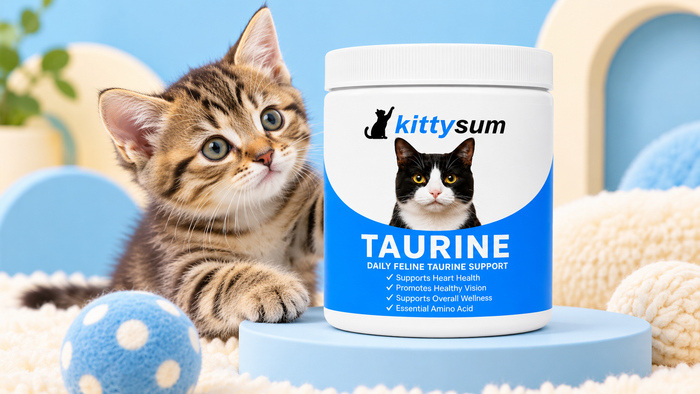
Our guide to taurine for homemade cat food explains safe amounts. For homemade feeders, Kittysum Taurine is a daily taurine powder in a 200 g tub with a measuring scoop, blended with chicken liver for a meaty smell. You can read the label and serving guide here.

Warning Signs After Eating Egg
Even so, watch your cat after any new food. Call your vet if you notice these signs.
- Vomiting or diarrhea
- Itchy skin or facial swelling
- Low energy or hiding
- Refusing food the next day
Overall, can cats have eggs without trouble? Most handle a small portion of plain cooked egg well, but every cat differs.

Can Cats Have Eggs Whole, or Only Yolk or White?
Often, owners ask whether the yolk or the white is better. In fact, both parts are safe when cooked. The white is mostly protein and water, while the yolk holds most of the fat, calories and vitamins. So can cats have eggs as whole cooked egg? Yes, and a mix of both parts gives a balanced treat. However, cats that need to lose weight do better with mostly cooked white, since the yolk is richer. Our guide to can cats eat egg yolk covers the yolk in detail.
Can Cats Have Eggs to Help Picky Eaters?
Sometimes a small amount of warm scrambled egg tempts a cat that is ignoring its bowl. For example, a teaspoon on top of wet food can restart interest after a vet visit or a food change. Still, a cat that refuses food for more than a day or two needs a vet, not just a topper. Also, avoid making egg a daily habit, or your cat may hold out for it. Our guide to taurine for picky cats offers more ideas. In short, can cats have eggs to coax appetite? Yes, briefly and in small amounts.
What About Eggshells?
Notably, eggshells are mostly calcium. Some homemade recipes use ground eggshell as a calcium source. However, the amount must match the recipe, because too much or too little calcium causes problems. Therefore, do not sprinkle eggshell on a commercial diet. Instead, follow a vet-formulated recipe if you cook for your cat.
Store-Bought Egg Treats and Foods
Also, many cat foods and treats list egg or dried egg product as an ingredient. These are formulated for cats, so the egg is already balanced within the recipe. Meanwhile, freeze-dried egg treats count toward the treat allowance like any snack. Our guide to cat food with egg explains how to read those labels. So can cats have eggs through commercial food? Yes, and that is often the simplest option.
How Often Can Cats Have Eggs?
In general, once or twice a week works well for a healthy adult cat. For instance, you might add a teaspoon of scrambled egg to Sunday breakfast and another midweek. Meanwhile, keep the rest of the week on complete food alone. As a result, egg stays a treat rather than a habit, and calories stay in check. Thus, can cats have eggs regularly? Yes, as long as the portion is small and the schedule is occasional.
Myths About Whether Cats Can Have Eggs
- "Raw eggs are more natural." They carry germ and biotin risks.
- "Eggs can replace meat." They lack enough taurine and other nutrients.
- "More egg means more protein, so it is healthier." Extra calories lead to weight gain.
- "Eggshells are a great calcium source." Use them only in a vet-formulated recipe.
Clearing up these myths keeps the answer to can cats have eggs simple and safe.
Common Mistakes When Cats Have Eggs
- Serving runny or raw egg. Cook it fully.
- Using butter, oil or salt. Keep it plain.
- Feeding a whole egg. Offer a teaspoon or two.
- Replacing meals with egg. Keep a complete food as the base.
- Ignoring stomach upset. Stop and check with your vet.
Avoiding these mistakes means the answer to can cats have eggs stays a happy yes.
Questions to Ask a Vet
- How much egg can my cat have, given its weight?
- Is egg safe with my cat's health conditions?
- Does my homemade recipe with egg cover taurine?
- Should my cat avoid egg because of allergies?
Finally, bring your cat's food label to the visit. For context, a 1991 Waltham study found cats need at least 39 mg of taurine per kg of body weight a day on canned food. Also, the AAFCO nutrient profiles set the taurine minimum for complete foods, the WSAVA guide offers diet advice, and Merck explains the heart disease linked to low taurine.
Cooking eggs or other homemade meals for your cat?
Kittysum Taurine is a daily taurine powder blended with chicken liver in a 200 g tub with a measuring scoop, free shipping on orders over $50 and a 30-day return policy. Ask your vet to confirm the amount. Shop Kittysum Taurine →
Key Terms Explained
- Avidin: a protein in raw egg white that binds the vitamin biotin; cooking inactivates it.
- Biotin: a B vitamin cats need for skin, coat and metabolism.
- Salmonella: bacteria that can contaminate raw eggs and make cats and people sick.
- Treat allowance: the share of daily calories, usually about 10 percent, that can come from extras.
- Complete and balanced: a food that meets a standard nutrient profile for a life stage.
Frequently Asked Questions
Can cats have eggs every day?
It is better to offer a teaspoon or two of plain cooked egg once or twice a week, keeping treats under about 10 percent of daily calories.
Can cats have scrambled eggs?
Yes, if they are plain, fully cooked and made without butter, oil, milk or salt.
Can cats have raw eggs?
No. Raw eggs can carry Salmonella, and raw egg white contains avidin, which blocks the vitamin biotin.
Are eggs a good source of taurine for cats?
No. Eggs contain far less taurine than meat, heart or shellfish, so they cannot replace a complete diet.
How much egg can a cat have?
About one to two teaspoons of plain cooked egg as an occasional treat for an average adult cat.
References
- VCA Animal Hospitals. Taurine in Cats.
- VCA Animal Hospitals. Lysine.
- Earle KE, Smith PM. Dietary taurine content and plasma taurine in the cat. Br J Nutr. 1991.
- Pion PD, et al. Myocardial failure in cats with low plasma taurine. Science. 1987.
- Spitze AR, et al. Taurine in animal feed ingredients. 2003.
- Kanakubo K, et al. Protein and amino acids in vegetarian pet diets. 2015.
- AAFCO. Cat Food Nutrient Profiles.
- Merck Veterinary Manual. Nutritional Requirements of Small Animals.
- Merck Veterinary Manual. Dilated Cardiomyopathy.
- WSAVA. Selecting a pet food for your pet.
- Companion Animals Extension. Taurine Requirement of Cats.
- AVMA. Dietary supplement law not applicable to products for animals.
- Purina. Can Cats Eat Eggs?.
- Chewy. Can Cats Eat Raw Eggs?.
- ASPCA. People Foods to Avoid Feeding Your Pets.
- FDA. Raw Pet Food Diets Can Be Dangerous.
This article is for general education and is not veterinary advice. These statements have not been evaluated by the Food and Drug Administration. Kittysum products are not intended to diagnose, treat, cure or prevent any disease.