

Key takeaways
- Is taurine safe for cats? VCA calls supplementation relatively safe, with no reports of problems from excess dietary taurine.
- AAFCO sets a minimum for taurine in cat food but no maximum, and a missing limit is not proof any amount is safe.
- The bigger risks are poor product quality, extra ingredients and human energy drinks, not taurine itself.
- Use the serving printed on the label or your vet's amount, and stop and call your vet if your cat gets sick.
- Cats with heart, eye, kidney or liver disease, and pregnant cats, should start only under a vet's care.
Is taurine safe for cats? At normal amounts, yes, according to VCA. Taurine is a nutrient cats need every day, and VCA reports no problems from excess dietary taurine in cats. Still, safety depends on the product, the amount and your cat's health.
This guide explains what the evidence says. It also covers product quality, risky extras and the times to ask your vet first.
New to taurine? Start with our complete guide to taurine for cats.
Table of contents
Is Taurine Safe for Cats? The Short Answer
For most cats, yes. VCA Animal Hospitals describes taurine supplementation as relatively safe. It also says there are no reports of problems from excessive dietary taurine in cats. VCA notes that taurine is sold over the counter, without a prescription.
However, "safe" is not the same as "needed." VCA also says a healthy cat on a high-quality food for its life stage does not require a supplement. So the first question is whether your cat needs it at all. Our guide on whether cats need taurine supplements helps you decide.
| Question | What the sources say |
|---|---|
| Is taurine safe for cats at normal amounts? | VCA calls supplementation relatively safe |
| Are there reports of harm from excess dietary taurine? | VCA reports none in cats |
| Does AAFCO set a maximum? | No; it sets a minimum only |
| Does supplement quality vary? | Yes, VCA says it may vary significantly |
| Does the FDA approve supplements before sale? | No, per VCA |
So, is taurine safe for cats overall? Yes, when the product is clean and the amount is sensible. In short, taurine itself has a strong safety record. The main risks come from the product and from skipping the vet when a cat is sick.

Why Cats Need Taurine in the First Place
To understand whether taurine is safe for cats, it helps to know why they need it. Cats make very little taurine on their own. VCA explains that taurine is found only in animal-based proteins. In addition, the Merck Veterinary Manual notes that plant protein contains none.
Also, cats do not store much taurine. So they need it from food every day. A shortage can cause vision loss from retinal degeneration and a heart disease called dilated cardiomyopathy (DCM).
The landmark 1987 Pion study in Science linked heart muscle failure to low blood taurine in cats fed commercial foods. Oral taurine went along with heart function returning to normal. In other words, the bigger danger has long been too little taurine, not too much.
Taurine is part of every complete cat food
AAFCO's cat food nutrient profiles require at least 0.10% taurine in dry food and 0.20% in canned food, on a dry matter basis. So every cat on a complete food already eats taurine daily. That daily exposure is part of why taurine is safe for cats at normal amounts.
Is Taurine Safe for Cats at High Amounts?
Is taurine safe for cats at high doses? This is the most common worry. VCA's answer is reassuring: there are no reports of problems from excessive dietary taurine in cats. Even so, there are two important limits to that statement.
- No maximum is set. AAFCO lists a taurine minimum for cat food but no maximum. However, a missing limit is not proof that any amount is safe.
- Research focused on need, not excess. For example, a 1991 Waltham study looked at the least taurine cats need: at least 39 mg per kg of body weight a day on canned food, and 19 mg per kg on dry food.
So the sensible approach is simple. Use the serving printed on the label or your vet's amount, and do not double up "just in case." More taurine does not mean better health for a cat that already gets enough.

What if my cat ate extra by mistake?
First, stay calm. Given VCA's safety notes, a one-time extra scoop of plain taurine is unlikely to be an emergency. Still, call your vet or a pet poison line if your cat seems unwell, or if the product has other ingredients. Also, keep the tub so you can read the label to them.
Next time, store the tub where your cat cannot reach it. For example, a closed cupboard works well. That simple habit answers "is taurine safe for cats" in a busy home, since most accidents come from open tubs. Likewise, wipe up any spilled powder right away.
Is Taurine Safe for Cats When Quality Varies?
So, is taurine safe for cats if the product is poor? Here is where real risk lies. VCA warns that the quality of supplements may vary significantly among manufacturers. In addition, the VCA supplement guide notes that the FDA does not review non-drug supplements for safety or effectiveness before they are sold.
Meanwhile, the rules for animal products are also different. The AVMA reports that the main US dietary supplement law does not apply to products for animals. So the label and the maker matter a lot.
A safety checklist for any taurine product
- A stated amount. First, the label should list mg of taurine per serving.
- Taurine named plainly. Next, avoid "proprietary blends" that hide amounts.
- Short ingredient list. In general, fewer extras means fewer surprises.
- A company contact. Then check for a name and a way to reach them.
- A lot number and date. Finally, a batch code allows tracing and recalls.
Our taurine supplement buying guide walks through each check, along with red flags to avoid.
Is Taurine Safe for Cats From Human Products?
Is taurine safe for cats from an energy drink? This is a firm no. Human energy drinks often contain taurine, but they also contain caffeine, sugar and other ingredients that are not meant for cats. Never give an energy drink, or anything made for people, to a cat.
- Energy drinks and shots: they may contain caffeine and other stimulants.
- Human capsules and tablets: amounts and fillers are not set for cats.
- Flavored powders: they may hold sweeteners or other additives.
- Dog products: amounts and extras are set for dogs, not cats.
So, is taurine safe for cats from these sources? The taurine may be fine, but the rest of the product may not be. If your cat drinks or eats any of these, call your vet right away.

Cats That Need Extra Care
For most cats, the answer to "is taurine safe for cats" is yes at normal amounts. However, some cats should start only under a vet's care.
- Heart disease: VCA notes taurine may be part of DCM treatment, which your vet manages.
- Eye disease: retinal degeneration may be slowed but usually not reversed, so early vet care matters.
- Kidney or liver disease: any new supplement should be checked first.
- Pregnant or nursing cats: VCA links low taurine in pregnancy to small litters, so diet matters, but your vet should guide any change.
- Cats on other medicines or supplements: ask about mixing products.
In these cases, is taurine safe for cats? Usually yes, but the right amount depends on the condition. That is a job for your vet, not the label alone.
Vegetarian, homemade and raw diets
In contrast, these cats often need taurine more, not less. A 2015 study found that three of seven vegetarian canned diets fell below the AAFCO taurine minimum. Also, Merck notes that taurine-related DCM is still seen in cats fed vegetarian, baby or home-cooked food. See our guide to taurine for homemade cat food.
Side Effects to Watch For
Is taurine safe for cats in terms of side effects? Serious problems are not reported with dietary taurine in cats. Still, any new product can upset some cats. So watch your cat for the first week.
- Vomiting or diarrhea
- Refusing food
- Itching, swelling or hives
- Unusual tiredness or hiding
If you see any of these, then stop the supplement and call your vet. Often, the cause is a flavor, filler or sudden diet change, rather than the taurine itself. In that case, your vet may suggest a plainer product.
Is Taurine Safe for Cats in Everyday Situations?
Owners often ask: is taurine safe for cats in specific cases? So here are short answers to the most common ones.
Is taurine safe for cats that are kittens?
Kittens need taurine to grow. In fact, VCA links low taurine to delayed growth. However, a complete growth food already covers it, so ask your vet before adding more.
Is taurine safe for cats that are seniors?
Generally, yes, at normal amounts. Still, older cats often have kidney or heart changes. Because of that, a quick vet check first is wise.
Is taurine safe for cats on prescription food?
Ask first. Prescription diets are set for a medical reason. Therefore, your vet should approve any extra product.
Is taurine safe for cats alongside other supplements?
Often, yes. For example, many cats take taurine and fish oil together. Even so, list every product for your vet, so nothing doubles up.
In short, is taurine safe for cats in these cases? Usually, but your vet knows your cat best.
How to Use Taurine Safely
Overall, is taurine safe for cats at home? Yes, with a routine that is short and steady. Here is how to keep taurine safe for cats in your home.
- Check with your vet. Bring your cat's food labels.
- Choose a clearly labeled product. Use the checklist above.
- Measure carefully. Use the label serving or your vet's amount, and level the scoop.
- Mix it into food. Our guide on how to add taurine to cat food shows how.
- Watch for changes. Note appetite, stool and energy for the first week.
- Store it safely. Keep the tub sealed, dry and out of reach of pets and children.

Cooking and taurine
If you cook for your cat, add taurine after cooking. A UC Davis study found that cooking, especially boiling, lowers taurine in meat. This is about keeping taurine in the food, not about safety, but it helps your vet's plan work.
When to Call the Vet
Call your vet before you start if your cat has a health condition, and right away if you notice any of these signs.
- Vomiting, diarrhea or refusing food after starting a supplement
- Fast breathing, coughing, low energy or fainting
- Bumping into things or other vision changes
- Any contact with a human energy drink
Of course, signs of low taurine build slowly. VCA warns they can take several months to show. Likewise, the Companion Animals Extension says vets may see retinal changes about 5 to 6 months into a deficiency. Fortunately, the Waltham study found blood taurine returned to normal within two weeks of an adequate diet.
If your cat has a reaction to a supplement, the VCA supplement guide suggests reporting it to the FDA or Health Canada. For more on reading labels, see the AAFCO guide to reading labels and the WSAVA guide to selecting a pet food. Our taurine FAQ has more quick answers.
Want a plain, clearly labeled taurine?
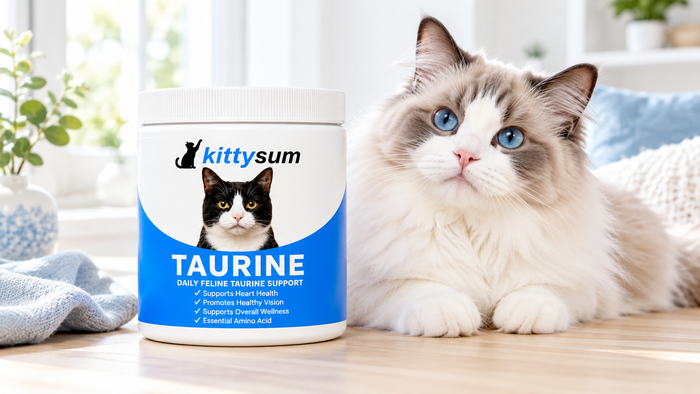
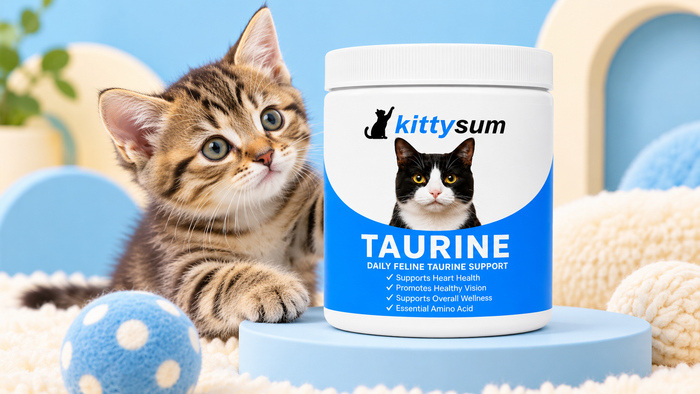
Kittysum Taurine is a daily taurine powder with a measuring scoop, made as daily nutrition support. Ask your vet to confirm the amount. See the label and serving directions →
Key Terms Explained
- Adverse event: an unwanted reaction after a product is given, such as vomiting or diarrhea.
- Upper limit: the highest intake set as safe by an authority; AAFCO sets none, so is taurine safe for cats at any dose is still unproven.
- Lot number: a batch code that lets a maker trace and recall a product.
- Over the counter: sold without a prescription from a vet.
- Complete and balanced: a label claim that a food meets AAFCO nutrient levels for a stated life stage.
Frequently Asked Questions
Is taurine safe for cats every day?
Yes, at normal amounts. Cats eat taurine daily in complete food, and VCA calls supplementation relatively safe. Use the label serving or your vet's amount.
Can a cat overdose on taurine?
VCA reports no problems from excess dietary taurine in cats. However, AAFCO sets no maximum, so do not give more than the label or your vet advises.
Is taurine from energy drinks safe for cats?
No. Energy drinks contain caffeine and other ingredients not meant for cats. Call your vet if your cat drinks any.
What are the side effects of taurine in cats?
Serious problems are not reported. Some cats may get an upset stomach from a new product or its extras. Stop and call your vet if that happens.
Is taurine safe for cats with kidney disease?
Ask your vet first. Any new supplement for a cat with kidney or liver disease should be checked against the treatment plan.
References
- VCA Animal Hospitals. Taurine in Cats.
- VCA Animal Hospitals. Lysine.
- Earle KE, Smith PM. Dietary taurine content and plasma taurine in the cat. Br J Nutr. 1991.
- Pion PD, et al. Myocardial failure in cats with low plasma taurine. Science. 1987.
- Spitze AR, et al. Taurine in animal feed ingredients. 2003.
- Kanakubo K, et al. Protein and amino acids in vegetarian pet diets. 2015.
- AAFCO. Cat Food Nutrient Profiles.
- AAFCO. Reading Labels.
- Merck Veterinary Manual. Nutritional Requirements of Small Animals.
- Merck Veterinary Manual. Dilated Cardiomyopathy.
- WSAVA. Selecting a pet food for your pet.
- Companion Animals Extension. Taurine Requirement of Cats.
- AVMA. Dietary supplement law not applicable to products for animals.
This article is for general education and is not veterinary advice. These statements have not been evaluated by the Food and Drug Administration. Kittysum products are not intended to diagnose, treat, cure or prevent any disease.