Key takeaways
- Taurine powder for cats suits homemade, raw or mixed diets, and cats whose vet has advised a supplement.
- Most healthy cats on a complete, high-quality food do not need extra taurine, according to VCA.
- Powder is the easiest form to split, adjust and mix into wet food.
- A good label states mg of taurine per serving, names taurine plainly, and lists a lot number.
- Use the serving printed on the label or your vet's amount, and store the tub sealed and dry.
Taurine powder for cats is the most flexible way to add taurine to a meal. You can measure it, split it across meals and mix it into wet food in seconds. However, many cats do not need it. A healthy cat eating a complete, high-quality food usually gets enough taurine already.
So this guide starts with who needs it. Then it compares powder with other forms, shows what to look for on a label, and explains how to measure and store it.
For the basics, see our complete guide to taurine for cats.
Table of contents
Who Needs Taurine Powder for Cats?
First, the honest answer: not every cat. VCA Animal Hospitals says a healthy cat eating a high-quality food for its life stage does not require supplementation. Since the late 1980s, all diets made for cats add enough taurine for a normal cat.
However, VCA recommends a supplement for cats with health problems, or for cats not getting most of their food from a high-quality commercial diet. That is where taurine powder for cats earns its place.
- Homemade or raw meals that make up a large share of the diet
- Vegetarian foods, since plant protein contains no taurine
- Lots of toppers or treats that are not complete and balanced
- Heart or eye disease, where a vet may use taurine as part of treatment
- Dog food in the bowl, since VCA warns it does not hold enough taurine for a cat
In other words, taurine powder for cats is a tool for certain diets. It is not a daily must for every cat. Our guide on whether cats need taurine supplements goes into each case.

Why Cats Need Taurine in the First Place
To begin with, cats make very little taurine on their own. VCA explains that taurine is found only in animal-based protein. In addition, the Merck Veterinary Manual notes that plant protein contains none. Cats also do not store much of it, so they need it from food every day.
In fact, taurine supports normal heart function, eyesight, digestion and reproduction. For example, VCA says low taurine can lead to feline central retinal degeneration and dilated cardiomyopathy (DCM). It is also part of bile salts, so a shortage can upset digestion.
The landmark 1987 Pion study in Science linked heart muscle failure to low blood taurine in cats fed commercial foods. Oral taurine went along with heart function returning to normal. As a result, makers began adding more taurine to cat food.
Today, Merck notes that taurine-related DCM is much less common in cats. Even so, it is still seen in cats fed vegetarian food, baby food or home-cooked food. That is why taurine powder for cats is most useful for those diets.

Taurine Powder for Cats vs Capsules, Liquids and Chews
Today, taurine for cats comes in several forms. VCA notes it is sold over the counter, without a prescription. Each form has trade-offs.
| Form | Strengths | Trade-offs |
|---|---|---|
| Powder | Easy to split and adjust; mixes into wet food; often low cost per serving | Needs a scoop and a dry place to store |
| Capsule | Fixed amount per capsule; easy to count | Pilling can stress some cats |
| Liquid | Good for cats that dislike texture changes | Check the amount per mL and how to store it |
| Chew or treat | Easy to give by hand | Adds calories and flavors; amount per chew may be small |
For most cats on wet or homemade food, taurine powder for cats is the simplest pick. You can start small and build up, which helps picky eaters. On the other hand, capsules suit owners who want a fixed amount that matches a vet's plan.
When taurine powder for cats is not the best fit
Still, powder is not ideal for every cat. A cat that eats only dry kibble may leave the powder at the bottom of the bowl. In that case, a capsule or a liquid may work better. Ask your vet which form suits your cat.
Our buying guide to taurine supplements compares all four forms in more depth.
What to Look for in Taurine Powder for Cats
In most cases, the label tells you almost everything. So before you buy, turn the tub over and check these points.
- Taurine per serving in mg. First, the label should give an exact amount per scoop or per gram.
- A clear serving size. Next, it should say what one serving is, such as one level scoop.
- Taurine named plainly. Then check that the ingredient list says taurine, not a "proprietary blend."
- Few extras. In general, a short ingredient list is easier to check with your vet.
- Company contact. Also, look for a name, address or email you can reach.
- Lot number and date. Finally, a batch code shows the maker can trace each batch.
- A scoop in the tub. In addition, a fitted scoop makes each serving the same.

Why quality checks matter
VCA warns that supplement quality may vary significantly among makers. Also, the VCA supplement guide notes that the FDA does not review non-drug supplements for safety or effectiveness before sale. The AVMA adds that the main US dietary supplement law does not apply to animal products.
So pick taurine powder for cats from a maker that answers questions. For example, ask how they test each batch. A clear reply is a good sign.
How to Measure Taurine Powder for Cats
Use the serving printed on the label or your vet's amount. Never guess, because a small error adds up each day. Then follow these steps each time.
- Use the scoop that came with it. Scoops differ between brands, so do not swap them.
- Level the scoop. Run a clean, dry knife across the top.
- Keep the scoop dry. Moisture makes powder clump and changes the amount.
- Split it if needed. For instance, half in the morning meal and half at night works well.
What the research says about daily needs
The clearest figures come from a 1991 Waltham study. Cats needed at least 39 mg of taurine per kg of body weight a day on canned food. On dry food, they needed at least 19 mg per kg. These figures describe the whole diet, not the supplement alone.
That is why your vet sets the amount of taurine powder for cats based on what your cat already eats. Our taurine dosage guide explains the math by weight.
How to Use Taurine Powder for Cats Every Day
Once your vet agrees, the routine takes about a minute. Here is a simple plan that works for most homes.
Wet food is the easiest base, because the powder blends in, while dry food needs one more step. For dry food, moisten a small handful of kibble first, then toss it with the powder. Our step-by-step guide on how to add taurine to cat food covers picky cats too.

Using it with homemade food
Homemade meals are where taurine powder for cats helps most. However, timing matters. A UC Davis study found that cooking, especially boiling, lowers taurine in meat. So add the powder after cooking, once the food has cooled.
That said, taurine alone does not balance a homemade recipe. WSAVA suggests asking who formulated the diet, ideally a board-certified veterinary nutritionist. See our guide to taurine for homemade cat food for more.
Vegetarian diets
In particular, plant-based diets carry a higher risk. A 2015 study tested seven vegetarian cat diets. Three canned diets came in below the AAFCO taurine minimum. If your cat eats a plant-based food, ask your vet about blood tests and taurine powder for cats.
How to Compare the Cost of Taurine Powder for Cats
A bigger tub is not always the better deal. Instead, compare the cost per serving. You only need the price and the label.
- Find the servings per pack. First, check the label. If it is not listed, divide the net weight by the serving size.
- Divide the price by the servings. Then you have the cost per serving.
- Multiply by your cat's daily servings. Next, use the amount your vet suggests.
- Compare mg of taurine per serving. Finally, check this too, because one scoop may hold more taurine than another.
For example, using made-up numbers, a tub with a net weight of 100 g and a 1 g serving holds about 100 servings. However, a tub with a 2 g serving holds only half as many. So always do the math with the real label numbers.
In short, the best value in taurine powder for cats is a fair price per milligram of taurine. Also, factor in a fitted scoop and a clear label, since both save guesswork. That way, you can compare taurine powder for cats from different brands on equal terms.
How to Store Taurine Powder for Cats
Good storage keeps every scoop of taurine powder for cats consistent. In general, treat the tub like a dry pantry item.
- Seal the lid after each use.
- Keep it cool and dry, away from the stove, sink and direct sun.
- Use only a dry scoop, never a wet spoon.
- Follow the label for the use-by date and any storage notes.
- Store it out of reach of pets and children.
If the powder clumps a little, break it up with a dry spoon. However, if it smells odd or changes color, stop using it and contact the maker.

Is Taurine Powder for Cats Safe?
At normal amounts, yes. VCA says supplementation is relatively safe, with no reports of problems from excess dietary taurine in cats. Even so, AAFCO sets no maximum, and a missing limit is not proof that any amount is safe.
So stick to the label serving or your vet's amount. Besides, never use human energy drinks or human products. They may contain caffeine or other ingredients not meant for cats. Our guide on is taurine safe for cats explains more.
How fast does it work?
Fortunately, blood levels can recover quickly, especially when the cause is diet. In the Waltham study, plasma taurine returned to normal within two weeks of an adequate diet. However, VCA notes that retinal damage may slow but usually does not reverse. So early care matters most.
When to See the Vet
Talk to your vet before starting taurine powder for cats in these cases.
- Signs of vision loss, such as bumping into things
- Fast breathing, low energy or a heart murmur
- Pregnancy, nursing, or a growing kitten
- Kidney, liver or gut disease
- Any other daily medicine or supplement
Of course, signs of low taurine build slowly. VCA says they can take several months to appear. Likewise, the Companion Animals Extension notes that vets may see retinal changes about 5 to 6 months into a deficiency.
Finally, check your cat's main food. AAFCO's cat food nutrient profiles require at least 0.10% taurine in dry food and 0.20% in canned food, on a dry matter basis. Our taurine FAQ has more quick answers.
Looking for a plain taurine powder?
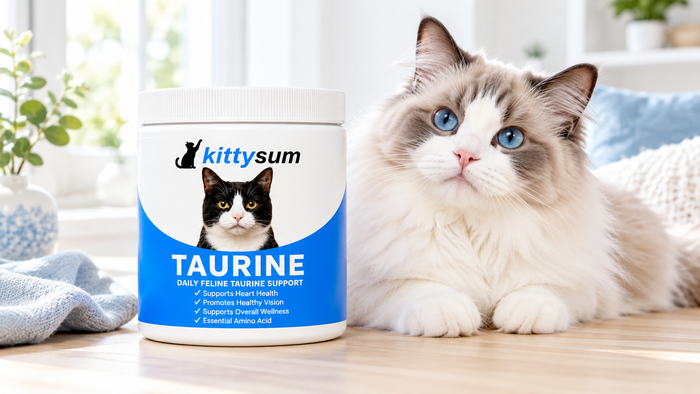
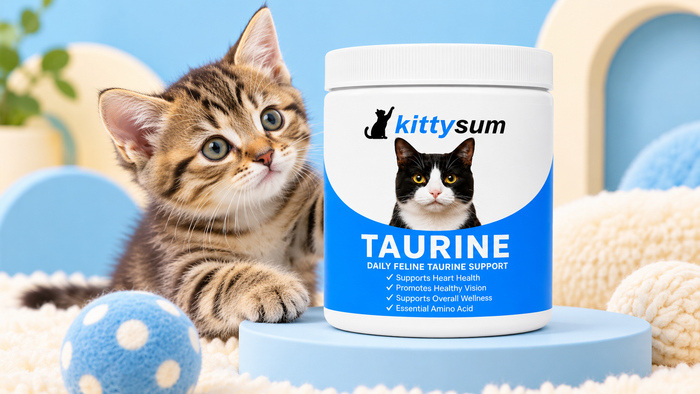
Kittysum Taurine is a daily taurine powder with a measuring scoop, made as daily nutrition support. Ask your vet to confirm the amount. See the label and serving directions →
Key Terms Explained
- Taurine: a nutrient cats must get from animal-based food, because they make very little of it.
- Unflavored powder: a powder with no added taste, so it blends into a cat's usual food.
- Net weight: the weight of the product in the pack, not counting the tub.
- Servings per pack: how many label servings the pack holds, found by dividing net weight by serving size.
- Lot number: a batch code that lets the maker trace how and when a product was made.
Frequently Asked Questions
Is taurine powder for cats better than capsules?
Powder is easier to split and mix into wet food. Capsules give a fixed amount. The better choice is the form your cat accepts and your vet agrees with.
How much taurine powder should I give my cat?
Use the serving printed on the label or your vet's amount. Your vet can adjust it for your cat's diet and health.
Can I mix taurine powder into dry food?
Yes. Moisten a small handful of kibble with a little water, toss it with the powder, and serve it right away.
Does my indoor cat need taurine powder?
Usually not. VCA says a healthy cat on a complete, high-quality food does not need extra taurine. Ask your vet if the diet is homemade or mixed.
How should I store taurine powder for cats?
Keep the lid sealed, use a dry scoop, and store the tub somewhere cool and dry, out of reach of pets and children.
References
- VCA Animal Hospitals. Taurine in Cats.
- VCA Animal Hospitals. Lysine.
- Earle KE, Smith PM. Dietary taurine content and plasma taurine in the cat. Br J Nutr. 1991.
- Pion PD, et al. Myocardial failure in cats with low plasma taurine. Science. 1987.
- Spitze AR, et al. Taurine in animal feed ingredients. 2003.
- Kanakubo K, et al. Protein and amino acids in vegetarian pet diets. 2015.
- AAFCO. Cat Food Nutrient Profiles.
- Merck Veterinary Manual. Nutritional Requirements of Small Animals.
- Merck Veterinary Manual. Dilated Cardiomyopathy.
- WSAVA. Selecting a pet food for your pet.
- Companion Animals Extension. Taurine Requirement of Cats.
- AVMA. Dietary supplement law not applicable to products for animals.
This article is for general education and is not veterinary advice. These statements have not been evaluated by the Food and Drug Administration. Kittysum products are not intended to diagnose, treat, cure or prevent any disease.