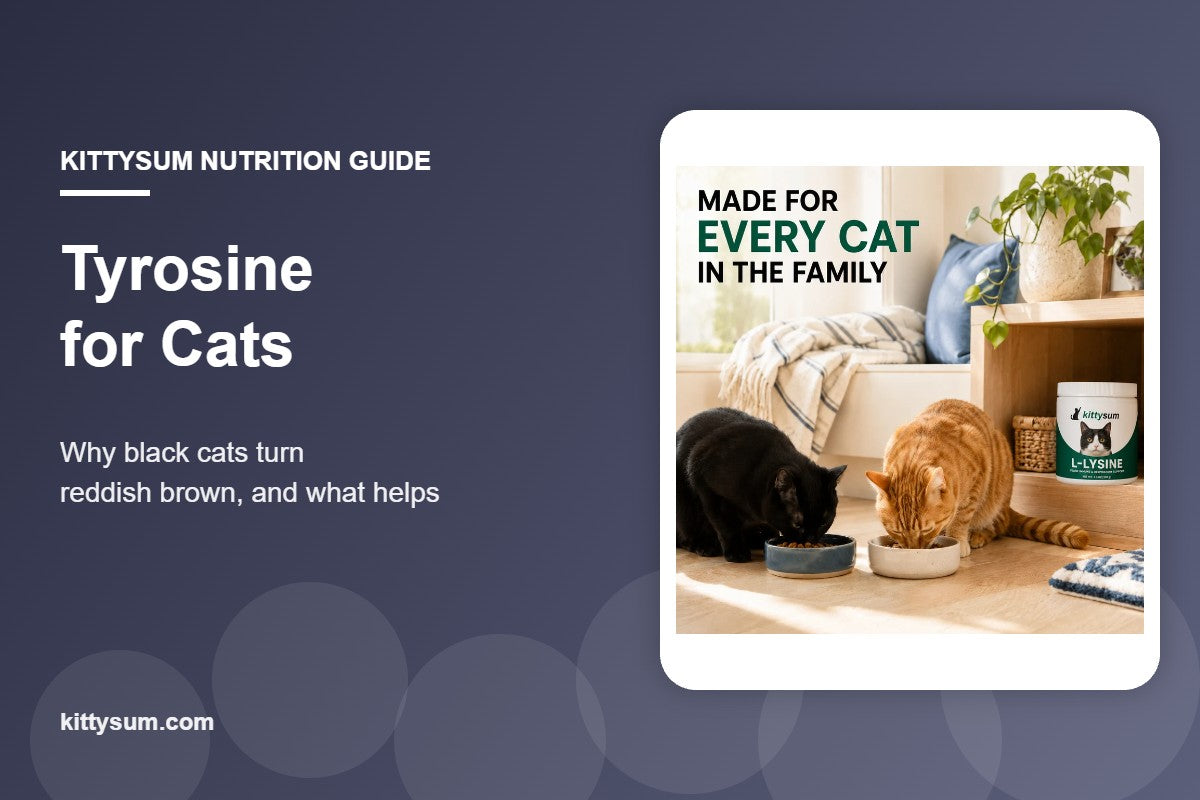
Tyrosine for cats is an amino acid that helps make melanin, the dark pigment in hair. Studies show that black cats fed diets low in tyrosine and phenylalanine can turn reddish brown, and that adding these amino acids restores the black color. Most cats on a complete, meat-based food do not need a tyrosine supplement, so ask your vet before adding one.
This guide explains what tyrosine does, what the research found and when a coat color change is worth a vet visit.
Key takeaways
- Tyrosine for cats is mainly about melanin, the pigment that makes black hair black.
- In UC Davis studies, black cats fed less than 16 g of phenylalanine plus tyrosine per kg of diet developed red hair.
- The researchers recommended at least 18 g per kg of these amino acids to prevent visible red hair in black cats.
- Very low intake over many months also caused nerve and gait problems in research cats.
- Most complete cat foods use animal proteins rich in these amino acids, so ask your vet before you add a supplement.
Table of contents
- What is tyrosine for cats
- Why black cats turn red: tyrosine for cats research
- How much tyrosine for cats is enough
- Tyrosine for cats: study levels compared
- Tyrosine for cats beyond coat color
- New research on adult cats
- Food sources of tyrosine for cats
- A 5-step plan if your black cat looks reddish
- Reading a food label for tyrosine for cats
- Signs to discuss about tyrosine for cats
- Should you give tyrosine for cats as a supplement
- Homemade and unusual diets
- What dog research adds
- Myths about tyrosine for cats
- Key Terms
- Frequently Asked Questions
- References
What is tyrosine for cats
Tyrosine is an amino acid. It belongs to a small group called aromatic amino acids, along with phenylalanine. Because they are so closely linked, research on cats often measures the two together.
One key job of tyrosine is pigment. A 2024 review on hair and skin explains that the skin makes melanin from tyrosine. Melanin gives hair its dark color.
So when people search for tyrosine for cats, they usually want to know about coat color. In particular, they ask why a black cat's coat can turn rusty or reddish brown.
Tyrosine for cats has other roles in the body too. Still, coat color is where the cat research is clearest, so this guide focuses there.

Why black cats turn red: tyrosine for cats research
For many years, owners and breeders noticed something odd. Some black cats slowly turned reddish brown. Researchers at UC Davis set out to explain it.
In a 2001 study, black cats ate purified diets with different protein sources. Diets that turned the hair reddish brown also lowered melanin in the hair and tyrosine in the blood.
Also, black kittens born to queens fed a tyrosine-deficient diet during pregnancy had a reddish coat. Then, diets high in tyrosine or phenylalanine kept or restored the black color.
A short 2002 report summed it up in its title: red hair in black cats is reversed by adding tyrosine to the diet. That is the core finding behind tyrosine for cats.
How much tyrosine for cats is enough
Next, researchers asked how much tyrosine for cats is enough. A 2002 study fed black cats diets with set levels of phenylalanine plus tyrosine for at least six months.
- Cats fed less than 16 g of phenylalanine plus tyrosine per kg of diet developed red hair.
- The researchers recommended at least 18 g per kg of these aromatic amino acids to prevent visible red hair in black cats.
- For comparison, a 1986 recommendation for growing kittens was 4.0 g per kg of phenylalanine and 8.5 g per kg of total aromatic amino acids.
In other words, black coat color needed about twice the amount set for growth. The authors wrote that they knew of no other case where a secondary need was so much higher than the growth need.
The earlier 2001 study pointed the same way. It found that the requirement was higher than 4.5 g of tyrosine plus 12 g of phenylalanine per kg, but lower than 24 g of phenylalanine alone per kg.
Tyrosine for cats: study levels compared
This table lines up the key numbers from the research. All values are per kg of diet, as used in the studies.
| Source | Phenylalanine plus tyrosine | What happened | Takeaway |
|---|---|---|---|
| 1986 kitten growth advice | 8.5 g total aromatic amino acids | Supports growth | Too low for full black color |
| Anderson 2002 | Under 16 g | Red hair in black cats | Not enough for pigment |
| Anderson 2002 | 18 g or more | No visible red hair | Recommended minimum for black cats |
| Dickinson 2004 | Under 16 g for 6+ months | Gait and behavior changes | Long-term need is higher |
| Yu 2001 | High tyrosine or phenylalanine | Black color kept or restored | Diet can reverse the change |
As you can see, the levels that caused problems came from purified research diets. They do not describe a typical meat-based cat food.
Tyrosine for cats beyond coat color
However, coat color was only part of the story. A 2004 study followed 53 black cats on purified diets with different levels of phenylalanine and tyrosine for up to nine months.
After six months, cats on diets with less than 16 g per kg showed nerve and behavior changes. These included vocalizing and an abnormal posture and gait. Tests in three cats pointed to a sensory nerve problem.
The authors concluded that the long-term need for these amino acids may be higher than short growth trials suggest. They also wrote that official recommendations at the time might not support normal long-term nerve function.
So tyrosine for cats is not only a cosmetic topic. It is a reminder that a complete, well-formulated diet matters over the long term.

New research on adult cats
Most early studies on tyrosine for cats used young or growing cats. More recently, a 2024 study measured the phenylalanine requirement of adult cats when tyrosine was in excess.
As a result, the team estimated a mean minimum need of 0.32% of dry matter. They placed the upper 95% limit at 0.59% of dry matter, which is higher than current NRC and AAFCO recommendations.
The same study gave cats a single dose of phenylalanine before meals. That dose did not change how much they ate.
Meanwhile, the study was small, with four cats in the first part and 12 in the second. So the numbers are a useful signal rather than a final answer.
Together, these results suggest that adult needs deserve more study. For now, the National Research Council reference on nutrient requirements and AAFCO profiles remain the main guides that pet food makers use.
Food sources of tyrosine for cats
First, remember that cats are obligate carnivores. As the Cornell Feline Health Center explains, they rely on nutrients found in animal products.
The 2024 hair and skin review notes that animal-sourced ingredients are excellent sources of the amino acids that support skin and hair. Meat, fish, poultry and eggs all supply phenylalanine and tyrosine.
Cornell also suggests looking for foods that list meat, meat byproducts or seafood among the first few ingredients. That signals enough animal-source ingredients to supply essential amino acids.
So for most cats, tyrosine for cats comes from the bowl, not a bottle. A complete and balanced food is the simplest way to cover it. Our guide to amino acids for cats explains the wider picture.

A 5-step plan if your black cat looks reddish
A rusty tint in a black coat can have more than one cause, so tyrosine for cats is only one thing to consider. Here is a simple, safe way to look into it with your vet.
- Take clear photos of the coat in daylight.
- Check that the food is complete and balanced for your cat's life stage.
- See your vet to rule out other health problems.
- Change the diet only with your vet's advice.
- Track the coat over several months, since hair grows slowly.
Reading a food label for tyrosine for cats
Many owners check the label to see how much tyrosine a food contains. However, you will rarely find it there.
AAFCO explains that labels on complete and balanced pet foods usually list only crude protein, crude fat, crude fiber and moisture. So owners cannot see most other nutrient amounts, although they should be adequate if the food is fed correctly.
Instead, look for three things. First, check for a statement that the food is complete and balanced for your cat's life stage. Next, look for animal proteins near the top of the ingredient list. Finally, ask the maker or your vet if you need exact amino acid values.
This approach covers tyrosine for cats without guesswork. In addition, it protects against other gaps that a single number would never show.
Signs to discuss about tyrosine for cats
Low intake is rare on a good commercial food. Still, it helps to know what the research cats showed, so you can raise concerns early.
- A black coat that slowly turns rusty or reddish brown.
- A coat that looks dull or patchy in color.
- Over many months, changes in gait or posture.
- Unusual crying or vocalizing.
The gait and vocal changes appeared in research cats after six months on very low diets. Because these signs have many other causes, never assume they relate to tyrosine for cats. Instead, book a vet visit and bring your food details.
Also, keep the photos you took. Side-by-side pictures help your vet judge whether a color change is real or just lighting.
Should you give tyrosine for cats as a supplement
Tyrosine supplements are sold for people, and some owners wonder about giving them to cats. However, there is no cat study that tests a tyrosine supplement on top of a complete commercial food.
AAFCO explains that healthy cats on a complete and balanced diet generally do not need supplements. It also warns that adding supplements can push some nutrients past safe limits.
Cornell goes further. It states that supplements can be harmful to cats and should never be given without a veterinarian's approval. Human products may also contain other ingredients that are not suited to cats.
So the honest answer is simple. Tyrosine for cats matters, but most cats get enough from good food. If your vet thinks your cat's diet falls short, they can suggest a better food rather than a pill.
Homemade and unusual diets
Tyrosine for cats becomes a bigger question when a diet is homemade, plant-based or very restricted. The research problems came from purified diets, and home recipes can also miss key nutrients.
Cornell notes that homemade diets are hard to balance and recommends recipes from veterinarians certified in animal nutrition when a home diet is needed. The WSAVA nutrition guidelines also encourage vets to review every diet in detail.
If you feed a home-prepared or plant-based diet, ask your vet to check the amino acid profile. Our guides to taurine for homemade cat food and taurine for vegan cats show how easily these diets can fall short.
Also, remember that amino acids work as a team. If one is low, others may be low as well. So when a vet reviews tyrosine for cats on a home diet, they usually check the whole recipe, including taurine, arginine and the fats that support skin. Our main taurine for cats guide explains why taurine gets so much attention in home diets.
What dog research adds
Dogs show a similar pattern, which adds weight to the cat findings on tyrosine for cats. In a 2018 study, adult black Labrador retrievers ate diets with higher or lower phenylalanine plus tyrosine for 24 weeks.
Dogs on the higher intake showed less red and yellow in their coats after 24 weeks. The authors concluded that coat color in adult dogs depends on dietary tyrosine intake.
Of course, dogs are not cats. Still, the dog data support the same idea: tyrosine for cats and dogs matters for dark coat color, and the need may be higher than the minimum for health.

Myths about tyrosine for cats
A few ideas about tyrosine for cats come up often. Here is what the evidence supports.
- Myth: a red tint always means poor food. Diet is one cause seen in research, but your vet should rule out others.
- Myth: more tyrosine makes any coat darker. Coat color depends mainly on genes, and the studies focused on black cats.
- Myth: human tyrosine pills are a quick fix. No cat study supports this, and Cornell advises against supplements without a vet.
- Myth: coat color changes fast. The studies ran for months, because hair grows slowly.
For other coat and skin questions, see our guides to dry skin on cats and omega-3 for cats.
Key Terms
- Tyrosine: an amino acid the body uses to make melanin and other compounds.
- Phenylalanine: an essential amino acid closely linked to tyrosine.
- Aromatic amino acids: the group that includes phenylalanine and tyrosine.
- Melanin: the pigment that gives hair and skin dark color.
- Purified diet: a research diet built from refined ingredients so each nutrient can be controlled.
- Dry matter: the part of a food left after all water is removed.
Frequently Asked Questions
Why is my black cat turning brown
In research, black cats on diets low in tyrosine and phenylalanine turned reddish brown. Other causes exist too, so check that the food is complete and ask your vet.
Do cats need a tyrosine supplement
Most cats on a complete, meat-based food do not. AAFCO and Cornell both advise against supplements without a vet's advice.
How much tyrosine for cats keeps a black coat dark
UC Davis researchers recommended at least 18 g of phenylalanine plus tyrosine per kg of diet to prevent visible red hair in black cats.
How long does it take for coat color to return
Hair grows slowly, and the studies ran for months. Expect to judge any change over several months, not weeks.
References
- Yu S, Rogers QR, Morris JG. Effect of low levels of dietary tyrosine on the hair colour of cats. J Small Anim Pract. 2001. Read the source.
- Morris JG, Yu S, Rogers QR. Red hair in black cats is reversed by addition of tyrosine to the diet. J Nutr. 2002. Read the source.
- Anderson PJ, Rogers QR, Morris JG. Cats require more dietary phenylalanine or tyrosine for melanin deposition in hair than for maximal growth. J Nutr. 2002. Read the source.
- Dickinson PJ, et al. Neurologic effects of dietary deficiencies of phenylalanine and tyrosine in cats. Am J Vet Res. 2004. Read the source.
- Lambie JG, et al. Phenylalanine requirements in adult cats. J Anim Sci. 2024. Read the source.
- Connolly ED, Wu G. Functions and metabolism of amino acids in the hair and skin of dogs and cats. Adv Exp Med Biol. 2024. Read the source.
More studies and guides
- Watson A, et al. Increased dietary intake of tyrosine upregulates melanin deposition in the hair of adult black-coated dogs. Anim Nutr. 2018. Read the source.
- Cornell Feline Health Center. Feeding Your Cat. Read the source.
- AAFCO. Supplements. Read the source.
- WSAVA. Global Nutrition Guidelines. Read the source.
- National Research Council. Nutrient Requirements of Dogs and Cats. Read the source.
This guide is general nutrition information for cat owners. It is not a diagnosis or treatment plan, so please talk with your veterinarian about your own cat.
This article is for general education and is not veterinary advice. These statements have not been evaluated by the Food and Drug Administration. Kittysum products are not intended to diagnose, treat, cure or prevent any disease.