Key takeaways
- Human taurine for cats is the same molecule, but the product around it is made for people.
- Capsules can hold fillers, flavors and doses sized for adults, not cats.
- Never give a cat an energy drink, because these contain caffeine.
- Most cats on a complete food do not need any extra taurine.
- If your vet advises a supplement, a cat product with a clear mg label and scoop is easier to measure.
Human taurine for cats sounds like an easy shortcut, because the taurine in a capsule is the same molecule cats need. Even so, a human product is built for people. The dose, fillers and flavors are chosen for adults, not for a 4 kg cat.
This guide explains what is really in human taurine products, which ones are never safe, how dose and measuring differ, and when a cat product is the simpler choice.
New to taurine? Start with our guide to taurine for cats.
Table of contents
What Human Taurine for Cats Means
Taurine is an amino acid cats must get from animal tissue. In fact, Merck notes that plant protein contains none. Also, VCA Animal Hospitals explains that cats need it for vision, heart muscle function and digestion.
People can make their own taurine, so human products are sold for sports, energy or general health. When owners search for human taurine for cats, they usually mean one of three things. First, a capsule or tablet from a health store. Second, a bag of bulk taurine powder. Third, an energy drink that lists taurine on the can.
Each one is a different risk. So it helps to look at them one at a time.

Is Human Taurine for Cats the Same Molecule?
Yes. Taurine is taurine, whether it is made for a person or a pet. In other words, the compound itself does not change. Research on cats has used pure taurine for decades. For example, the 1978 study that showed taurine is essential for cats used purified taurine in the diet.
However, the molecule is only part of the story. A product also has a dose, a form and other ingredients. Therefore, human taurine for cats is safe only when every part of the product suits a cat. That is the key point of this guide, and it shapes every rule for human taurine for cats below.
What changes between products
- Dose: human capsules often hold far more taurine than a cat needs in a day.
- Additives: sweeteners, flavors, herbs and stimulants may be added.
- Form: a hard capsule is harder to split and hide than a measured powder.
Human Taurine for Cats: What You Must Never Give
Some taurine products are never safe for cats. Above all, never give a cat an energy drink. These drinks contain caffeine, and the ASPCA lists caffeine among the people foods that are dangerous for pets. They also hold sugar or sweeteners and other stimulants.
Similarly, avoid any product that combines taurine with other active ingredients. For example, pre-workout powders, energy shots and "focus" blends often add caffeine, guarana or herbs. As a result, the taurine on the label is not the real concern. The extras are.
- Energy drinks and energy shots
- Pre-workout and sports powders
- Multi-ingredient "focus" or "energy" capsules
- Flavored chewables or gummies made for people
If your cat drinks or eats any of these, call your vet or a pet poison line right away. In short, human taurine for cats is never a reason to share an energy product.
Capsules, Tablets and Human Taurine for Cats
Plain capsules are the most common form owners try. Many list only taurine and a capsule shell. Still, others add fillers, flow agents or coatings. Most of these are common in human products, but few are tested in cats.
In addition, capsules are awkward for cats. You may need to open one and pour out the powder. Then you have to split that powder into tiny portions. So human taurine for cats quickly becomes a measuring problem, even when the ingredient list looks clean.
Questions to ask about a capsule
- Does the label list taurine as the only active ingredient?
- What other ingredients are listed?
- How many mg of taurine are in one capsule?
- Can you measure a small, steady portion each day?
If any answer is unclear, ask your vet before using it. Also, VCA warns that supplement quality may vary significantly among makers. Likewise, the AVMA reports that the main US dietary supplement law does not apply to animal products.


Dose and Body Size: Human Taurine for Cats
Human doses are sized for an adult person. By contrast, an adult cat may weigh about 4 kg. For this reason, a single capsule can hold many times what a cat would get from a supplement in a day.
For context, a 1991 Waltham study found cats need at least 39 mg of taurine per kg of body weight a day on canned food and about 19 mg per kg on dry food. That is the total from the whole diet. So most cats on a complete food already meet it before any extra is added.
VCA describes taurine supplementation as relatively safe, with no reports of problems from excess dietary taurine in cats. Even so, AAFCO sets no maximum, so there is no reason to give more than your vet suggests. Our guide to too much taurine for cats explains this in detail. In short, human taurine for cats is mainly a dosing and measuring issue.
Measuring Human Taurine for Cats at Home
Measuring is where most owners struggle. For example, splitting a 500 mg capsule into equal daily portions is hard with kitchen tools. Meanwhile, a kitchen spoon can vary a lot from one scoop to the next.
- Use the amount your vet sets: then you have a target to measure against.
- Use a scale or a set scoop: a level scoop is far more steady than a pinch.
- Mix into a small portion first: serve that portion before the rest of the meal.
- Keep a log: note the amount and how your cat ate.
As a result, you can see whether the routine works. Our guide to taurine dosage for cats shows how many mg cats need on wet and dry food.
Human Taurine for Cats vs a Cat Taurine Product
Here is a quick side-by-side comparison.
| Feature | Human product | Cat taurine product |
|---|---|---|
| Molecule | Taurine | Taurine |
| Dose per serving | Sized for adults | Sized for cats |
| Other ingredients | May include fillers, flavors or stimulants | Chosen for cats |
| Form | Capsule, tablet or drink | Powder with scoop |
| Mixing into food | Open and split capsules | Mix a measured scoop |
| Serving guide | For people | For cats by weight |
In short, human taurine for cats can work only with careful checks, while a cat product is built for the job.
Does Your Cat Need Any Taurine Supplement?
Before you choose a product, ask whether your cat needs one at all. VCA says a healthy cat eating a complete food for its life stage does not require supplementation. Commercial cat foods add taurine for this reason.
However, some cats may benefit from a measured source. For example:
- Homemade or raw diets
- Vegetarian or plant-based food
- A heart or eye exam that worried your vet
- Very small meals of a complete food
In fact, a 2015 study found three of seven vegetarian canned diets below the AAFCO minimum for taurine. Also, a UC Davis study found that cooking, especially boiling, lowers taurine in meat. So human taurine for cats usually comes up when the diet is homemade. Our guide to whether cats need taurine supplements has a full checklist.
5 Safe Rules for Human Taurine for Cats
If you are still thinking about a human product, follow these rules.
- Ask your vet first. Get a daily amount that suits your cat's weight and diet.
- Choose single-ingredient taurine. The label should list taurine as the only active ingredient.
- Avoid stimulants and sweeteners. No caffeine, guarana, sugar or flavor blends.
- Measure every day. Use a scale or a set scoop, never a guess.
- Track your cat. Stop and call your vet if your cat eats less or vomits.
These rules make human taurine for cats as safe as it can be. Still, human taurine for cats takes effort every single day.
Why a Cat Product Is Simpler
A taurine product made for cats solves the measuring problem. For instance, the serving is sized for a cat, and a scoop comes in the tub. In addition, a powder mixes into wet food without opening capsules.
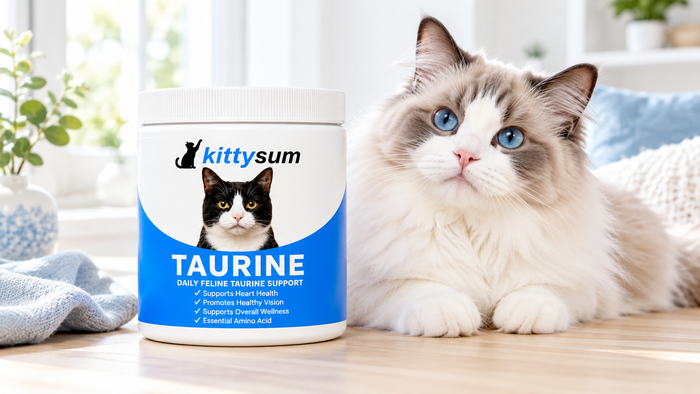
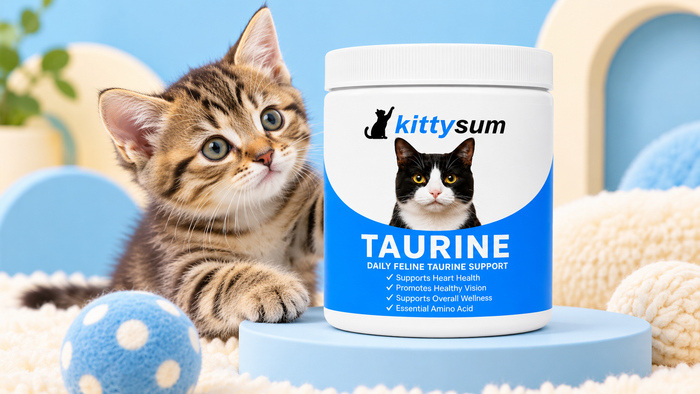
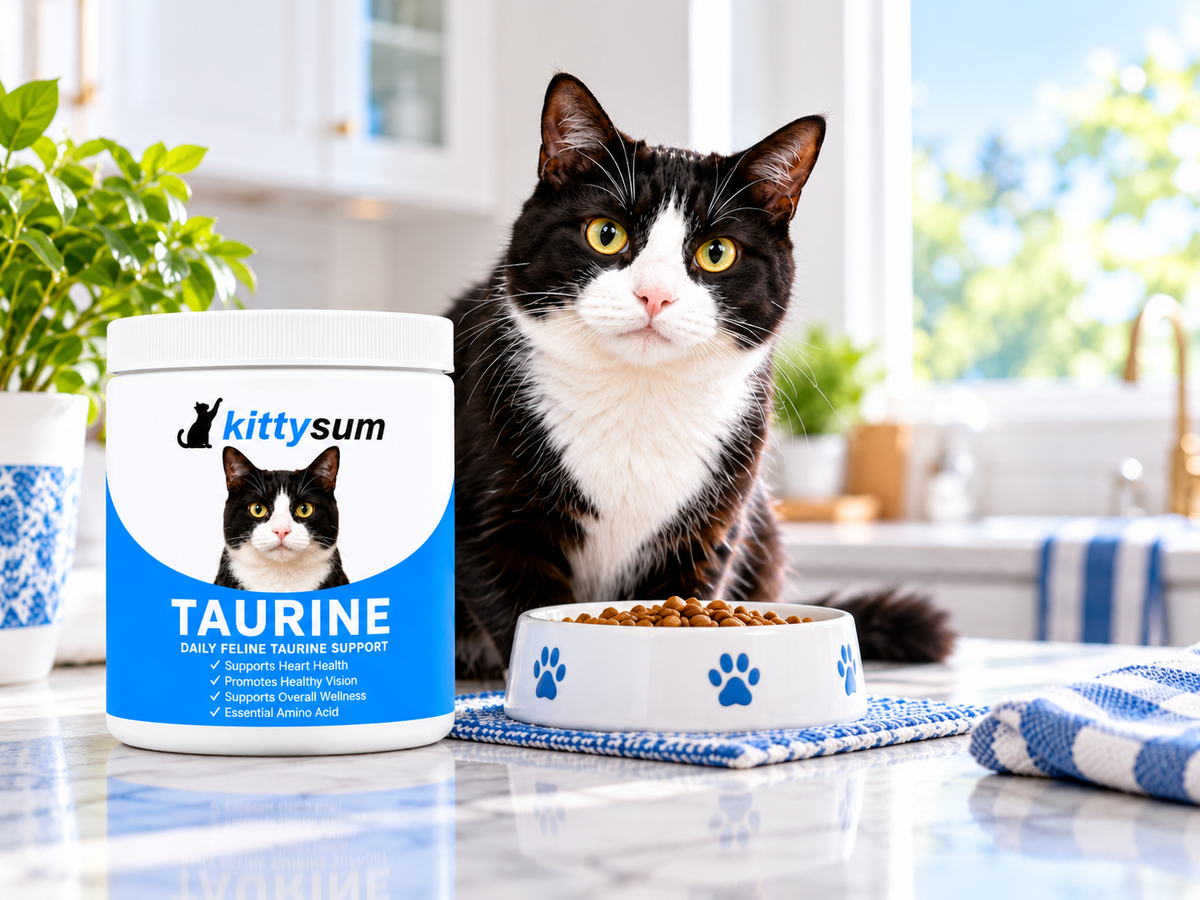
Kittysum Taurine is a daily taurine powder for cats in a 200 g tub with a measuring scoop, blended with chicken liver for a meaty smell. You can read the label and serving guide here. For a wider comparison, see our guide to the best taurine supplement for cats.
That said, a cat product is not required for every cat. Instead, it is the easier choice when your vet says your cat needs a set amount.

Label Checks Before You Buy Any Taurine
Whether you pick a human or a cat product, read the label closely. So look for these points.
- Taurine per serving in mg: you need this to measure.
- Full ingredient list: every added ingredient should be named.
- Serving guide: ideally by cat weight.
- Batch or lot number: this helps with tracing and quality.
- Contact details: a real company you can ask questions.
Also, the VCA supplement guide notes that the FDA does not review non-drug supplements before sale. Therefore, a clear label matters for human taurine for cats and for pet products alike.
Switching From Human Taurine for Cats to a Cat Product
Some owners start with a capsule and later switch. Moving away from human taurine for cats is simple to do.
- First, note the daily mg your vet set.
- Next, find how many mg are in one scoop of the new product.
- Then mix the new product into a small portion of strong-smelling wet food.
- Also, keep the old routine on the same days until the switch is done.
- Finally, log appetite for the first week.
As a result, your cat keeps a steady supply during the change. Our guide to how to add taurine to cat food shows the mixing steps.
Myths About Human Taurine for Cats
- "Energy drinks are a good taurine source." False. They contain caffeine and sugar.
- "More taurine is always better." False. Use the amount your vet sets.
- "A capsule is the same as a pet powder." Partly. The molecule matches, but the dose and form differ.
- "Every cat needs extra taurine." False. Most cats on a complete food get enough.
In short, human taurine for cats is neither magic nor poison. Instead, it is a product that needs careful checks.
Common Mistakes With Human Taurine for Cats
- Giving a full capsule. That dose is sized for a person.
- Using a multi-ingredient blend. Extra actives may not suit cats.
- Sharing a drink or chew. Sweeteners and caffeine are a real risk.
- Skipping the vet. Your vet can confirm whether your cat needs it.
- Guessing the amount. Measure with a scale or a set scoop instead.
Avoiding these mistakes keeps human taurine for cats from turning into a problem.
Warning Signs After Any New Supplement
Watch your cat for a few days after any change. For example, look out for these signs.
- Vomiting or diarrhea
- Eating much less than usual
- Restlessness, a racing heart or tremors
- Hiding or unusual tiredness
Restlessness, tremors or a racing heart can follow caffeine exposure, so call your vet at once. Otherwise, stop the new product and ask your vet before you restart. In short, early action matters far more than any one supplement.
Questions to Ask Your Vet About Human Taurine for Cats
- Does my cat's diet already cover taurine?
- Is a supplement needed, and how many mg a day?
- Is this human product safe for my cat, ingredient by ingredient?
- Would a cat product be easier to measure?
Bring the human taurine for cats product, or a photo of its label, to the visit. As a result, your vet can check the dose and every added ingredient at once. For diet advice, the WSAVA guide explains how to choose a pet food. Also, the Companion Animals Extension says retinal changes may appear 5 to 6 months into a deficiency, while the landmark 1987 Pion study linked heart failure in cats to low blood taurine, and Merck explains dilated cardiomyopathy.
Want taurine sized for cats?
Kittysum Taurine is a daily taurine powder blended with chicken liver in a 200 g tub with a measuring scoop, free shipping on orders over $50 and a 30-day return policy. Ask your vet to confirm the amount. Shop Kittysum Taurine →
Key Terms Explained
- Taurine: an amino acid cats must get from animal tissue.
- Filler: an extra ingredient that bulks out a capsule or tablet.
- Excipient: an inactive ingredient such as a binder, coating or flow agent.
- Energy drink: a sweet, caffeinated drink that often lists taurine on the label.
- Complete and balanced: a food that meets a standard nutrient profile for its life stage.
Frequently Asked Questions
Can I give my cat human taurine?
Plain, single-ingredient taurine is the same molecule, but the dose and added ingredients are made for people. Ask your vet for a daily amount and check every ingredient first.
Is it safe to give a cat an energy drink for taurine?
No. Energy drinks contain caffeine, which the ASPCA lists as dangerous for pets. Call your vet if your cat drinks one.
How much human taurine can a cat have?
Use only the amount your vet sets. A human capsule often holds far more than a cat would get from a supplement in a day.
Is a cat taurine product better than a human one?
It is usually easier, because the serving is sized for cats and comes with a scoop. The molecule itself is the same.
Do cats need taurine if they eat commercial food?
Most cats on a complete and balanced food get enough. Supplements matter mainly for homemade, raw or vegetarian diets.
References
- VCA Animal Hospitals. Taurine in Cats.
- VCA Animal Hospitals. Lysine.
- Earle KE, Smith PM. Dietary taurine content and plasma taurine in the cat. Br J Nutr. 1991.
- Pion PD, et al. Myocardial failure in cats with low plasma taurine. Science. 1987.
- Spitze AR, et al. Taurine in animal feed ingredients. 2003.
- Kanakubo K, et al. Protein and amino acids in vegetarian pet diets. 2015.
- AAFCO. Cat Food Nutrient Profiles.
- Merck Veterinary Manual. Nutritional Requirements of Small Animals.
- Merck Veterinary Manual. Dilated Cardiomyopathy.
- WSAVA. Selecting a pet food for your pet.
- Companion Animals Extension. Taurine Requirement of Cats.
- AVMA. Dietary supplement law not applicable to products for animals.
- Knopf K, et al. Taurine: an essential nutrient for the cat. J Nutr. 1978.
- ASPCA. People Foods to Avoid Feeding Your Pets.
This article is for general education and is not veterinary advice. These statements have not been evaluated by the Food and Drug Administration. Kittysum products are not intended to diagnose, treat, cure or prevent any disease.