Key takeaways
- A natural taurine supplement for cats usually means taurine from food sources such as heart, or a product marketed as natural.
- The taurine molecule is the same whether it comes from meat or from a lab.
- Food-based products often state less precise amounts, which makes dosing harder.
- What matters most is a clear mg-per-serving figure, a full ingredient list and a lot number.
- Most cats on complete food need no supplement, so ask your vet first.
A natural taurine supplement for cats sounds like the safest choice, but the word "natural" can mean different things. Some products use food sources such as freeze-dried heart. Others use the same taurine found in most cat foods and simply market it as natural.
This guide explains natural versus synthetic taurine, what to look for on a label, and how to choose the form that fits your cat.
Not sure your cat needs taurine? Read do cats need taurine supplements first.
Table of contents
What Does a Natural Taurine Supplement for Cats Mean?
There is no single meaning. In general, products use the word in one of two ways.
- Food-based: taurine comes from ingredients such as heart, liver or fish.
- Marketing: the product contains added taurine but is labeled natural for other reasons.
Under pet food labeling rules, a product called natural may still contain added vitamins, minerals and other trace nutrients, as long as the label says so. So the front of the pack does not tell the whole story. Instead, the ingredient list does.
Why cats need taurine at all
Taurine is found in animal tissue. In fact, Merck notes that plant protein contains none. Also, VCA Animal Hospitals explains that cats need it for vision, heart muscle function, digestion and growth.

Is Synthetic Taurine Different From a Natural Taurine Supplement for Cats?
Chemically, no. Taurine from a lab and taurine from meat are the same molecule. Your cat's body uses both in the same way. In fact, most complete cat foods add taurine to meet the AAFCO minimum.
So the real differences between a natural taurine supplement for cats and a standard one are practical, not chemical.
- Precision: standard powders usually state an exact amount.
- Extras: food-based products add protein, fat and flavor.
- Calories: food-based products add more calories per serving.
- Price: food-based products often cost more per mg of taurine.
Food-Based Sources in a Natural Taurine Supplement for Cats
Some ingredients are naturally rich in taurine. For example:
- Heart: one of the richest sources, often sold freeze-dried.
- Dark poultry meat: richer than breast meat.
- Shellfish and some fish: rich, though fish raises other concerns.
- Liver: adds flavor and other nutrients, with variable taurine.
However, the taurine in these foods varies with the animal, the cut and the processing. Also, a UC Davis study found that cooking, especially boiling, lowers taurine in meat. So two bags of the same freeze-dried heart may not hold the same amount. Our guide to taurine foods for cats lists natural sources in more detail. Also, keep in mind that food-based sources work best alongside a complete diet. They are a helpful extra, but they rarely replace a measured source on their own, especially for cats on home-made meals.

Natural Taurine Supplement for Cats vs Standard Powder
Here is a side-by-side view.
| Point | Food-based natural product | Standard taurine powder |
|---|---|---|
| Taurine molecule | Same | Same |
| Amount per serving | Often variable or unstated | Usually stated in mg |
| Calories | Higher | Very low |
| Flavor | Often strong meat flavor | Mild; depends on the blend |
| Best for | Treat-style top-ups | Measured daily plans and home diets |
In short, a natural taurine supplement for cats can be a nice extra, while a measured powder is easier for a set daily amount.
Dosing a Natural Taurine Supplement for Cats
Dosing is where food-based products are hardest. Without a clear mg figure, you cannot follow a vet's plan. So use these steps.
- Find the taurine figure. First, look for mg per serving or mg per kg.
- Check the serving size. Next, note how many pieces or scoops make a serving.
- Work out mg per day. Then multiply to get the daily amount.
- Compare with your vet's target. Also, ask your vet for a daily mg goal.
- Adjust calories. Finally, trim meals slightly if the product adds many calories.
For context, a 1991 Waltham study found cats need at least 39 mg per kg of body weight a day on canned food and 19 mg per kg on dry food. Those figures cover the whole diet, not just the supplement.
Label Checks for Any Natural Taurine Supplement for Cats
VCA warns that supplement quality may vary significantly among makers. In addition, the AVMA reports that the main US dietary supplement law does not apply to animal products. So check every label.
- mg of taurine per serving
- The full ingredient list, in order
- Calories per serving
- Lot number and best-by date
- Maker contact details
If a label says natural but lists no taurine amount, ask the maker. In fact, a clear answer is a good sign. Our guide to the best taurine supplement for cats explains label reading in depth.
Which Cats Need a Natural Taurine Supplement for Cats?
VCA says a healthy cat eating a high-quality food for its life stage does not require supplementation. However, some cats may need extra.
- Homemade diets: recipes without a set source can fall short.
- Cats on raw diets: handling and storage can lower taurine.
- Vegetarian diets: a 2015 study found three of seven vegetarian canned diets below the AAFCO minimum.
Also, Merck notes that taurine-related heart disease is still seen in cats fed vegetarian, baby or home-cooked food. For these cats, a measured source matters more than the word natural. Our guide to taurine for raw fed cats covers raw diets.
Forms of a Natural Taurine Supplement for Cats
Natural products come in several forms. Each has strengths and limits, so here is a quick tour.
Freeze-dried heart bites
First, freeze-dried heart is the most common food-based option. Cats often love the taste. However, the taurine per bite varies, and the bites add calories. Therefore, they work best as a treat or a top-up.
Meat-based powders
Next, some powders are made from dried meat or organs. They mix into wet food like a standard powder. On the other hand, the taurine figure may be less precise, so check the label for mg per scoop.
Broths and toppers
Meanwhile, bone broths and meat toppers may contain some taurine. Still, few list an amount. As a result, they are pleasant extras rather than a reliable natural taurine supplement for cats.
Blends with added taurine
Finally, many products combine food ingredients with added taurine. In fact, this can give the best of both: flavor plus a clear amount. So read the label to see how much taurine each scoop holds.

Switching to a Natural Taurine Supplement for Cats
If you change products, keep the daily amount steady. So follow these steps.
- First, write down the mg of taurine in the old and new product.
- Next, ask your vet to confirm the new serving.
- Then switch at the same meal you used before.
- Also, watch appetite, stool and weight for a week.
- Finally, keep the old product sealed in case your cat refuses the new one.
In short, a careful switch protects the routine. Likewise, it shows you whether the natural taurine supplement for cats suits your cat better than the old one. For example, a picky cat may finish a meaty powder that it ignored before. On the other hand, a cat watching its weight may do better with a low-calorie option. Either way, the natural taurine supplement for cats you choose should fit both your cat's taste and its daily plan.
Where Kittysum Taurine Fits
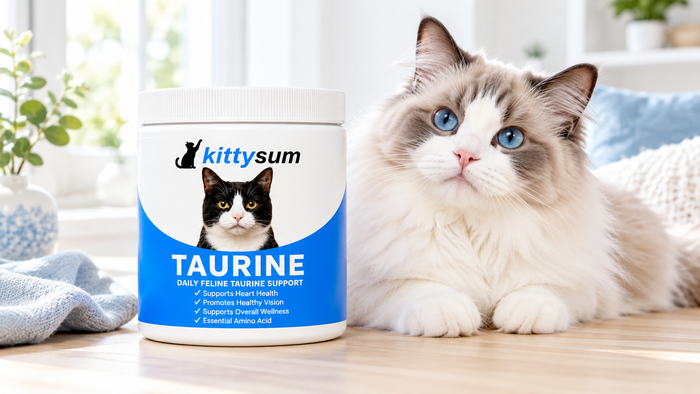
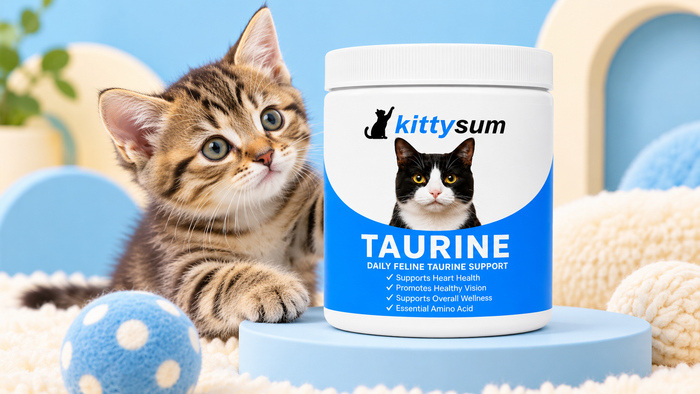
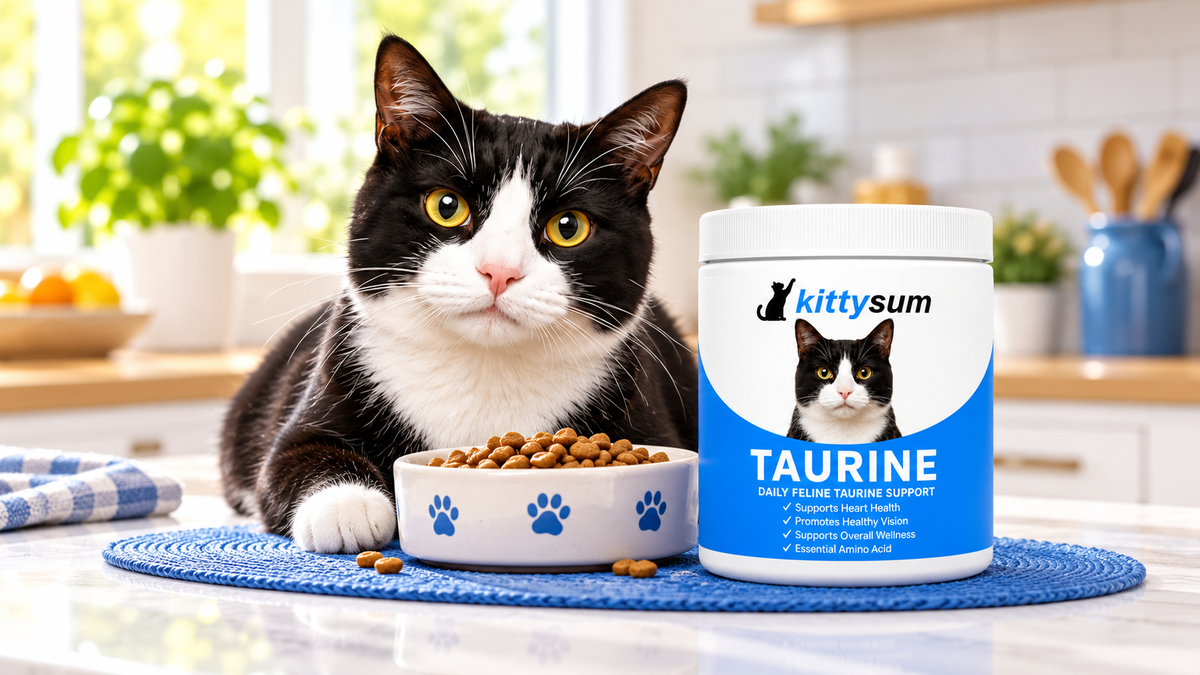
Kittysum Taurine is a daily taurine powder in a 200 g tub with a measuring scoop, made to mix into wet food. The scoop makes it easy to repeat the same amount every day. You can read the full ingredient list and serving guide here, and compare it with any natural product you are considering.

Cost Per Mg: Natural Taurine Supplement for Cats vs Powder
Natural products and powders are priced in different ways. So compare like with like.
- First, find the total mg of taurine in the pack.
- Next, divide the price by that total.
- Then add shipping, which can change the real cost.
- Finally, check the return policy before you buy.
In many cases, a natural taurine supplement for cats costs more per mg, since you also pay for meat and processing. That is fine if your cat loves it. Otherwise, a measured powder is often better value. Our guide on where to buy taurine for cats compares places to shop.
A Daily Routine With a Natural Taurine Supplement for Cats
Whatever product you pick, a simple routine keeps intake steady. For example, many owners follow these habits.
- Same meal every day: pair the supplement with breakfast or dinner.
- Small portion first: mix it into a spoonful of wet food, then serve the rest.
- Simple log: tick a note so no one doubles the serving.
- Monthly check: weigh your cat and see how much product is left.
As a result, a natural taurine supplement for cats becomes part of the normal day. In addition, the log helps your vet see exactly what your cat gets. So keep it near the food bowls.
When the routine slips
Missed days happen. In that case, simply resume the normal amount at the next meal. Do not double up to catch up. Above all, steady intake over weeks matters more than any single serving of a natural taurine supplement for cats.
Travel and a Natural Taurine Supplement for Cats
Trips and boarding stays can break routines. For instance, freeze-dried bites travel well but are hard to measure. By contrast, a small bag of pre-measured powder is easy for a sitter to use. Therefore, write the amount on each bag and ask the sitter to log every serving. That way, your natural taurine supplement for cats routine continues even while you are away, and your cat keeps a steady supply. Likewise, pack a spare serving in case of delays. Finally, leave the product label with the sitter, so any vet who sees your cat knows exactly what it takes.
Myths About a Natural Taurine Supplement for Cats
- "Synthetic taurine is fake." No. The molecule is the same as taurine from meat.
- "Natural always means safer." Not necessarily. Safety depends on the full ingredient list and the amount.
- "Natural products need no dosing." They still need a clear daily amount.
- "More meat means more taurine." Amounts vary by cut and processing.
Is taurine safe?
VCA describes taurine supplementation as relatively safe, with no reports of problems from excess dietary taurine in cats. Even so, AAFCO sets no maximum, so follow the label or your vet's amount. Our guide too much taurine for cats explains more.
Common Mistakes With a Natural Taurine Supplement for Cats
- Trusting the front label. Instead, read the ingredient list and taurine figure.
- Ignoring calories. Food-based products can add weight over time.
- Using treats as the only source in a home diet. Use a measured source instead.
- Skipping the vet. Signs like fast breathing need an exam, not a supplement.
Also, the Companion Animals Extension says retinal changes may appear 5 to 6 months into a deficiency, and the landmark 1987 Pion study linked heart failure to low blood taurine. So reliable daily intake matters most.
Questions to Ask Your Vet About a Natural Taurine Supplement for Cats
- Does my cat need extra taurine on this diet?
- Is a food-based product or a measured powder a better fit?
- How many mg a day, and should I split it?
- Do the extra calories matter for my cat?
For diet advice, see the WSAVA guide, and note the VCA supplement guide says the FDA does not review non-drug supplements before sale.
Want a clear amount in every scoop?
Kittysum Taurine is a daily taurine powder in a 200 g tub with a measuring scoop, free shipping on orders over $50 and a 30-day return policy. Ask your vet to confirm the amount. Shop Kittysum Taurine →
Key Terms Explained
- Synthetic taurine: taurine made in a lab; the molecule is the same as taurine from food.
- Food-based source: an ingredient such as heart or liver that naturally contains taurine.
- Freeze-dried: food dried at low temperature to keep it shelf-stable.
- Cost per mg: the price divided by the total mg of taurine in the pack.
- Complete and balanced: a food that meets a standard nutrient profile for its life stage.
Frequently Asked Questions
Is natural taurine better for cats than synthetic?
Not chemically. The taurine molecule is the same. The practical differences are dosing precision, calories and price.
What is a natural source of taurine for cats?
Heart, dark poultry meat, shellfish and some fish are rich sources. Amounts vary by cut and processing.
Can I use freeze-dried heart instead of a supplement?
It can add taurine, but the amount varies. For a set daily amount, a measured powder is easier to rely on.
Does a natural label mean no added taurine?
No. Products called natural may still contain added trace nutrients if the label says so. Read the ingredient list.
Do all cats need a taurine supplement?
No. A healthy cat on a complete and balanced food usually gets enough taurine from meals.
References
- VCA Animal Hospitals. Taurine in Cats.
- VCA Animal Hospitals. Lysine.
- Earle KE, Smith PM. Dietary taurine content and plasma taurine in the cat. Br J Nutr. 1991.
- Pion PD, et al. Myocardial failure in cats with low plasma taurine. Science. 1987.
- Spitze AR, et al. Taurine in animal feed ingredients. 2003.
- Kanakubo K, et al. Protein and amino acids in vegetarian pet diets. 2015.
- AAFCO. Cat Food Nutrient Profiles.
- Merck Veterinary Manual. Nutritional Requirements of Small Animals.
- Merck Veterinary Manual. Dilated Cardiomyopathy.
- WSAVA. Selecting a pet food for your pet.
- Companion Animals Extension. Taurine Requirement of Cats.
- AVMA. Dietary supplement law not applicable to products for animals.
This article is for general education and is not veterinary advice. These statements have not been evaluated by the Food and Drug Administration. Kittysum products are not intended to diagnose, treat, cure or prevent any disease.