Key takeaways
- The best omega 3 foods for cats are oily fish that supply EPA and DHA directly.
- Plant sources such as flaxseed give ALA, which cats use poorly.
- Cook fish plain, because raw fish can break down thiamine.
- Pick lower-mercury fish and keep fish to small treat portions.
- A complete cat food stays the base, so talk to your vet before big changes.
The best omega 3 foods for cats are oily fish such as salmon, sardines, herring and mackerel, cooked plain and served in small amounts. These fish supply EPA and DHA, the forms a cat can use right away. Plant oils help much less.
That is the short answer. Still, the details of omega 3 foods for cats matter, because fish can also bring mercury, thiamine problems and too many calories.
Below, we rank common choices, explain the risks and show a simple plan you can review with your vet.
Table of contents
Why Omega 3 Foods for Cats Matter
Omega-3s are fats the body uses in cell walls, the brain and the eyes. The two most useful types for cats are EPA and DHA.
VCA Animal Hospitals explains that EPA and DHA act as anti-inflammatory agents. So vets may add them to plans for skin, joint or kidney problems.
VCA also notes that fish oils may help improve dry skin and give a glossier coat. That is the main reason owners look for omega 3 foods for cats.
However, honesty matters here. For example, the Merck Veterinary Manual says evidence for DHA in feline arthritis is not clear. So think of these foods as nutrition support, not a cure.

Why Animal Omega 3 Foods for Cats Work Best
Cats are obligate carnivores. The Cornell Feline Health Center explains that they rely on nutrients found only in animal products.
Fats follow the same rule. The MSD Veterinary Manual notes that cats cannot readily convert linoleic acid to arachidonic acid. That fat comes from meat, poultry and eggs, not vegetable oils.
A classic 1975 paper by Rivers, Sinclair and Crawford first described this limit in cats. Later, a 1994 study by Pawlosky and colleagues found the key enzyme does exist in cats, but works in a limited way.
So the practical lesson is simple. Give a cat the finished long-chain fats. In other words, choose omega 3 foods for cats that already contain EPA and DHA.
Best sources named by vets
MSD lists the best dietary sources of EPA and DHA as oily fish, krill oil and algae oil. Oily fish is the one most owners already have at home.
The Best Fish as Omega 3 Foods for Cats
The NIH Office of Dietary Supplements lists cold-water fatty fish such as salmon, mackerel, herring and sardines as rich sources of long-chain omega-3s.
Here is how the top omega 3 foods for cats compare, based on that NIH table. Note that NIH measures a 3-ounce human serving, which is far more than a cat treat.
Salmon
Salmon tops the list of omega 3 foods for cats. Farmed Atlantic salmon has about 1.24 g DHA and 0.59 g EPA per 3 ounces cooked. Wild Atlantic salmon is close behind.
Herring
Atlantic herring has about 0.94 g DHA and 0.77 g EPA per 3 ounces. Because it is small and oily, it is also a lower-mercury pick.
Sardines
Sardines have about 0.74 g DHA and 0.45 g EPA per 3 ounces in the NIH table. They are another popular choice among omega 3 foods for cats.
Atlantic mackerel
Atlantic mackerel has about 0.59 g DHA and 0.43 g EPA. However, do not confuse it with king mackerel, which is a high-mercury fish.
Light tuna
Canned light tuna is much lower, at about 0.17 g DHA and 0.02 g EPA. So tuna is a weak omega-3 source despite its fishy appeal. Our can cats eat tuna guide explains its other limits.
Omega 3 Foods for Cats Compared
This table pulls the key facts on omega 3 foods for cats together. Use it as a talking point with your vet.
| Food | EPA + DHA (per 3 oz, NIH) | Mercury (FDA list) | Cat notes |
|---|---|---|---|
| Salmon, farmed Atlantic | About 1.83 g | Best choice | Cook plain, small piece |
| Atlantic herring | About 1.71 g | Best choice | Cook plain |
| Sardines | About 1.19 g | Best choice | Fresh and cooked is simpler |
| Atlantic mackerel | About 1.02 g | Best choice | Avoid king mackerel |
| Light tuna, canned | About 0.19 g | Best choice | Low omega-3, treat only |
| Flaxseed oil | ALA only | Not a fish | Weak for cats |
The EPA plus DHA column adds the two NIH figures together. Mercury labels come from the FDA's advice for people, because no cat-specific list exists.
Plant Omega 3 Foods for Cats Fall Short
Flaxseed, chia and hemp give a plant omega-3 called ALA. Even in people, the NIH says ALA converts to EPA and DHA at low rates, often under 15%.
Cats appear to do no better. In fact, VCA's flaxseed oil page says its effectiveness may be questionable in cats.
So plant oils are not true omega 3 foods for cats in a practical sense. If you want EPA and DHA, choose fish or an algae or fish-based product your vet approves.

Mercury and Omega 3 Foods for Cats
Mercury builds up most in large, long-lived fish. The FDA advice about eating fish puts salmon, sardines, anchovy, herring and Atlantic mackerel among its best choices.
On the other hand, the FDA lists king mackerel, bigeye tuna, marlin, shark, swordfish and orange roughy as choices to avoid. That advice targets people, yet it is a sensible filter for pets too.
Also, the FDA notes that albacore tuna has about three times more mercury than canned light tuna, per its fish advice questions and answers.
So the safest omega 3 foods for cats are small oily fish from the best-choice list.
Raw Fish Risk in Omega 3 Foods for Cats
Raw fish carries a hidden problem. According to VCA's thiamine page, raw fish contains enzymes called thiaminases, which break down vitamin B1.
Thiamine is vital for the nerves. Fortunately, VCA and MSD both say cooking destroys thiaminases.
That is why we suggest only cooked omega 3 foods for cats. Bake, poach or steam it plain, then let it cool before serving.
Canned fish meant for people
Cornell adds a caution about human canned fish. It reports that some cats eating canned fish products meant for people developed serious nerve problems.
So fresh fish you cook yourself is the simpler choice. If you want to use canned fish, ask your vet first.
Too Many Omega 3 Foods for Cats
More is not better. The Merck Veterinary Manual links most cases of yellow fat disease in cats to diets made partly or fully of fish.
Merck explains the likely cause as too much unsaturated fat with too little vitamin E. MSD also reports vitamin E deficiency in cats fed large amounts of canned tuna.
Calories matter too. WSAVA suggests treats stay at no more than about 10% of daily calories. Cornell gives a range of 10 to 15 percent.
Because of this, keep omega 3 foods for cats as small extras on top of a complete food.
How to Serve Omega 3 Foods for Cats
Here is a simple, step-by-step plan for omega 3 foods for cats. Review it with your vet first, especially if your cat has a health condition.
- Ask your vet. Share why you want more omega-3s.
- Pick a low-mercury fish. Salmon, sardines or herring are good starting points.
- Cook it plain. Skip salt, butter, onion and garlic.
- Start small. Offer a fingertip-sized piece at first.
- Stay under the treat limit. Keep all treats near 10% of daily calories.
- Watch the results. Note stool, appetite and coat over a few weeks.
If stools turn loose, cut back. If your cat refuses fish, that is fine too, since a complete food already covers basic needs.

Omega 3 Foods for Cats vs Supplements
Omega 3 foods for cats and supplements each have a place. Fish treats are easy and tasty, but the omega-3 amount changes from piece to piece.
In contrast, a supplement gives a steady, measured dose. Our fish oil for cats guide and omega-3 for cats guide cover those products in depth.
Be careful with cod liver oil, though. It adds vitamins A and D, so read our cod liver oil for cats guide before you buy.
VCA also lists fish oil side effects, such as stomach upset, a fishy odor and, especially in cats, unusual bruising or bleeding. So any supplement belongs in a vet-guided plan.
Prefer a measured daily serving
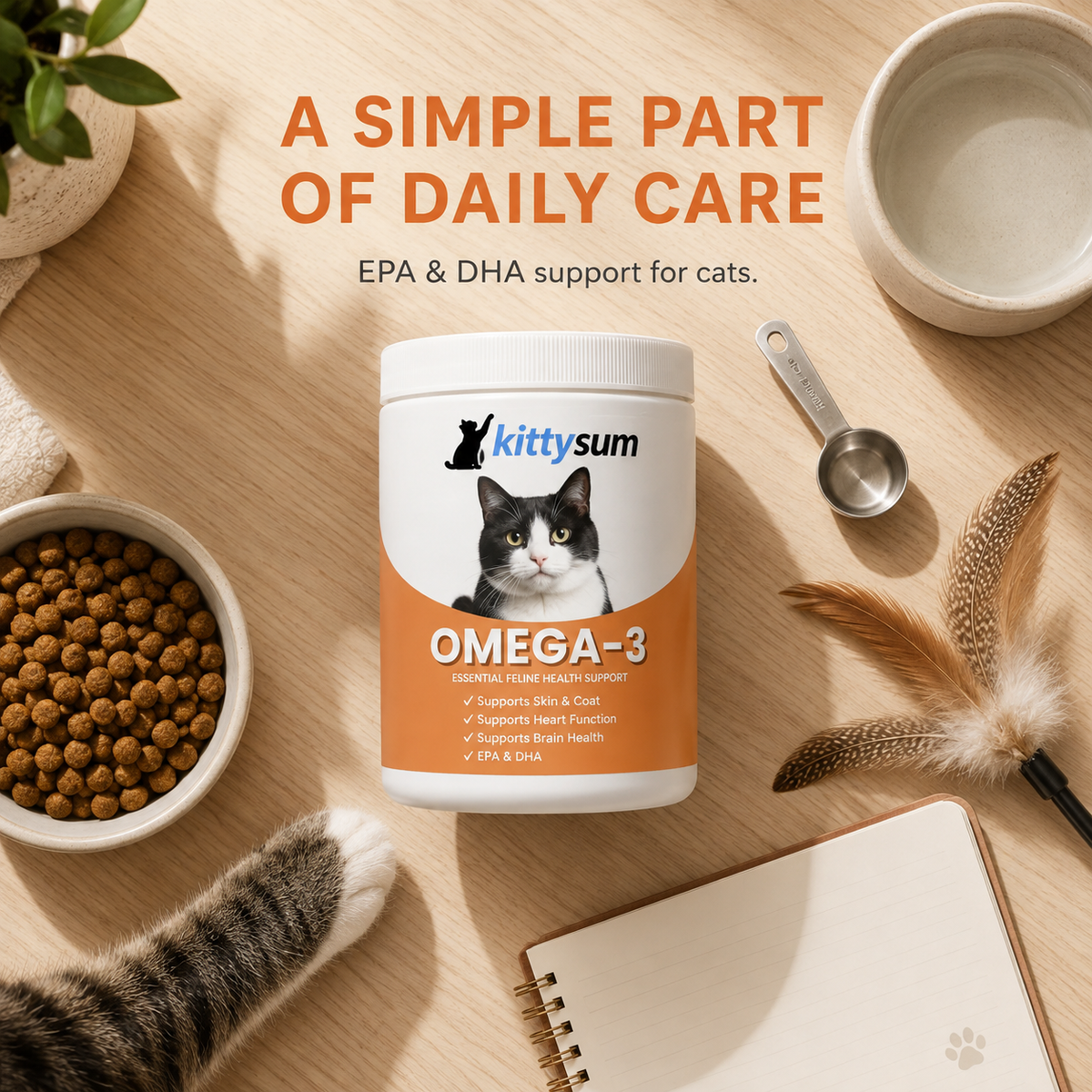
Kittysum Omega-3 is a daily omega-3 powder made for cats, with label serving directions by weight. It is nutrition support, not a treatment. Ask your vet to confirm it fits your cat's diet. Shop Kittysum Omega-3 →
Common Mistakes With Omega 3 Foods for Cats
- Serving raw fish, which can lower thiamine.
- Using fish cooked with onion, garlic or heavy salt.
- Letting fish replace the complete food.
- Choosing high-mercury fish like swordfish or king mackerel.
- Counting on flaxseed to supply EPA and DHA.
- Adding several oils at once without a vet's plan.
Each of these mistakes with omega 3 foods for cats is easy to fix. Next time, start with one plain, cooked, low-mercury fish in a tiny portion.
Other Omega 3 Foods for Cats to Know
Fish is not the only option. MSD also names krill oil and algae oil as strong sources of EPA and DHA.
Krill oil
Krill are tiny sea animals, so krill oil counts as an animal source. However, few studies look at krill in cats, so treat it as a product question for your vet rather than a kitchen food.
Algae oil
Algae oil is where fish get much of their DHA in the first place. Because it is plant-like yet supplies DHA directly, some owners pick it to avoid fish. Again, ask your vet about the amount.
Meat, poultry and eggs
These foods are not rich in omega-3s. Still, MSD notes they supply arachidonic acid, a fat cats need from animal sources. So a meat-based complete food covers part of the fat picture on its own.
Reading Labels for Omega 3 Foods for Cats
Your cat's main food may already add omega-3s. So check the label before you add omega 3 foods for cats on top.
- Look for a complete and balanced statement. Cornell explains that foods meeting AAFCO profiles count as complete.
- Scan the ingredients. Fish oil, salmon oil or algae oil near the middle of the list suggests added omega-3s.
- Check for EPA and DHA figures. If the label lists them, note the amounts for your vet.
- Note special diets. Some vet diets already contain set omega-3 levels, so extra fish may upset the balance.
As a result, you may find that your cat already gets a steady base. In that case, omega 3 foods for cats become an occasional bonus rather than a must.
Omega 3 Foods for Cats by Life Stage
Kittens
Kittens grow fast and need a growth formula. Therefore, keep extras very small and ask your vet first. Our omega-3 for kittens guide explains more.
Adult cats
Healthy adults on a complete food rarely need extra fish. Even so, a small piece of cooked salmon can be a welcome treat.
Senior cats
Older cats often eat less, so every bite counts. For this reason, ask your vet whether omega 3 foods for cats fit alongside any kidney or heart diet.
Tips for Picky Eaters
Some cats love fish, while others ignore it. That is normal, and it does not mean your cat is missing out. After all, many healthy cats never eat fish treats at all. If your cat turns away, try these simple ideas.
- Warm the cooked fish slightly to boost its smell.
- Flake it into tiny pieces over the usual food.
- Try a different fish, such as herring instead of salmon.
- Offer it at the start of a meal, when your cat feels hungriest.
If none of these work, that is fine. In short, your cat does not need fish to stay healthy on a complete diet, and a vet-approved supplement can fill the gap if needed.
When to Talk to Your Vet
Talk to your vet before adding omega 3 foods for cats if your cat has kidney disease, a bleeding disorder, pancreatitis or a food allergy.
Also ask if your cat takes blood thinners. VCA advises caution with fish oil in those cases.
Finally, call your vet if your cat vomits, has ongoing diarrhea or bruises easily after a diet change.

Key Terms
- EPA: eicosapentaenoic acid, a long-chain omega-3 from fish.
- DHA: docosahexaenoic acid, a long-chain omega-3 important for the brain and eyes.
- ALA: alpha-linolenic acid, the plant omega-3 in flaxseed and chia.
- Thiaminase: an enzyme in some raw fish that breaks down vitamin B1.
- Yellow fat disease: fat inflammation linked to fish-heavy diets low in vitamin E.
Frequently Asked Questions
What foods have omega 3 for cats
Oily fish such as salmon, sardines, herring and mackerel supply the most EPA and DHA. Cook them plain and serve them as small treats on top of a complete food.
Is flaxseed a good omega 3 source for cats
Not a strong one. Flaxseed gives plant omega-3, and VCA notes its effectiveness may be questionable in cats. Fish-based sources supply EPA and DHA directly.
Can I give my cat canned salmon or sardines
Ask your vet first. Cornell warns that some cats fed canned fish meant for people developed serious nerve problems. Plain cooked fresh fish, with no onion, garlic or salt, is the simpler treat.
How often can cats eat fish for omega 3
Keep fish as an occasional treat rather than a main meal. Fish-heavy diets have been linked to vitamin E problems in cats, so the complete food should stay the base.
References
- NIH Office of Dietary Supplements. Omega-3 Fatty Acids: Health Professional Fact Sheet.
- U.S. Food and Drug Administration. Advice About Eating Fish.
- U.S. Food and Drug Administration. Questions and Answers from the FDA/EPA Advice about Eating Fish.
- Cornell Feline Health Center. Feeding Your Cat.
- VCA Animal Hospitals. Fish Oil.
- VCA Animal Hospitals. Fish oils: the hardworking supplement with many uses.
- VCA Animal Hospitals. Thiamine.
- VCA Animal Hospitals. Flaxseed Oil.
- MSD Veterinary Manual. Nutritional Requirements of Small Animals.
- Merck Veterinary Manual. Muscle Disorders in Cats.
- Merck Veterinary Manual. Osteoarthritis in Dogs and Cats.
- WSAVA. Frequently Asked Questions and Myths.
- Rivers JP, Sinclair AJ, Crawford MA. Inability of the cat to desaturate essential fatty acids. Nature. 1975.
- Pawlosky R, Barnes A, Salem N Jr. Essential fatty acid metabolism in the feline. J Lipid Res. 1994.
This article is for general education and is not veterinary advice. These statements have not been evaluated by the Food and Drug Administration. Kittysum products are not intended to diagnose, treat, cure or prevent any disease.