
Key takeaways
- Taurine treats for cats are snacks with added taurine, but the amount per treat is often small.
- Treats add calories, so they work best as a bonus, not as the main taurine source.
- Powder is easier to measure, split and adjust for cats on homemade or raw food.
- Compare products by mg of taurine per serving and cost per mg, not by price per bag.
- A healthy cat on complete food usually needs no supplement, so ask your vet first.
Taurine treats for cats are snacks or soft chews with added taurine. Many owners like them because cats eat them happily. However, a treat is not always the best way to deliver a set daily amount.
This guide compares treats with powder, shows how to read a treat label, and helps you pick the form that fits your cat and your routine.
Not sure your cat needs extra taurine? Read do cats need taurine supplements first.
Table of contents
What Are Taurine Treats for Cats?
Taurine treats for cats are snacks with taurine added during making. Some are crunchy bites, while others are soft chews or lickable pastes. Most also contain meat, fish or liver for flavor.
Taurine itself is an amino acid found only in animal tissue. In fact, Merck notes that plant protein contains none. Also, VCA Animal Hospitals explains that cats need it for vision, heart muscle function, digestion and growth.
Does your cat need extra taurine at all?
First, look at the bowl. VCA says a healthy cat eating a high-quality food for its life stage does not require supplementation. However, cats on homemade, raw or vegetarian diets may need extra. Also, Merck notes that taurine-related heart disease is still seen in cats fed vegetarian, baby or home-cooked food.

Types of Taurine Treats for Cats
Treats come in several styles. Each has strengths and limits, so here is a quick tour.
Crunchy bites
First, crunchy bites are easy to store and count. However, they tend to be small, so the taurine per bite is often low. Also, some contain grain or plant fillers.
Soft chews
Next, soft chews are popular with older cats and cats with sore teeth. On the other hand, they often carry more calories per piece. So check the label before you give several a day.
Lickable pastes
Meanwhile, lickable tubes are a favorite with picky cats. In addition, some owners use them to hide pills. Still, many tubes list no taurine figure at all, which makes dosing a guess.
Freeze-dried meat
Finally, freeze-dried heart or liver bites are naturally rich in taurine. For example, heart muscle is one of the best natural sources. Even so, the exact amount varies by batch, and these bites are not complete meals. Our guide to taurine foods for cats lists natural sources in more detail.
In short, taurine treats for cats differ a lot from brand to brand. Therefore, read every label, even within the same style.
Taurine Treats for Cats vs Powder at a Glance
Both forms deliver the same nutrient. So the real differences are measuring, calories and routine.
| Point | Treats | Powder |
|---|---|---|
| How you measure | Per treat or chew | Per scoop, easy to split |
| Taurine per serving | Often small, varies a lot | Set by the scoop size |
| Calories | Adds calories each day | Very few calories |
| Picky cats | Often eaten by hand | Mixed into strong wet food |
| Homemade or raw diets | Hard to hit a set target | Easy to weigh and adjust |
In short, taurine treats for cats suit treat-loving cats, while powder suits owners who need a set daily amount.
How Much Taurine Is in Taurine Treats for Cats?
This is the most important question. Unfortunately, many treat labels give only a guaranteed minimum per kg, or no number at all. As a result, you may need to work it out.
- Find mg per kg or mg per treat. First, look for a taurine figure on the label.
- Check the weight of one treat. Next, use the label or a kitchen scale.
- Multiply. Then multiply mg per kg by the treat weight in kg.
- Compare with your target. Finally, compare that with the amount your vet suggests.
For context, a 1991 Waltham study found cats need at least 39 mg per kg of body weight a day on canned food and 19 mg per kg on dry food. Those figures are for the whole diet, not just the treat. Still, they show why a few small treats may not move the needle.
Why this matters most for home diets
Cats on complete food already get most of their taurine from meals. However, cats on homemade or raw food may rely on the added source. In that case, a treat with an unknown amount is risky. So taurine treats for cats should not be the only source in a home-made diet.

Calories in Taurine Treats for Cats
Treats add calories every day. A common rule of thumb is to keep treats to about 10 percent of daily calories. Otherwise, extra weight can creep on.
- Check the calories per treat on the label.
- Count every treat, not just the taurine ones.
- Cut back meal size slightly if you add daily treats.
- Weigh your cat each month if you are unsure.
By contrast, a scoop of powder adds almost no calories. Therefore, powder is often the better daily choice for cats that need to watch their weight. That said, taurine treats for cats can still play a small role as a reward.
How to Read a Label for Taurine Treats for Cats
Before you buy, run through these checks.
- Taurine amount. First, look for mg per treat or mg per kg.
- Calories per treat. Next, check how many you can give within the daily limit.
- The full ingredient list. Then look for allergens, sweeteners or fillers.
- The product type. Also, treats are not complete meals, so the label should say so.
- Lot number and date. Finally, a batch code allows tracing and recalls.
VCA warns that supplement quality may vary significantly among makers. In addition, the AVMA reports that the main US dietary supplement law does not apply to animal products. So the label is your best guide.
When Taurine Treats for Cats Make Sense
Treats are not a bad choice. Instead, they simply fit some cats better than others.
- Healthy cats on complete food. Here, a treat is a bonus, not a rescue.
- Cats that refuse mixed food. A hand-fed chew may be easier.
- Training and bonding. Rewards can carry a little extra nutrition.
- Short trips. Sealed treats travel well.
In these cases, taurine treats for cats are a pleasant extra. Still, check the calories and keep portions small.
When Powder Beats Taurine Treats for Cats
Powder is usually the better tool when the amount matters. For example, cats on homemade or raw diets need a reliable, measured source. Likewise, a vet plan with a set mg target is easier to follow with a scoop.
- Easy to split. Half a scoop at breakfast and half at dinner is simple.
- Easy to adjust. You can follow your vet's changes exactly.
- Almost no calories. Weight stays easier to manage.
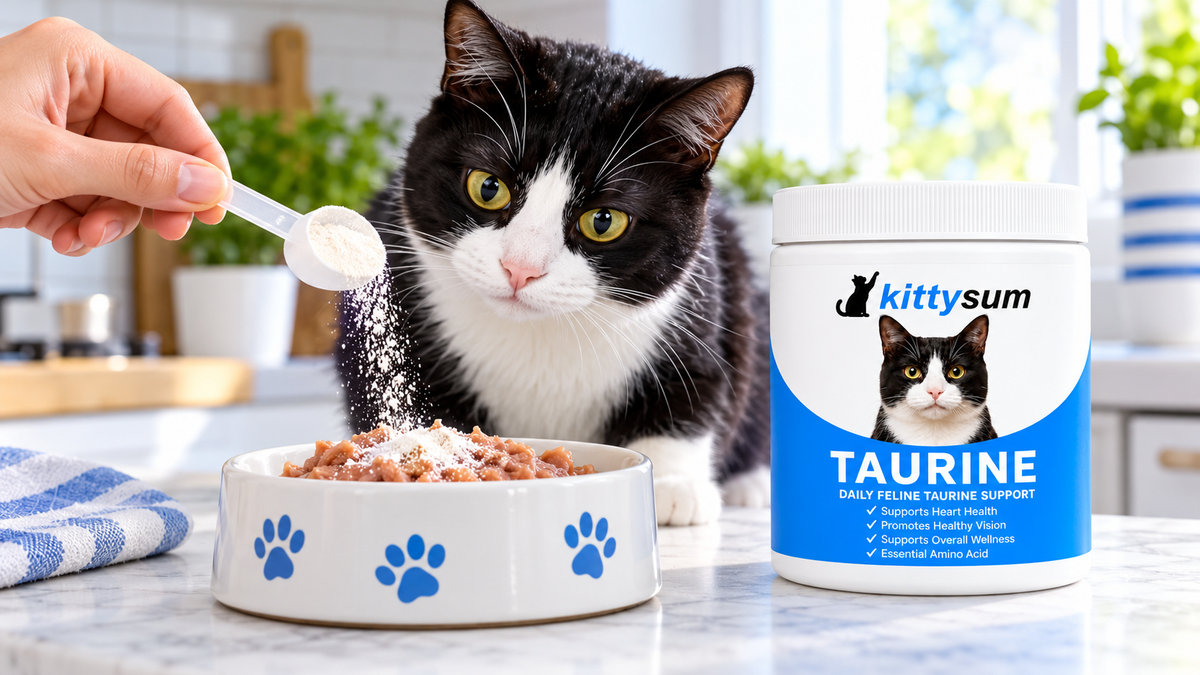
- Works in recipes. Add it to cooled homemade food in seconds.
That is why Kittysum makes its taurine as a powder in a 200 g tub with a measuring scoop. You can read the full label and pack options here, and compare it with any treat you are considering.

Add powder after cooking
If you cook for your cat, stir the powder into cooled food. A UC Davis study found that cooking, especially boiling, lowers taurine in meat. Our guide on how to add taurine to cat food has step-by-step tips.
Can You Use Taurine Treats for Cats and Powder Together?
Yes, many owners do. For instance, they use powder as the measured daily source and treats as an occasional reward. That way, the core amount stays steady, while the cat still enjoys a snack.
However, count both toward the daily total. Also, tell your vet about every product you use, so nothing doubles up. VCA calls supplementation relatively safe, with no reports of problems from excess dietary taurine in cats. Even so, AAFCO sets no maximum, so use the label or your vet's amount.
Comparing the Cost of Taurine Treats for Cats
Treats and powders are priced in very different ways. So compare like with like.
- First, find the total mg of taurine in the pack.
- Next, divide the price by that total to get the cost per mg.
- Then add shipping, since it can change the real cost a lot.
- Finally, check the return policy before you buy.
In many cases, taurine treats for cats cost more per mg because you also pay for flavor and filler. On the other hand, a multi-pack of powder that reaches a free-shipping threshold can lower the cost per tub. Our guide on where to buy taurine for cats compares places to shop.
Picky Cats: Taurine Treats for Cats or Powder?
Picky cats are the main reason owners try treats. Indeed, a cat that sniffs at mixed food may take a chew from your hand. Still, many picky cats also accept powder when it is hidden well.
- Start with a pinch of powder in a strong-smelling pâté.
- Offer the mixed portion first, then the rest of the meal.
- Build up to the full amount over several days.
- Use a treat as a reward right after the meal.
Our guide to taurine powder for cats has more tips for fussy eaters.

Storing Taurine Treats for Cats and Powder
Good storage keeps every serving the same. So follow the label first, and then use these simple habits.
- Seal the bag. Air and moisture can make treats stale or moldy.
- Keep it cool and dry. Heat can change texture and taste.
- Note the opening date. Use soft chews within the time on the pack.
- Use a dry scoop for powder. Wet scoops cause clumps.
Also, keep taurine treats for cats out of reach, since some cats will raid an open bag. As a result, a cat can eat a whole day's calories in minutes.
Common Mistakes With Taurine Treats for Cats
- Assuming treats cover the need. Without a mg figure, you cannot know. Instead, check the label first.
- Ignoring calories. Daily treats add up fast, so count them.
- Using treats as the only source in a home diet. Use a measured powder instead.
- Feeding dog treats. They are not made for a cat's needs.
- Skipping the vet. Signs like fast breathing need an exam, not a snack.
Also, the Companion Animals Extension says retinal changes may appear 5 to 6 months into a deficiency. So steady daily intake matters more than an occasional treat.
A Sample Week Using Powder and Taurine Treats for Cats
Here is one way a busy owner might combine both forms. Of course, your vet's plan comes first.
- Every morning: mix the measured powder into a small portion of wet food.
- Every evening: serve the normal meal, plus a second split dose if your vet suggests it.
- A few times a week: offer one treat as a reward after brushing or play.
- Once a month: weigh your cat and check how much powder is left.
In this plan, the powder does the real work, while the treat adds fun. As a result, the daily amount stays steady and calories stay in check. Similarly, a pet sitter can follow the same list with no guesswork. So whether you use taurine treats for cats or not, the measured source stays the backbone of the routine.
Questions to Ask Your Vet About Taurine Treats for Cats
- Does my cat need extra taurine on this diet?
- Are taurine treats for cats enough, or should I use a powder?
- How many mg a day, and should I split it?
- How many treats fit my cat's daily calories?
For context, the landmark 1987 Pion study linked heart failure to low blood taurine. In addition, a 2015 study found three of seven vegetarian canned diets below the AAFCO minimum. For diet advice, see the WSAVA guide, and note the VCA supplement guide says the FDA does not review non-drug supplements before sale.
Need a measured daily amount?
Kittysum Taurine is a daily taurine powder in a 200 g tub with a measuring scoop, free shipping on orders over $50 and a 30-day return policy. Ask your vet to confirm the amount. Shop Kittysum Taurine →
Key Terms Explained
- Treat: a snack fed in addition to meals, not a complete diet.
- mg per treat: how much taurine one chew or bite holds.
- Cost per mg: the price divided by the total mg of taurine in the pack.
- Complete and balanced: a food that meets a standard nutrient profile for its life stage.
- Lot number: a batch code that lets the maker trace and recall a product.
Frequently Asked Questions
Are taurine treats for cats enough on their own?
Often not. Many treats hold a small or unstated amount. For cats that need a set daily amount, a measured powder is easier to rely on.
Are taurine treats better than powder?
Treats suit treat-loving cats as a bonus. Powder is easier to measure, split and adjust, and adds almost no calories.
How many taurine treats can my cat have?
Keep all treats to about 10 percent of daily calories, and check the label. Your vet can give a number for your cat.
Can I give taurine treats and powder together?
Yes. Use powder as the measured source and treats as a reward, and count both toward the daily total.
Do healthy cats need taurine treats?
Usually not. A healthy cat on a complete and balanced food gets enough taurine from meals.
References
- VCA Animal Hospitals. Taurine in Cats.
- VCA Animal Hospitals. Lysine.
- Earle KE, Smith PM. Dietary taurine content and plasma taurine in the cat. Br J Nutr. 1991.
- Pion PD, et al. Myocardial failure in cats with low plasma taurine. Science. 1987.
- Spitze AR, et al. Taurine in animal feed ingredients. 2003.
- Kanakubo K, et al. Protein and amino acids in vegetarian pet diets. 2015.
- AAFCO. Cat Food Nutrient Profiles.
- Merck Veterinary Manual. Nutritional Requirements of Small Animals.
- Merck Veterinary Manual. Dilated Cardiomyopathy.
- WSAVA. Selecting a pet food for your pet.
- Companion Animals Extension. Taurine Requirement of Cats.
- AVMA. Dietary supplement law not applicable to products for animals.
This article is for general education and is not veterinary advice. These statements have not been evaluated by the Food and Drug Administration. Kittysum products are not intended to diagnose, treat, cure or prevent any disease.