

Key takeaways
- Taurine per pound of cat food depends on the food's water content, so start from dry matter.
- AAFCO sets a taurine minimum of 0.20% of dry matter for canned-style food and 0.10% for dry food.
- For a typical homemade wet recipe, that minimum works out to roughly 230 to 270 mg per pound in total.
- Recipes add taurine above the minimum because grinding, freezing and cooking cause losses.
- Always follow your veterinary nutritionist's recipe amount and measure with a scoop or scale.
Taurine per pound of cat food is the number every home cook eventually needs. Recipes, labels and studies use different units, so it is easy to end up confused. This guide turns the official minimums into simple mg per pound.
You will learn the formula, see a worked example for a typical homemade batch, and understand why most recipes add more than the minimum. Finally, you will see how to measure accurately.
New to taurine? Start with our guide to taurine for cats.
Table of contents
Why Taurine per Pound of Cat Food Matters
Taurine is an amino acid cats must get from animal tissue. In fact, Merck notes that plant protein contains none. Also, VCA Animal Hospitals explains that cats need it for vision, heart muscle function and digestion.
Commercial complete foods already include enough. However, homemade and raw diets depend entirely on the cook. Therefore, knowing the taurine per pound of cat food helps you check a recipe, scale it up or down, and spot a mistake before it matters.

Units Explained: Percent, Dry Matter and mg
Different sources use different units, so taurine per pound of cat food is rarely printed anywhere. For example, AAFCO uses percent of dry matter, studies use mg per kg of body weight, and recipes often use mg per batch. So start with three simple ideas.
- Dry matter (DM): the food with all water removed.
- Percent of DM: 0.20% means 2 g of taurine per 1,000 g of dry matter.
- Moisture: homemade wet food is often 70 to 80 percent water.
Because water has no taurine, the same recipe can look very different per pound depending on how wet it is. That is the key to taurine per pound of cat food.
AAFCO Minimums Behind Taurine per Pound of Cat Food
The AAFCO cat food nutrient profiles set two taurine minimums on a dry matter basis.
- Canned or wet-style food: 0.20% of dry matter.
- Dry, extruded food: 0.10% of dry matter.
The wet minimum is higher because cats absorb taurine less well from heat-processed canned food. Homemade recipes are wet, so most cooks use the 0.20% figure. Also, AAFCO sets no maximum for taurine. Our guide to taurine in dry cat food explains the dry-food side.
The Formula for Taurine per Pound of Cat Food
Here is the simple formula. First, find the dry matter in one pound. Then multiply by the minimum percentage.
- One pound equals 454 g.
- Estimate moisture. Many meat-based homemade recipes are around 70 to 75 percent water.
- Find dry matter. At 72 percent moisture, dry matter is 28 percent of 454 g, about 127 g.
- Apply the minimum. 0.20% of 127 g is about 0.25 g, or roughly 254 mg.
In short, taurine per pound of cat food for a typical wet recipe is roughly 230 to 270 mg at the AAFCO minimum. This is the total from all ingredients, not just the supplement.
Taurine per Pound of Cat Food: Quick Table
Here is a quick table at the 0.20% dry matter minimum.
| Moisture | Dry matter per lb | Minimum taurine per lb |
|---|---|---|
| 80% | 91 g | about 180 mg |
| 75% | 114 g | about 230 mg |
| 72% | 127 g | about 255 mg |
| 70% | 136 g | about 270 mg |
| 10% (dry food, 0.10%) | 409 g | about 410 mg |
Use the row closest to your recipe. However, treat these as minimums, not targets, for taurine per pound of cat food.
Worked Example: A 3-Pound Homemade Batch
Suppose your vet-built recipe makes a 3 lb batch at about 72 percent moisture. Then the minimum total taurine is about 3 x 255 mg, or roughly 765 mg for the whole batch.
Meat and heart already supply some of that. Still, recipes usually add a measured powder on top, often well above the minimum, for the reasons below. For example, if your nutritionist sets 1,000 mg per batch and your scoop holds 250 mg, you add four level scoops.
- Batch size: 3 lb.
- Minimum total: about 765 mg.
- Recipe amount: whatever your nutritionist sets.
- Scoops: recipe mg divided by mg per scoop.
In other words, the taurine per pound of cat food check tells you whether a recipe is in a safe range, while the recipe tells you exactly what to add.

Why Recipes Add More Than the Minimum
Taurine dissolves in water and leaks out easily, which makes taurine per pound of cat food harder to predict. In fact, a UC Davis study found that cooking, especially boiling, lowers taurine in meat. Also, grinding and freezing let juices escape during thawing.
- Cooking: boiling loses the most; baking and roasting lose less.
- Thawing: taurine leaves with the juices.
- Grinding: more surface area means more leakage.
- Batch variation: meat cuts differ from week to week.
Therefore, most recipes add a measured powder after cooking, at mixing time. As a result, taurine per pound of cat food stays above the minimum even when losses vary. Our guide to taurine for raw fed cats covers the thawing step.
A Daily Check Using Body Weight
You can also check from the cat's side. A 1991 Waltham study found cats need at least 39 mg of taurine per kg of body weight a day on canned food and about 19 mg per kg on dry food.
For example, a 4 kg cat on wet food needs about 156 mg a day in total. If that cat eats about 200 g of food a day, the food must supply at least 156 mg in 200 g. That equals roughly 350 mg per pound. So the body-weight check is often stricter than the AAFCO minimum. This is another reason recipes add a margin above the minimum taurine per pound of cat food.
Measuring Taurine Accurately
Small amounts are easy to get wrong. So use the right tools to hit your taurine per pound of cat food target.
- Know the mg per scoop: read it on the label.
- Use level scoops: scrape the top flat with a knife.
- Consider a mg scale: jewelry scales measure to 0.01 g.
- Mix in a small portion first: then stir it through the whole batch.
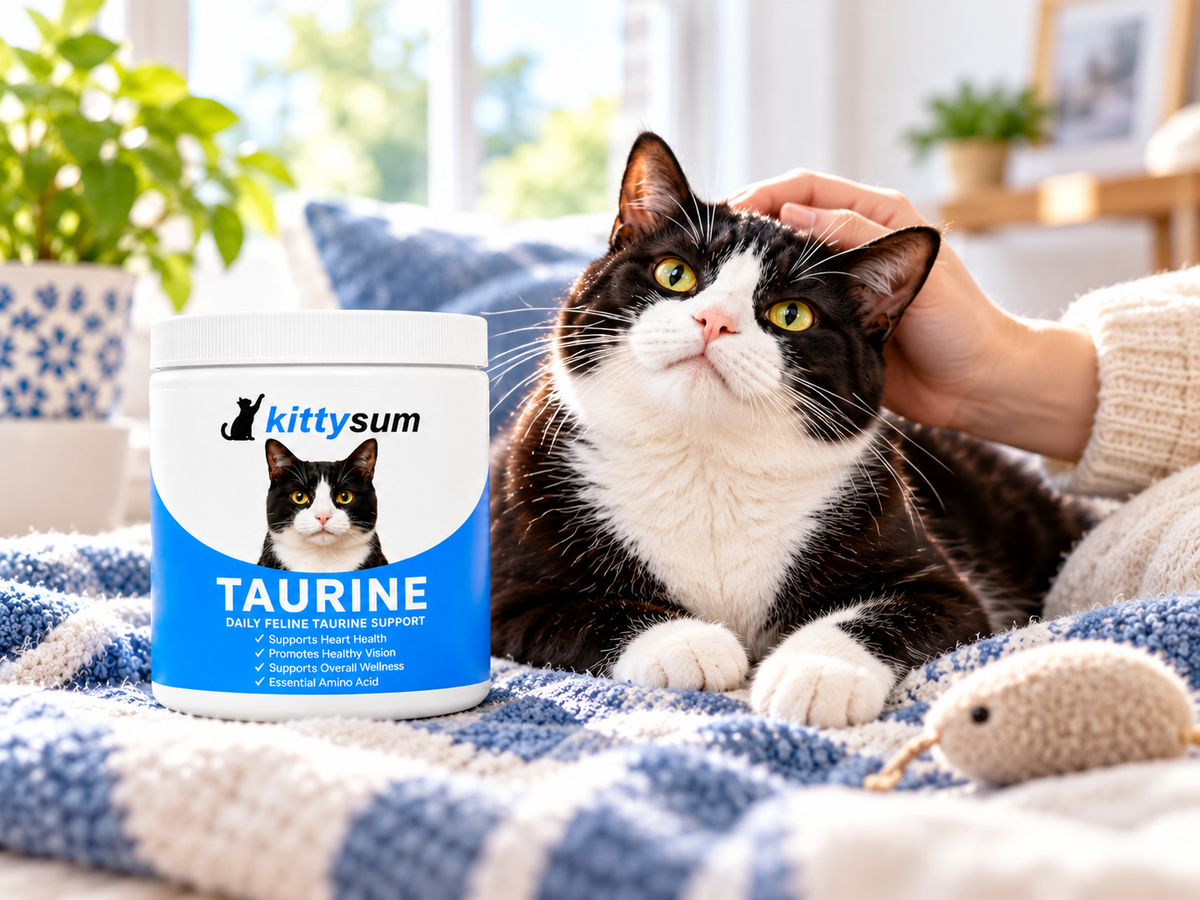
Kittysum Taurine is a daily taurine powder in a 300 g tub with a measuring scoop, blended with chicken liver for a meaty smell. You can read the label and serving guide here. For amounts per cat, see our guide to taurine dosage for cats.

Batch Steps for Taurine per Pound of Cat Food
Here is a simple routine for every homemade batch, so taurine per pound of cat food stays on target.
- First, weigh the finished batch in pounds.
- Next, multiply by the recipe's mg per pound.
- Then divide by the mg in one level scoop.
- After that, add the powder once the food has cooled.
- Finally, mix well and portion into daily containers.
As a result, every portion holds the same amount. Our guide to taurine for homemade cat food explains cooking and cooling.
Taurine per Pound of Cat Food in Kilograms
Some recipes use metric units. Fortunately, the conversion is simple: one kilogram equals about 2.2 pounds. So multiply the mg per pound by 2.2 to get mg per kilogram.
- 230 mg per pound: roughly 500 mg per kilogram.
- 255 mg per pound: roughly 560 mg per kilogram.
- 270 mg per pound: roughly 600 mg per kilogram.
Likewise, divide by 2.2 to go the other way. As a result, you can compare a metric recipe with taurine per pound of cat food in seconds. Above all, keep one unit system per recipe card to avoid mix-ups.
Portioning Taurine per Pound of Cat Food
Good math only helps if every portion gets its share. Therefore, mix the powder through the whole batch before you divide it. Then portion the food into containers sized for one or two days.
- First, label each container with the date.
- Next, refrigerate what you will use within two to three days.
- Then freeze the rest in flat bags so it thaws evenly.
- Finally, keep any thaw juices with the food.
In short, careful portioning keeps taurine per pound of cat food the same from the first meal to the last. Similarly, a written batch log helps your vet if anything changes.
Raw Recipes and Taurine per Pound of Cat Food
Raw recipes skip cooking losses, yet thawing still drains taurine. Moreover, raw diets carry germ risks, and the AVMA discourages feeding raw animal protein to pets. If you still feed raw, keep these points in mind.
- Keep thaw juices in the bowl.
- Add the powder at serving time, not before freezing.
- Follow the recipe's mg per pound exactly.
- Thaw in the fridge, never on the counter.
In short, taurine per pound of cat food still matters with raw diets, because thawing and handling cause losses.
What About Commercial Food?
A food labeled complete and balanced already meets the AAFCO minimum. So you do not need to calculate taurine per pound of cat food for it. Likewise, VCA says a healthy cat on a complete food does not require supplementation.
However, mixing homemade and commercial food changes the picture. For example, half commercial and half homemade means the homemade half must still meet the minimum on its own. Our guide to whether cats need taurine supplements has a full checklist.
Label Units and Taurine per Pound of Cat Food
Supplement labels list taurine in different ways. For example, one brand lists mg per scoop, while another lists mg per gram of powder. So convert everything to mg per scoop before you plan a batch.
- mg per scoop: use it directly in your batch math.
- mg per gram: multiply by the grams in one level scoop.
- Percent taurine: 50 percent means 500 mg in each gram.
Then write the result on your recipe card. As a result, every batch uses the same number, and taurine per pound of cat food stays consistent even if you change brands. Also, check whether the powder includes a flavor base, since that changes the grams per scoop.
Common Mistakes With Taurine per Pound of Cat Food
- Using dry food numbers for wet recipes. Use the 0.20% wet minimum.
- Forgetting water content. Always start from dry matter.
- Adding taurine before cooking. Add it after the food cools.
- Using kitchen spoons. Use a level scoop or a scale.
- Treating the minimum as the target. Recipes add a margin for losses.
Avoiding these mistakes keeps your taurine per pound of cat food math, and your cat, on track.

Questions to Ask Your Vet About Taurine per Pound of Cat Food
- How many mg of taurine per pound should my recipe contain?
- Does the recipe already count taurine from heart and dark meat?
- Should we test blood taurine after a few months?
- How should I store and portion each batch?
Bring your recipe to the visit, so your vet can check taurine per pound of cat food in one look. Also, the landmark 1987 Pion study linked heart failure in cats to low blood taurine, and Merck explains the heart disease involved.
In addition, the Companion Animals Extension says retinal changes may appear 5 to 6 months into a deficiency, and a 2015 study found three of seven vegetarian canned diets below the AAFCO minimum. VCA describes taurine supplementation as relatively safe, while the AVMA reports that the main US supplement law does not apply to animal products. Finally, see the WSAVA guide for diet advice and the VCA supplement guide on supplement oversight.
Making cat food at home?
Kittysum Taurine is a daily taurine powder blended with chicken liver in a 300 g tub with a measuring scoop, free shipping on orders over $50 and a 30-day return policy. Ask your vet to confirm the recipe amount. Shop Kittysum Taurine →
Key Terms Explained
- Dry matter (DM): what is left of a food after all water is removed.
- Moisture: the water content of a food, often 70 to 80 percent in wet and homemade food.
- Batch: one full portion of a homemade recipe made at once.
- mg: milligram, one thousandth of a gram.
- AAFCO: the US body that publishes nutrient profiles for pet food.
Frequently Asked Questions
How much taurine per pound of homemade cat food?
At the AAFCO wet-food minimum of 0.20% of dry matter, a typical homemade recipe needs roughly 230 to 270 mg per pound in total. Recipes usually add more to cover losses.
Does the minimum include taurine from meat?
Yes. The AAFCO figure is total taurine from all ingredients. Your recipe decides how much powder to add on top.
Why is the wet food minimum higher than dry?
AAFCO sets 0.20% of dry matter for canned-style food and 0.10% for dry food, because cats absorb taurine less well from heat-processed canned food.
Should I add taurine before or after cooking?
After cooking, once the food has cooled. Cooking, especially boiling, lowers taurine.
How do I convert mg per pound into scoops?
Multiply the batch weight in pounds by the mg per pound, then divide by the mg in one level scoop.
References
- VCA Animal Hospitals. Taurine in Cats.
- VCA Animal Hospitals. Lysine.
- Earle KE, Smith PM. Dietary taurine content and plasma taurine in the cat. Br J Nutr. 1991.
- Pion PD, et al. Myocardial failure in cats with low plasma taurine. Science. 1987.
- Spitze AR, et al. Taurine in animal feed ingredients. 2003.
- Kanakubo K, et al. Protein and amino acids in vegetarian pet diets. 2015.
- AAFCO. Cat Food Nutrient Profiles.
- Merck Veterinary Manual. Nutritional Requirements of Small Animals.
- Merck Veterinary Manual. Dilated Cardiomyopathy.
- WSAVA. Selecting a pet food for your pet.
- Companion Animals Extension. Taurine Requirement of Cats.
- AVMA. Dietary supplement law not applicable to products for animals.
- AVMA. Raw or undercooked animal-source protein in cat and dog diets.
This article is for general education and is not veterinary advice. These statements have not been evaluated by the Food and Drug Administration. Kittysum products are not intended to diagnose, treat, cure or prevent any disease.


