

Key takeaways
- Taurine for senior cats matters because older cats often eat less, which can lower intake.
- Most seniors on a complete food they eat well get enough taurine.
- Dental pain, kidney disease and picky eating are common reasons seniors fall short.
- Heart and eye checks at senior visits help catch problems early.
- Ask your vet before adding a supplement, especially if your cat takes medicines.
Taurine for senior cats is worth a closer look, because older cats often eat less than they used to. Less food can mean less taurine. Meanwhile, the heart and eyes still need a steady supply.
This guide explains why seniors can fall short, how to support appetite, what to ask at checkups, and how to build an easy daily routine.
New to taurine? Start with our guide to taurine for cats.
Table of contents
Why Taurine for Senior Cats Matters
Taurine is an amino acid cats must get from animal tissue. In fact, Merck notes that plant protein contains none. Also, VCA Animal Hospitals explains that cats need it for vision, heart muscle function and digestion.
These needs do not stop with age. However, seniors often eat less, eat differently or eat home-cooked food. So taurine for senior cats is about keeping a steady supply as habits change.
What low taurine can do
Low taurine can harm the heart and eyes. The landmark 1987 Pion study linked heart failure in cats to low blood taurine. Also, the Companion Animals Extension says retinal changes may appear 5 to 6 months into a deficiency.

Why Senior Cats Can Fall Short on Taurine
Most seniors on a complete food they eat well get enough. Still, several common changes can lower intake.
- Smaller appetite: eating less food means less of every nutrient.
- Dental pain: sore teeth can make cats skip meals.
- Kidney disease: nausea and special diets change how cats eat.
- Home-cooked food: owners sometimes cook for older cats, and recipes can fall short.
- Picky eating: some seniors refuse foods they once liked.
Also, Merck notes that taurine-related heart disease is still seen in cats fed home-cooked food. So taurine for senior cats deserves attention whenever the diet changes.
Appetite Tips That Support Taurine for Senior Cats
Supporting appetite is the simplest way to support intake. So try these tips.
- Warm wet food slightly to boost the smell.
- Offer small meals more often.
- Use shallow, wide bowls that do not touch the whiskers.
- Feed in a quiet spot away from other pets.
- Raise the bowl a little for cats with stiff joints.
If your senior eats less than usual for more than a day, call your vet. In fact, appetite loss in older cats can signal many health problems. Therefore, it matters more than any supplement.

Dental Pain and Taurine for Senior Cats
Dental disease is very common in older cats. As a result, a cat may drop food, chew on one side or walk away from the bowl. In turn, intake drops.
So book a dental check if you notice these signs. Meanwhile, soft pâté is easier to eat than chunks or kibble. Also, a powder mixed into soft food adds no crunch. Our guide to how to add taurine to cat food shows how to mix it in.
Kidney Disease and Taurine for Senior Cats
Chronic kidney disease is one of the most common illnesses in older cats, according to the Cornell Feline Health Center. Many cats with CKD eat a renal diet, which is made to be complete and already includes taurine.
However, home-made kidney diets limit protein, which can also limit taurine. Therefore, they need a recipe from a veterinary nutritionist. Our guide to taurine for cats with kidney disease covers this group in depth.
Heart and Eye Checks for Senior Cats
Heart disease is common in older cats. Most of it is not caused by low taurine. For example, the most common form, hypertrophic cardiomyopathy, is a thickening of the heart wall. By contrast, taurine-related disease is the dilated form.
So taurine for senior cats is not a cure for heart disease. Instead, it is about making sure low taurine is not adding to the problem. At senior visits, ask whether your cat needs a heart scan or an eye exam. Our guide to taurine deficiency in cats explains how vets test for low taurine.
Vision changes in older cats
Older cats can lose vision for several reasons, including high blood pressure. Therefore, any vision change needs a vet exam. Meanwhile, keep furniture, food and litter in fixed places to help your cat get around.
Hydration, Wet Food and Taurine for Senior Cats
Older cats often drink too little. For this reason, many vets favor wet food for seniors, since it adds water with every meal. In addition, wet food is the easiest base for a measured powder.
- Place water bowls in several quiet spots.
- Try a fountain if your cat likes running water.
- Add a splash of warm water to wet food if your vet agrees.
So good hydration and soft food work together. As a result, taurine for senior cats is easy to fold into meals your cat already enjoys. Likewise, steady routines lower stress, which can help appetite.
Mobility, Comfort and Taurine for Senior Cats
Stiff joints can make eating harder than it looks. For example, a cat with arthritis may avoid bowls on the floor or in high places. Therefore, place food on a low, stable stand in a warm room. Also, keep food, water and litter on the same floor. These comfort steps help seniors eat more, and eating more helps keep taurine for senior cats covered. Similarly, a soft mat near the bowl gives older cats a comfortable place to rest after meals.
Taurine for Senior Cats: Common Situations
Here is a quick guide to common situations.
| Situation | Taurine concern | Next step |
|---|---|---|
| Complete food, eating well | Low | Keep the routine, attend senior checkups |
| Complete food, eating less | Moderate | Call your vet about appetite |
| Dental pain | Moderate | Book a dental check, offer soft food |
| Home-cooked meals | Higher | Use a vet-nutritionist recipe with a set taurine source |
| Renal diet for CKD | Low if eaten well | Track appetite and recheck as planned |
In short, taurine for senior cats depends on the diet and on how much your cat actually eats.
Adding a Supplement: Taurine for Senior Cats
VCA says a healthy cat eating a complete food for its life stage does not require supplementation. However, seniors on home-cooked food, or seniors your vet is concerned about, may benefit from a measured source.
- Check the diet. First, confirm whether the food is complete and balanced.
- Ask your vet. Next, get a daily amount that suits your cat's health.
- List medicines. Then share every medicine and supplement your cat takes.
- Choose a clear label. Also, look for mg of taurine per serving.
- Start small. Mix a pinch into a strong-smelling wet food and build up.
- Track appetite. Finally, stop and call your vet if your cat eats less.
VCA describes taurine supplementation as relatively safe, with no reports of problems from excess dietary taurine in cats. Even so, AAFCO sets no maximum, so use the label or your vet's amount. VCA also warns that supplement quality may vary significantly among makers, and the AVMA reports that the main US dietary supplement law does not apply to animal products.
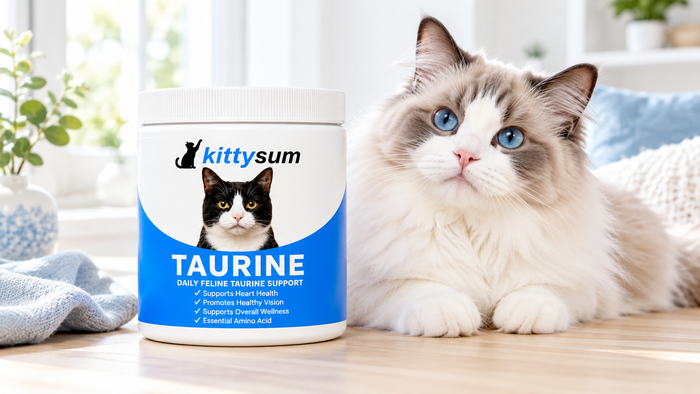
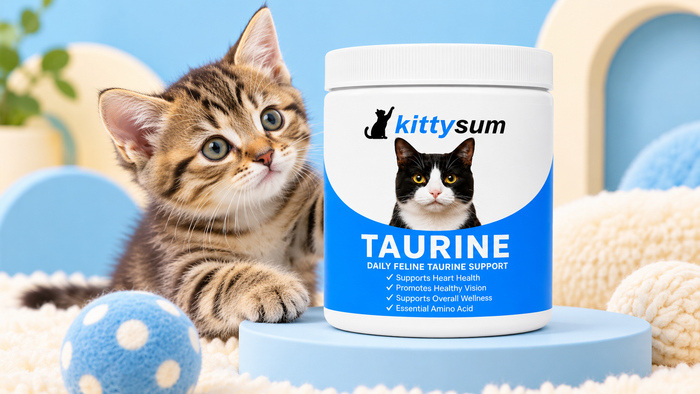
Kittysum Taurine is a daily taurine powder in a 200 g tub with a measuring scoop, made to mix into soft wet food. You can read the label and serving guide here. For amounts, see our guide to taurine dosage for cats.

An Easy Daily Routine: Taurine for Senior Cats
Older cats like predictable days. So a simple routine helps both of you.
- Morning: mix the measured amount into a small portion of warm wet food.
- Through the day: offer small meals and fresh water in easy-to-reach spots.
- Evening: note how much your cat ate.
- Weekly: weigh your cat if you can.
As a result, you will spot appetite changes early. Also, the log helps your vet see whether taurine for senior cats is covered. Our guide to too much taurine for cats explains safe measuring.
Picky Eaters and Taurine for Senior Cats
Many older cats become fussy. For example, a cat may refuse a flavor it ate for years. As a result, owners often switch foods often, which can change intake from week to week.
- Change one thing at a time: then you know what works.
- Mix new food in slowly: blend it with the old food over a week.
- Hide a supplement well: use a strong-smelling pâté and a small first portion.
- Offer variety within complete foods: rotate flavors from complete ranges.
In addition, a picky cat may accept a powder more easily than a pill. So taurine for senior cats can stay steady even when tastes change. However, if a picky phase lasts more than a few days, call your vet.

Home-Cooked Meals and Taurine for Senior Cats
Some owners start cooking for older cats to tempt a poor appetite. That is a kind instinct. Still, home-cooked food needs a complete recipe. Otherwise, taurine and other nutrients can fall short.
- First, ask your vet for a referral to a veterinary nutritionist.
- Next, follow the recipe's named taurine source and amount.
- Then add taurine after cooking, once the food cools.
- Also, keep the recipe the same unless your vet changes it.
- Finally, bring the recipe to every checkup.
Our guide to taurine for homemade cat food explains the mixing steps. In short, a careful recipe keeps taurine for senior cats covered while you tempt a fussy appetite.
What to Bring to Senior Checkups
Senior visits are the best time to review taurine for senior cats. So bring a short list.
- The exact name of every food and treat
- Every supplement and medicine, with labels
- A log of appetite and weight
- Any changes in breathing, vision or energy
As a result, your vet can judge the whole picture in one visit. Likewise, the list helps if you see a new vet or an emergency clinic. Above all, regular checkups help older cats stay well, and they keep taurine for senior cats on your vet's radar.
Common Mistakes With Taurine for Senior Cats
- Ignoring appetite loss. Eating less lowers every nutrient.
- Switching to home-cooked food without a recipe. Use a vet-nutritionist recipe instead.
- Adding supplements without telling the vet. Seniors often take medicines.
- Expecting taurine to fix heart disease. Most senior heart disease is not taurine-related.
- Skipping checkups. Senior visits catch problems early.
Signs an Older Cat Needs a Vet Visit
Some changes in older cats need prompt attention. For example, watch for these signs.
- Fast or labored breathing at rest
- Bumping into furniture or dilated pupils
- Eating much less for more than a day
- Sudden weight loss or hiding
These signs have many causes, so never guess. Instead, call your vet and mention the diet, any supplements and recent changes. In short, early action matters far more than any single nutrient.
Questions to Ask Your Vet About Taurine for Senior Cats
- Is my senior's diet complete for its age and health?
- Should we check the heart or eyes?
- Would a taurine supplement help, and how much?
- How can I support my cat's appetite?
For context, a 1991 Waltham study found cats need at least 39 mg per kg of body weight a day on canned food. Also, a UC Davis study found that cooking lowers taurine in meat, and a 2015 study found three of seven vegetarian canned diets below the AAFCO minimum. For diet advice, see the WSAVA guide, and note the VCA supplement guide says the FDA does not review non-drug supplements before sale.
Need an easy routine for an older cat?
Kittysum Taurine is a daily taurine powder in a 200 g tub with a measuring scoop, free shipping on orders over $50 and a 30-day return policy. Ask your vet to confirm the amount. Shop Kittysum Taurine →
Key Terms Explained
- Senior cat: a cat roughly 11 years or older, though vets judge each cat individually.
- Appetite: how much and how willingly a cat eats.
- CKD: chronic kidney disease, common in older cats.
- HCM: hypertrophic cardiomyopathy, a heart disease not caused by low taurine.
- Complete and balanced: a food that meets a standard nutrient profile for its life stage.
Frequently Asked Questions
Do senior cats need more taurine?
Not usually more than adults, but they can fall short if they eat less or eat home-cooked food. Ask your vet if your senior's diet covers it.
Can taurine help my older cat's heart?
Taurine helps only when low taurine is part of the problem. Most senior heart disease is not taurine-related, so your vet must check the cause.
Is taurine safe for senior cats?
VCA calls supplementation relatively safe. Still, list every medicine and supplement for your vet before adding taurine.
How do I give taurine to a picky senior cat?
Mix a small amount into warm, strong-smelling wet food, serve that portion first, and build up slowly.
Do senior cats with kidney disease need taurine?
They need a steady supply like any cat. Renal diets usually cover it; home-made kidney diets need a vet-built recipe.
References
- VCA Animal Hospitals. Taurine in Cats.
- VCA Animal Hospitals. Lysine.
- Earle KE, Smith PM. Dietary taurine content and plasma taurine in the cat. Br J Nutr. 1991.
- Pion PD, et al. Myocardial failure in cats with low plasma taurine. Science. 1987.
- Spitze AR, et al. Taurine in animal feed ingredients. 2003.
- Kanakubo K, et al. Protein and amino acids in vegetarian pet diets. 2015.
- AAFCO. Cat Food Nutrient Profiles.
- Merck Veterinary Manual. Nutritional Requirements of Small Animals.
- Merck Veterinary Manual. Dilated Cardiomyopathy.
- WSAVA. Selecting a pet food for your pet.
- Companion Animals Extension. Taurine Requirement of Cats.
- AVMA. Dietary supplement law not applicable to products for animals.
- Cornell Feline Health Center. Chronic Kidney Disease.
This article is for general education and is not veterinary advice. These statements have not been evaluated by the Food and Drug Administration. Kittysum products are not intended to diagnose, treat, cure or prevent any disease.