Juvenile periodontitis in cats is gum and bone disease that starts much earlier than usual, often in young cats with very red, swollen gums. It can progress quickly and lead to tooth loss. So if a young cat has red gums, bad breath or pain when eating, book a dental exam early.
This guide explains what the condition is, what a recent study found and how home care fits around your vet's plan.
Key takeaways
- Juvenile periodontitis in cats means early, often fast gum and bone disease in young cats.
- In a 2023 study of 27 cats, X-rays showed moderate to severe disease in 78% of cats, while awake exams found signs in only 30%.
- Researchers advise oral checks from as early as 6 months of age, plus dental care under anesthesia when gums are badly inflamed.
- Home brushing helps prevent plaque, but it does not remove tartar or replace treatment.
- Supplements and dental powders are daily support only, never a treatment for gum disease.
Table of contents
- What is juvenile periodontitis in cats
- What a 2023 study found about juvenile periodontitis in cats
- Signs of juvenile periodontitis in cats
- Why X-rays matter for juvenile periodontitis in cats
- Juvenile periodontitis in cats compared with other gum problems
- Why some young cats are at risk
- Young cats from shelters and catteries
- A 5-step plan for juvenile periodontitis in cats
- How vets treat juvenile periodontitis in cats
- Home care for juvenile periodontitis in cats
- How to check for juvenile periodontitis in cats at home
- Questions to ask your vet about juvenile periodontitis in cats
- Where dental powders fit
- Outlook for cats with juvenile periodontitis
- Myths about juvenile periodontitis in cats
- Key Terms
- Frequently Asked Questions
- References
What is juvenile periodontitis in cats
Periodontal disease affects the gums and the bone that hold each tooth. It usually starts with gingivitis, which is red, inflamed gum tissue. Over time, it can damage the deeper tissues and bone.
Most cats develop it slowly with age. In fact, the 2019 AAHA dental care guidelines note that most dogs and cats have some periodontal disease by age three.
Juvenile periodontitis in cats is different. It starts in young cats and can move fast. Vets may also call it early-onset gingivitis and periodontitis, or aggressive periodontitis when bone loss is rapid.
The AVDC nomenclature gives vets shared terms for these oral problems. For owners, the main point is simple: early gum disease in a young cat needs early care.

What a 2023 study found about juvenile periodontitis in cats
The most detailed recent look comes from a 2023 study from UC Davis. The team reviewed 27 client-owned cats with early-onset gingivitis or periodontitis from 1997 to 2022.
- X-rays showed moderate to severe periodontal disease in 78% of the cats (21 of 27).
- In contrast, awake exams found signs of periodontal disease in only 30% (8 of 27).
- Bone loss along with missing teeth appeared in 89% of cases (24 of 27).
- Seven cats showed worsening aggressive periodontitis, and two developed lesions like chronic gingivostomatitis.
- Cats whose gums did not improve by the first recheck were more likely to get worse.
As a result, the authors recommend oral checks in cats from as early as 6 months of age. For cats with marked gingivitis, they advise an exam under anesthesia, periodontal treatment and long-term follow-up.
They also note that owners should be told about the possible need for tooth extractions. In short, juvenile periodontitis in cats is often more serious than it looks from the outside.
Signs of juvenile periodontitis in cats
Young cats hide pain well. So the early signs are easy to miss, and many owners first notice them during play or grooming.
- Bright red or swollen gums, often along the back teeth.
- Bad breath that seems strong for a young cat.
- Drooling or pawing at the mouth.
- Chewing on one side or dropping food.
- Bleeding gums or blood on toys.
- Loose or missing adult teeth.
If you see these signs, book a vet visit. Our guides to red gums in cats and cat gingivitis show what healthy and inflamed gums look like.

Why X-rays matter for juvenile periodontitis in cats
The 2023 numbers tell a clear story. Awake exams missed much of the disease that X-rays found. That gap is the main reason vets recommend dental X-rays under anesthesia.
The AAHA guidelines explain why. A full exam needs dental X-rays and gentle probing under the gum line. A conscious cat will not stay still for that, and probing can hurt.
Also, AAHA does not support anesthesia-free cleaning. Its page on nonanesthetic dentistry explains that it only cleans the visible tooth surface and gives owners a false sense of benefit.
So for juvenile periodontitis in cats, a proper exam under anesthesia is the step that shows how much bone and tooth support remains.
Juvenile periodontitis in cats compared with other gum problems
Several mouth problems can look alike. This table compares them in simple terms, but only your vet can tell them apart.
| Condition | Typical age | What you may see | Usual next step |
|---|---|---|---|
| Juvenile periodontitis | Young cats | Very red gums, bad breath, early tooth loss | Exam and X-rays under anesthesia |
| Simple gingivitis | Any age | Thin red line at the gum edge | Vet check, then daily home care |
| Adult periodontal disease | Usually older cats | Tartar, bad breath, loose teeth | Dental cleaning and X-rays |
| Chronic gingivostomatitis | Any age | Severe redness at the back of the mouth | Vet or dental specialist care |
| Oral ulcers from infection | Any age | Sores in the mouth with a cold | Vet exam and supportive care |
The last row matters for young cats. The Cornell Feline Health Center notes that calicivirus can cause inflammation or ulcers in the mouth, so a vet may need to rule out infection too.
Why some young cats are at risk
No one fully understands why juvenile periodontitis in cats develops. However, research gives a few clues.
A study of 109 colony cats found that 13% had aggressive periodontitis. Only 4% were free of gum inflammation. That shows how common gum problems are, even in a managed group.
Another Cornell study of 44 cats compared bacteria under the gum line. The bacteria in cats with aggressive periodontitis differed from those in healthy cats. Many disease-linked bacteria were present in healthy mouths too, but at lower levels.
In other words, the balance of bacteria and the cat's own immune response both seem to matter. That is why treatment focuses on cleaning, monitoring and keeping plaque low.
Young cats from shelters and catteries
Many kittens come from shelters or breeding catteries. These busy places can expose young cats to viruses that also affect the mouth.
The Cornell Feline Health Center reports that about 10% of cats in small groups carry calicivirus. By contrast, up to 90% of cats in crowded settings such as shelters and catteries may be infected.
Calicivirus can cause inflammation or ulcers in the mouth. So a young cat with a sore mouth may need checks for infection as well as for juvenile periodontitis in cats.
Cornell also recommends vaccination against calicivirus for all healthy cats. The vaccine does not block every infection, but it lowers the chance of severe disease. Keep your kitten's vaccine record handy for the dental visit.
A 5-step plan for juvenile periodontitis in cats
Here is a simple path that matches the research and the AAHA guidelines.
- Notice early signs such as red gums, bad breath or chewing on one side.
- Book a vet visit, even if your cat still eats well.
- Ask about dental X-rays and an exam under anesthesia.
- Follow the treatment plan, which may include extractions.
- Keep up home care and attend every recheck, because early response predicts the outlook.
How vets treat juvenile periodontitis in cats
Treatment depends on how much damage your vet finds. In general, it involves a full cleaning above and below the gum line, X-rays and close follow-up.
Some teeth may need to come out. The 2023 study found that moderate to severe disease was common, so owners should be ready for that talk. Your vet will explain why each tooth needs to come out.
Pain control is part of good dental care too. AAHA lists pain management as a core part of dental treatment, so ask how your vet will keep your cat comfortable during and after the visit.
After treatment, rechecks matter a great deal. The same study found that cats that did not improve by the first follow-up were more likely to progress. So keep every recheck, even if your cat seems fine.
If your vet suspects a complex case, they may refer you to a board-certified veterinary dentist. That is a normal step for juvenile periodontitis in cats that keeps getting worse.

Home care for juvenile periodontitis in cats
Home care cannot cure this condition. Still, it helps control plaque between visits, and plaque drives gum inflammation.
The AAHA guidance on home products gives clear points:
- Brushing removes plaque, but it does not remove tartar.
- Brushing must be daily to help.
- Brushing already inflamed gums can hurt and make a cat avoid it.
- Even daily brushing does not replace exams and X-rays under anesthesia.
So start brushing after your vet has treated sore gums. Our guides on brushing kitten teeth and how often to brush cat teeth show how to build the habit step by step.
Also, go slowly. Gentle, short sessions work better than a long struggle, especially after treatment for juvenile periodontitis in cats.
How to check for juvenile periodontitis in cats at home
You do not need tools to do a quick mouth check. A calm minute once a week is enough to spot changes early.
- First, pick a quiet time when your cat is relaxed, such as after a meal.
- Next, gently lift the upper lip at the side of the mouth.
- Then, look at the gum line above the back teeth.
- Note the color, and compare it with last week. A bright red band along the teeth is a reason to call your vet.
- Finally, check the breath and look for blood or drool.
Stop if your cat pulls away or seems sore. Pain is a sign in itself, so tell your vet. Also, take a photo each week. Photos make it much easier to show your vet how juvenile periodontitis in cats has changed over time.
Questions to ask your vet about juvenile periodontitis in cats
A dental diagnosis can feel like a lot at once. So bring a short list of questions to the visit.
- How much bone loss do the X-rays show?
- Which teeth need treatment now, and which need watching?
- How soon should we recheck the gums?
- When can I start brushing, and what should I use?
- Should we see a board-certified veterinary dentist?
Also ask which signs mean you should call before the next visit. For example, your vet may want to hear about bleeding, drooling or a cat that stops eating. Early calls help catch flare-ups of juvenile periodontitis in cats before they become painful.
Write down the answers. Then keep them with your cat's records so you can track progress at each recheck.
Also, ask about cost and timing up front. Clear plans help owners stick with care, and steady care is what keeps juvenile periodontitis in cats under control.
Where dental powders fit
Dental powders and water additives are popular. They can be part of a daily routine, but they are support only. They do not treat gum disease.
AAFCO also explains that products claiming to treat or prevent disease are making drug claims. So be wary of any powder that promises to cure gum problems.
If your vet agrees, a powder can sit alongside brushing and rechecks. Our guide to cat dental supplements explains what to look for on a label. Cornell's feeding guide adds that supplements should never be given without a vet's approval.

Outlook for cats with juvenile periodontitis
The outlook for juvenile periodontitis in cats varies. Some cats settle well after treatment and steady home care. Others need more extractions over time.
The 2023 study suggests that early response is a useful guide. Cats whose gums improve by the first recheck tend to do better. In addition, the authors note that early-onset gingivitis may progress to aggressive periodontitis, so ongoing checks are vital.
A mouth free of pain is the main goal of treatment, even if that means fewer teeth. So stay positive, keep the plan simple and ask your vet what to expect for your cat.
Myths about juvenile periodontitis in cats
A few common beliefs can delay care.
- Myth: young cats do not get gum disease. Research shows that serious disease can start early.
- Myth: if the cat eats, the mouth is fine. Cats often keep eating despite pain.
- Myth: anesthesia-free cleaning is a safe shortcut. AAHA says it is not appropriate and misses disease below the gum line.
- Myth: a powder can replace the vet. No supplement treats juvenile periodontitis in cats.
For broader daily habits, see our guide to cat dental care at home. If bad breath is your main worry, our cat bad breath guide covers other causes too.
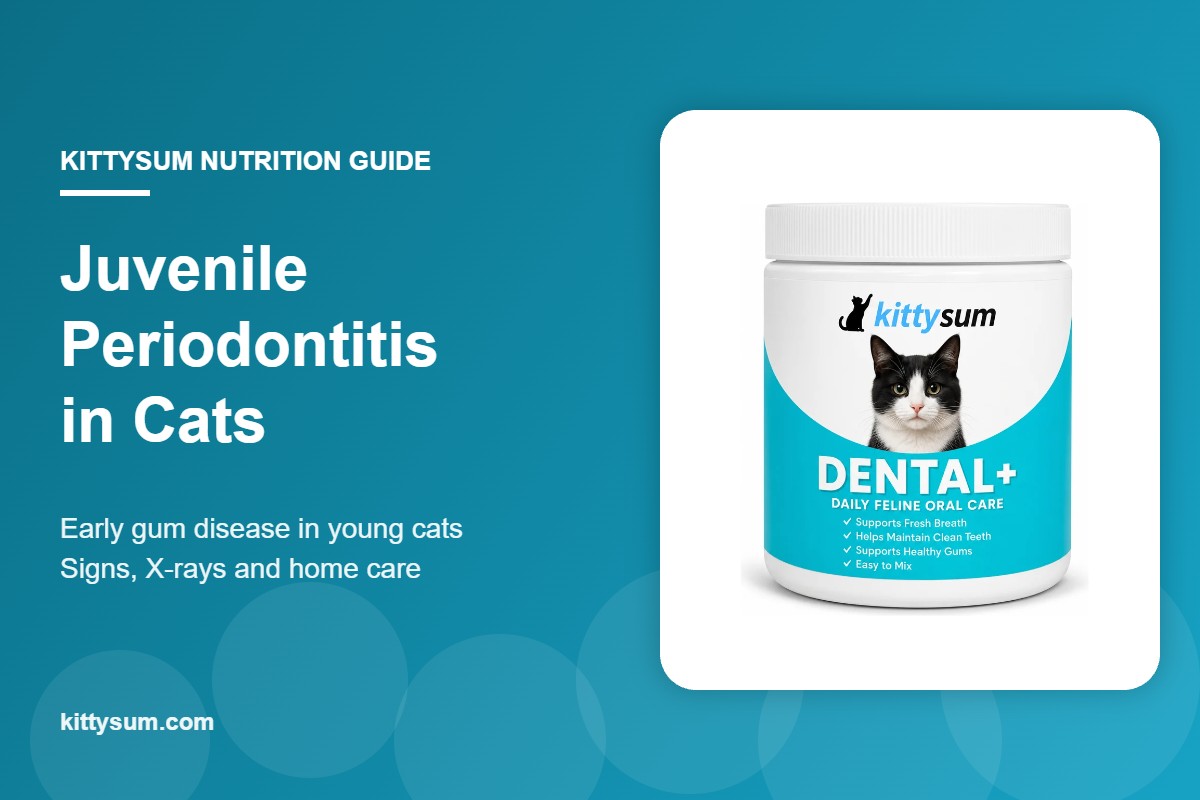
Daily oral care support, after your vet's plan
Kittysum Dental+ is a daily powder for cats, made as part of a home oral care routine. It is not a treatment for gingivitis, periodontitis or any disease, so use it only alongside your vet's advice.
Key Terms
- Gingivitis: red, inflamed gum tissue, often the first stage of gum disease.
- Periodontitis: disease of the deeper tissues and bone that hold a tooth in place.
- Early-onset gingivitis: marked gum inflammation that starts in young cats.
- Aggressive periodontitis: fast bone loss around the teeth, often in young cats.
- Plaque: a soft film of bacteria that forms on teeth every day.
- Calculus: hardened plaque, also called tartar, that brushing cannot remove.
Frequently Asked Questions
At what age does juvenile periodontitis in cats start
It can begin in young cats, and researchers advise oral checks from as early as 6 months of age. Any young cat with very red gums should see a vet.
Can juvenile periodontitis in cats be cured
It can often be controlled with treatment under anesthesia, home care and rechecks. Some cats need tooth extractions, so ask your vet what recovery looks like.
Is anesthesia really needed for a dental exam
Yes, for a full exam. AAHA explains that X-rays and probing below the gum line are not possible in an awake cat.
Can a dental powder fix my kitten's red gums
No. A powder is daily support only. Red, swollen gums in a young cat need a vet exam first.
References
- Soltero-Rivera M, et al. Clinical, radiographic and histopathologic features of early-onset gingivitis and periodontitis in cats (1997-2022). J Feline Med Surg. 2023. Read the source.
- Girard N, et al. Periodontal health status in a colony of 109 cats. J Vet Dent. 2009. Read the source.
- Rodrigues MX, et al. The subgingival microbial community of feline periodontitis and gingivostomatitis. Sci Rep. 2019. Read the source.
- AAHA. 2019 AAHA Dental Care Guidelines for Dogs and Cats. Read the source.
- AAHA. Nonanesthetic Dentistry. Read the source.
- AAHA. Recommending home oral hygiene and products. Read the source.
- American Veterinary Dental College. AVDC Nomenclature. Read the source.
- Cornell Feline Health Center. Respiratory Infections. Read the source.
- Cornell Feline Health Center. Feeding Your Cat. Read the source.
- AAFCO. Supplements. Read the source.
This guide is general nutrition information for cat owners. It is not a diagnosis or treatment plan, so please talk with your veterinarian about your own cat.
This article is for general education and is not veterinary advice. These statements have not been evaluated by the Food and Drug Administration. Kittysum products are not intended to diagnose, treat, cure or prevent any disease.