
Key takeaways
- Good taurine powder storage means cool, dry and tightly closed.
- Moisture is the main enemy, so use a dry scoop and keep the lid sealed.
- The fridge is usually not needed and can cause condensation.
- Keep the tub out of reach of pets and children, away from heat and sunlight.
- Mix powder into food at serving time, not hours in advance.
Taurine powder storage sounds like a small detail, yet it decides whether every scoop stays fresh, accurate and appealing to your cat. Powder that absorbs moisture clumps, measures unevenly and can lose its meaty smell.
This guide explains where to keep a taurine tub, why heat and humidity matter, how to scoop safely, and how to tell if a cat supplement has gone off. It also covers travel, multi-cat homes and mixing powder into meals.
New to taurine? Start with our guide to taurine for cats.
Table of contents
- Why it matters
- The basics
- Where to keep it
- Storage comparison
- Fridge or freezer?
- Moisture
- Scooping
- Labels and dates
- Signs of spoilage
- Mixing into food
- Travel
- Multi-cat homes
- Child and pet safety
- Buying the right size
- Daily routine
- Opened tubs
- Prepared meals
- Myths
- Mistakes
- Questions for a vet
- FAQ
- References
Why Taurine Powder Storage Matters
To begin with, taurine is an amino acid cats must get from animal tissue. In fact, Merck notes that plant protein contains none. Also, VCA Animal Hospitals explains that cats need it for vision, heart muscle function and digestion.
So when a vet recommends a supplement, every dose counts. However, a powder that clumps or picks up odors can lead to uneven doses or a cat that refuses its food. Therefore, good taurine powder storage protects both accuracy and appetite.

Taurine Powder Storage Basics
In general, the same rules that keep pet food fresh apply to supplements. For example, the FDA advises storing pet food in a cool, dry place and keeping containers closed. Likewise, AAFCO offers safe handling tips for pet food and treats.
- Cool: room temperature, away from heaters and stoves.
- Dry: away from sinks, kettles and dishwashers.
- Dark: out of direct sunlight.
- Sealed: lid closed tightly after every use.
In short, these four rules cover most taurine powder storage questions.
Where to Keep the Tub for Taurine Powder Storage
Ideally, choose a kitchen cupboard or pantry shelf away from the stove. Also, keep it near where you prepare your cat's meals, so dosing becomes a habit. However, avoid the cupboard above the kettle or dishwasher, because steam rises into those spaces.
Similarly, avoid windowsills, car glove boxes and garages, where temperatures swing widely. Consequently, a stable indoor shelf is the best place for taurine powder storage in most homes.
Taurine Powder Storage: Place Comparison
Here is a quick guide to taurine powder storage in common household spots.
| Location | Suitability | Why |
|---|---|---|
| Pantry or cupboard | Best | Cool, dark and dry |
| Counter near the stove | Poor | Heat and steam |
| Above the kettle or dishwasher | Poor | Rising moisture |
| Refrigerator | Usually not needed | Condensation when opened |
| Garage or car | Poor | Large temperature swings |
In other words, the boring cupboard is the right answer.

Fridge or Freezer for Taurine Powder Storage?
Surprisingly, the fridge is usually not the best choice for a dry powder. Because cold tubs meet warm kitchen air each time you open them, water droplets can form inside. As a result, the powder may clump.
Instead, follow the label. If the maker gives no cold-storage instruction, a cool cupboard is the better place. Also, never freeze and thaw a powder repeatedly. In short, room-temperature taurine powder storage is simpler and safer for most products.
Moisture and Taurine Powder Storage
Above all, moisture is the main enemy of any supplement powder. For example, a damp scoop or an open lid on a humid day can cause clumps within days.
- Close the lid right after scooping.
- Keep any desiccant packet that came in the tub, and never feed it.
- Avoid scooping over a steaming bowl of food.
- Wipe the rim before closing so the lid seals well.
Moreover, humid climates call for extra care. For instance, during rainy seasons, keep the tub in the driest room. Therefore, careful taurine powder storage keeps every scoop loose and accurate.
Scooping Safely
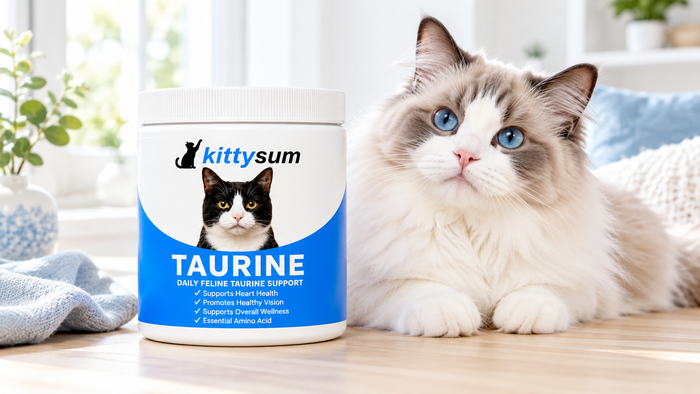
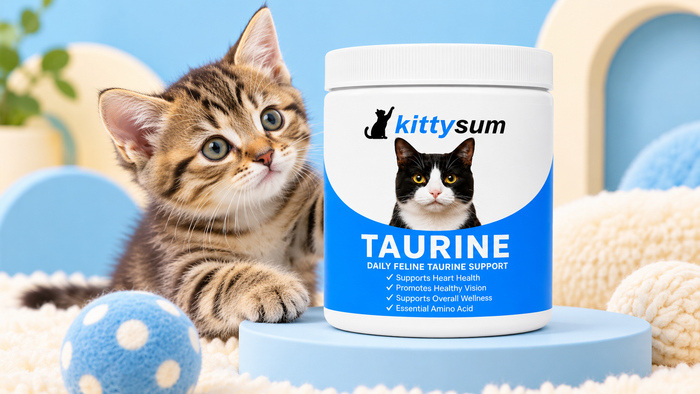
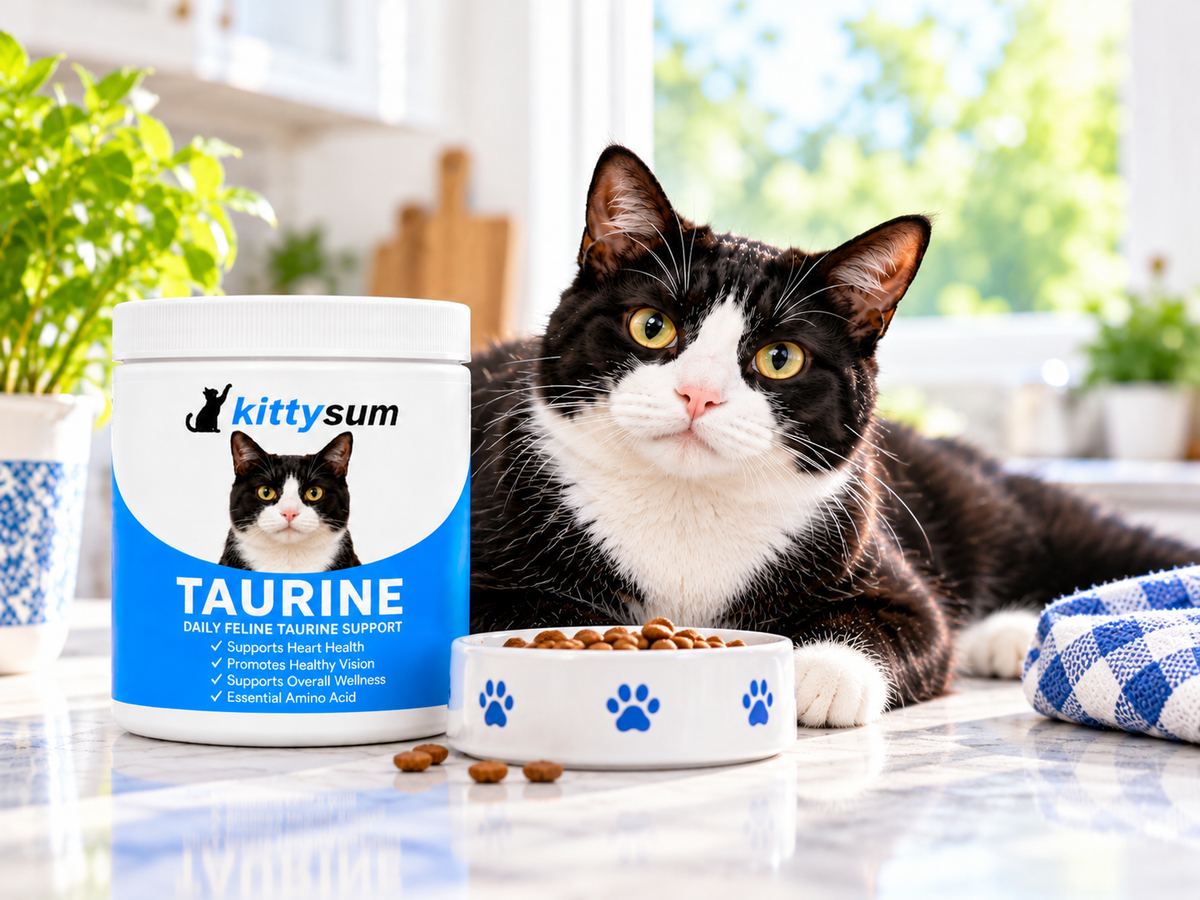
Next, the scoop itself matters. Kittysum Taurine is a daily taurine powder in a 200 g tub with a measuring scoop, blended with chicken liver for a meaty smell. Since the scoop sets the dose, keep it clean and dry.
- First, wash and dry your hands.
- Second, use only the dry scoop that came with the tub.
- Then level each scoop with a clean knife or the rim.
- After that, close the lid right away.
- Finally, return the tub to its cupboard.
Also, the FDA suggests washing pet food scoops and bowls regularly. If you wash the scoop, dry it fully before it goes back in. You can read the label and serving guide here.
Labels, Lot Numbers and Dates
Meanwhile, the label holds useful details. For example, check the best-by date, the lot number and any storage instructions. Also, keep the product in its original tub, so this information stays with it.
In fact, VCA warns that supplement quality may vary significantly among makers, and the AVMA reports that the main US dietary supplement law does not apply to animal products. So choose a clearly labeled product, and keep the label for reference. Good taurine powder storage starts with a container that tells you what is inside.
Signs a Taurine Powder Has Gone Off
Thankfully, a well-stored powder rarely spoils. Even so, check for these signs before each use.
- Hard clumps that do not break apart easily.
- A sour, musty or rancid smell instead of a mild meaty one.
- Color changes such as dark spots or patches.
- Visible mold or insects.
- A cat that suddenly refuses food with the powder mixed in.
If you notice any of these, stop using that tub and contact the seller. For example, Kittysum offers a 30-day return policy. In short, a quick sniff and look is part of taurine powder storage.
Mixing Powder Into Food
Similarly, timing matters once the powder leaves the tub. For example, mix it into food right before serving, rather than hours in advance. Also, remove uneaten wet food after about 30 minutes, as many vets advise.
Because taurine dissolves in water, a little stirring spreads it evenly through wet food. However, a UC Davis study found that cooking lowers taurine in meat, so add the powder after cooking homemade meals, not before. Our guide to how to add taurine to cat food shows mixing tips. Overall, taurine powder storage and smart mixing work together.
Taurine Powder Storage for Travel and Boarding
Additionally, many owners need to take a supplement on trips or to a boarding facility. In that case, pre-measure doses into small, clean, airtight containers. Then label each one with your cat's name and the dose.
- Pack containers in a cool bag away from direct sun.
- Give the sitter written instructions.
- Bring the original tub for longer trips, so the label stays with it.
Consequently, your cat keeps its routine away from home, and taurine powder storage stays safe on the road.
Multi-Cat Homes
Likewise, homes with several cats need a clear system. For instance, if only one cat takes the supplement, mix it into that cat's portion and feed it in a separate spot. Also, keep a simple log of who got which dose. As a result, no cat gets a double serving or misses one, and good taurine powder storage supports accurate dosing for the right cat.
Child and Pet Safety With Taurine Powder Storage
Of course, keep supplements out of reach of children and pets. For example, a curious dog or cat may knock over a tub and eat the powder. Although VCA describes taurine as relatively safe, with no reports of problems from excess dietary taurine in cats, a spilled tub is still a mess, and other household products may be nearby. Therefore, store the tub on a high shelf or in a closed cupboard. Also, keep it apart from human medicines, so nobody grabs the wrong container.

Buying the Right Size
Notably, buying a size you can use well before the best-by date keeps powder fresh. For example, one cat on a daily maintenance amount uses a 200 g tub slowly, while several cats or higher vet-advised doses use it faster. Also, Kittysum offers 2- and 3-tub packs, which qualify for free shipping on orders over $50. However, store unopened tubs sealed in the same cool cupboard. Our guide to taurine dosage for cats helps you estimate daily use, so taurine powder storage never becomes a problem.
A Daily Taurine Powder Storage Routine
In practice, a short routine keeps everything easy.
- Morning: take the tub out, scoop the dose and close the lid.
- Mix: stir the powder into a small part of the meal.
- Serve: offer the rest of the meal once the first part is eaten.
- Return: put the tub back in the cupboard.
- Weekly: check for clumps, smell and the best-by date.
In short, a two-minute habit makes taurine powder storage automatic.
Taurine Powder Storage for Opened vs Unopened Tubs
Once a tub is opened, air and humidity reach the powder every time you scoop. By contrast, an unopened tub with its seal intact is well protected. Therefore, open one tub at a time, and keep spares sealed until you need them.
- Unopened: store in the cupboard until the best-by date.
- Opened: close tightly after each use and check it weekly.
- Nearly empty: do not pour old powder into a new tub.
Also, write the opening date on the lid with a marker. As a result, you always know how long the current tub has been in use, which makes taurine powder storage easy to track.
Storing Prepared Meals That Contain Powder
Sometimes owners batch-cook homemade cat food. In that case, cook and cool the food first, then portion it into containers. However, add the taurine powder at serving time when possible, rather than mixing it into a week of frozen meals. That way, each dose is easy to check. If your vet-formulated recipe calls for mixing it in before freezing, follow the recipe and keep portions small. Our guide to taurine for homemade cat food explains safe amounts. In short, taurine powder storage covers the tub, while food safety rules cover the prepared meals.

Myths About Taurine Powder Storage
- "The fridge always keeps supplements fresher." For dry powders, it can add moisture.
- "Any container works." The original tub keeps the label and seal.
- "Clumps are harmless." They point to moisture and uneven doses.
- "Pre-mixing a week of meals saves time." Mix at serving time instead.
Clearing up these myths keeps taurine powder storage simple.
Common Mistakes With Taurine Powder Storage
- Leaving the lid loose. Air and moisture get in.
- Using a wet scoop. It causes clumps.
- Storing above the stove. Heat and steam damage powder.
- Throwing away the label. You lose the dose and date.
- Ignoring smells. A sour odor means stop using it.
Avoiding these mistakes keeps taurine powder storage reliable.
Questions to Ask a Vet
- Does my cat still need a taurine supplement?
- What daily amount should I give?
- Is it safe to pre-measure doses for a sitter?
- Should I change the dose if my cat's diet changes?
For context, a 1991 Waltham study found cats need at least 39 mg per kg of body weight a day on canned food to keep normal blood taurine. Also, the landmark 1987 Pion study linked heart failure to low blood taurine, and the Companion Animals Extension notes retinal changes may appear 5 to 6 months into a deficiency. In addition, a 2015 study found three of seven vegetarian canned diets below the AAFCO minimum, Merck explains the heart disease linked to low taurine, the WSAVA guide offers diet advice, and the VCA supplement guide says the FDA does not review non-drug supplements before sale.
Looking for an easy-to-store taurine powder?
Kittysum Taurine is a daily taurine powder blended with chicken liver in a 200 g tub with a measuring scoop, free shipping on orders over $50 and a 30-day return policy. Ask your vet to confirm the amount. Shop Kittysum Taurine →
Key Terms Explained
- Taurine: an amino acid cats must get from animal tissue for heart, eye and digestive health.
- Airtight: sealed so that air and moisture cannot get in.
- Condensation: water droplets that form when cold items meet warm, humid air.
- Clumping: powder sticking together, usually because it absorbed moisture.
- Best-by date: the date until which the maker expects the product to stay at full quality.
Frequently Asked Questions
How should I store taurine powder for my cat?
Keep it in its original tub with the lid tightly closed, in a cool, dry, dark cupboard away from the stove and sink.
Should taurine powder go in the fridge?
Usually not, unless the label says so. Opening a cold tub in warm air can cause condensation and clumps.
Why is my taurine powder clumping?
Clumps usually mean moisture got in, often from a damp scoop or loose lid. Check the smell and contact the seller if in doubt.
Can I pre-mix taurine into a week of cat food?
It is better to mix it into each meal at serving time and remove uneaten wet food after about 30 minutes.
How do I know if taurine powder has gone bad?
Watch for hard clumps, a sour or musty smell, color changes, mold or a cat suddenly refusing food with the powder.
References
- VCA Animal Hospitals. Taurine in Cats.
- VCA Animal Hospitals. Lysine.
- Earle KE, Smith PM. Dietary taurine content and plasma taurine in the cat. Br J Nutr. 1991.
- Pion PD, et al. Myocardial failure in cats with low plasma taurine. Science. 1987.
- Spitze AR, et al. Taurine in animal feed ingredients. 2003.
- Kanakubo K, et al. Protein and amino acids in vegetarian pet diets. 2015.
- AAFCO. Cat Food Nutrient Profiles.
- Merck Veterinary Manual. Nutritional Requirements of Small Animals.
- Merck Veterinary Manual. Dilated Cardiomyopathy.
- WSAVA. Selecting a pet food for your pet.
- Companion Animals Extension. Taurine Requirement of Cats.
- AVMA. Dietary supplement law not applicable to products for animals.
- FDA. Proper Storage of Pet Food and Treats.
- AAFCO. Pet Food Product Handling and Safety.
This article is for general education and is not veterinary advice. These statements have not been evaluated by the Food and Drug Administration. Kittysum products are not intended to diagnose, treat, cure or prevent any disease.