

Key takeaways
- Taurine for Maine Coon cats matters because bigger cats need more total taurine each day.
- Maine Coons are prone to HCM, an inherited heart disease that taurine does not prevent or cure.
- Low taurine causes a different heart disease, DCM, so a steady supply still matters.
- A DNA test and regular heart scans are the main tools against HCM in this breed.
- Most Maine Coons on a complete food get enough taurine; ask your vet before adding a supplement.
Taurine for Maine Coon cats raises two separate questions: how much a big cat needs, and what taurine can and cannot do for the breed's heart. Maine Coons are large and grow slowly. They are also prone to an inherited heart disease that taurine does not prevent.
This guide explains how size affects taurine needs, how HCM differs from taurine-related heart disease, which tests matter, and how to feed a Maine Coon well from kitten to senior.
New to taurine? Start with our guide to taurine for cats.
Table of contents
Why Taurine for Maine Coon Cats Matters
Taurine is an amino acid cats must get from animal tissue. In fact, Merck notes that plant protein contains none. Also, VCA Animal Hospitals explains that cats need it for vision, heart muscle function and digestion.
Of course, every cat needs taurine. However, Maine Coon owners often ask about it because the breed is famous for two things: size and heart disease. So taurine for Maine Coon cats deserves a clear, breed-specific look.

Size and Total Taurine for Maine Coon Cats
Above all, taurine needs scale with body weight. For example, a 1991 Waltham study found cats need at least 39 mg per kg of body weight a day on canned food and about 19 mg per kg on dry food.
- 4 kg cat on wet food: at least about 156 mg a day.
- 6 kg Maine Coon: at least about 234 mg a day.
- 8 kg Maine Coon: at least about 312 mg a day.
However, these are totals from the whole diet. Therefore, a big Maine Coon that eats enough of a complete food usually gets enough, because it simply eats more. Still, taurine for Maine Coon cats matters most when the diet is homemade, because recipes must scale with weight. Our guide to taurine dosage for cats explains the math.
HCM: The Heart Disease Maine Coons Are Prone To
Hypertrophic cardiomyopathy, or HCM, is the most common heart disease in cats, according to the Cornell Feline Health Center. The heart wall thickens and stiffens. In Maine Coons, a specific gene change is linked to the disease.
Fortunately, the UC Davis Veterinary Genetics Laboratory offers a DNA test for this Maine Coon gene change. Cats that carry it are more likely to develop HCM. However, not every carrier develops disease, and cats without it can still develop HCM.
Importantly, HCM is not caused by low taurine. Therefore, taurine for Maine Coon cats is not a treatment or prevention for HCM. Instead, HCM needs screening and, when found, vet care.

DCM: Where Taurine for Maine Coon Cats Still Matters
By contrast, low taurine causes a different heart disease: dilated cardiomyopathy, or DCM. The heart muscle becomes thin and weak. The landmark 1987 Pion study linked this disease in cats to low blood taurine, and Merck notes it is still seen in cats fed home-cooked or poorly made diets.
Thus, a Maine Coon can face both risks. HCM comes from genes, while DCM can come from diet. In short, taurine for Maine Coon cats protects against the diet-related one. Our guide to taurine for cat heart health explains both diseases.
Taurine for Maine Coon Cats: HCM vs DCM
Here is a quick comparison of the two heart diseases behind taurine for Maine Coon cats.
| Feature | HCM | DCM |
|---|---|---|
| Heart change | Thick, stiff wall | Thin, weak, enlarged |
| Main cause | Inherited; gene change in some Maine Coons | Low taurine, often from diet |
| Can taurine prevent it? | No | Yes, a steady supply prevents the diet-related form |
| Key test | DNA test and echocardiogram | Echocardiogram and blood taurine |
| How common in Maine Coons | A known breed risk | Rare on complete diets |
In other words, taurine for Maine Coon cats is necessary, but it is not a heart cure.
Gene Tests and Heart Scans
In practice, two tools matter most for Maine Coon hearts. First, the DNA test shows whether a cat carries the known gene change. Second, an echocardiogram shows what the heart actually looks like.
- DNA test: often done once, ideally before breeding.
- Echocardiogram: your vet or a cardiologist advises how often, especially for carriers.
- Listening at checkups: murmurs or abnormal rhythms can prompt a scan.
- Blood taurine: useful if diet is a concern.
As a result, problems are found early. Meanwhile, keep taurine for Maine Coon cats steady through a complete diet, so low taurine never adds to the picture.
Maine Coon Kittens and Taurine
Notably, Maine Coons grow slowly and may not reach full size for several years. Therefore, feeding in the first year matters a lot. A complete food made for growth covers taurine for most kittens.
- Use a growth food: look for "complete and balanced for growth" or all life stages.
- Weigh monthly: big kittens need portions adjusted often.
- Ask about timing: your vet can advise when to switch to adult food.
Our guide to taurine for kittens covers growth, milk and weaning.
Choosing Food for Taurine for Maine Coon Cats
Generally, a complete and balanced food is the simplest way to cover taurine. The AAFCO cat food nutrient profiles set a taurine minimum, and commercial foods add taurine to meet it.
- Look for: "complete and balanced" for your cat's life stage.
- Feed cat food, not dog food: dog food is not made for a cat's taurine needs.
- Offer wet food often: it adds water, which helps large cats stay hydrated.
- Follow a recipe: homemade diets need a vet nutritionist.
Also, the WSAVA guide gives questions to ask any pet food maker. In short, good food covers taurine for Maine Coon cats in most homes.
Adding a Supplement: Taurine for Maine Coon Cats
VCA says a healthy cat eating a complete food for its life stage does not require supplementation. However, Maine Coons on homemade or raw diets, or cats your vet is concerned about, may benefit from a measured source.
- Check the diet. First, confirm whether the food is complete and balanced.
- Weigh your cat. Next, use the current weight, since doses scale with size.
- Ask your vet. Then get a daily amount in mg.
- Choose a clear label. Also, look for mg of taurine per scoop.
- Measure daily. Finally, mix into wet food with a set scoop.
VCA describes taurine supplementation as relatively safe, with no reports of problems from excess dietary taurine in cats. Even so, AAFCO sets no maximum, so use the label or your vet's amount. VCA also warns that supplement quality may vary significantly among makers, and the AVMA reports that the main US dietary supplement law does not apply to animal products.
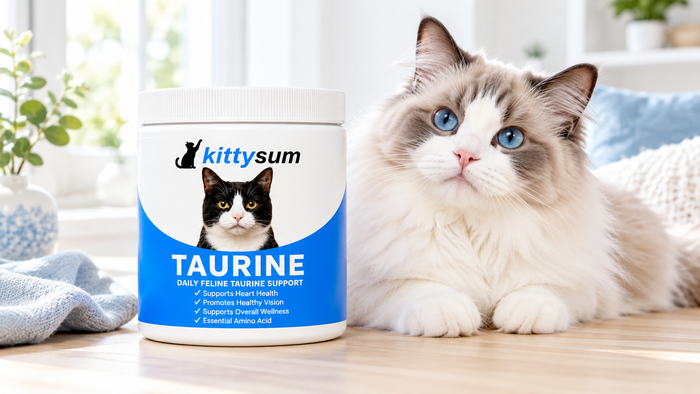
Kittysum Taurine is a daily taurine powder in a 200 g tub with a measuring scoop, blended with chicken liver for a meaty smell. A scoop makes it easy to scale the amount for a large cat. You can read the label and serving guide here.

Weight, Joints and Taurine for Maine Coon Cats
Naturally, big cats carry more weight on their joints. As a result, Maine Coons can be prone to joint problems, and extra weight makes them worse. Meanwhile, overweight cats are also harder to examine with a heart scan.
- Measure meals: do not free-feed a large cat without a plan.
- Use body condition: ribs should be easy to feel, not see.
- Encourage play: daily play keeps muscles strong.
If your Maine Coon needs to lose weight, your vet may build a diet plan. Our guide to taurine vs L-carnitine for cats explains where carnitine fits. Above all, keep taurine for Maine Coon cats covered during any diet.
Heart Warning Signs in Maine Coons
Cats hide illness well, and big cats are no exception. Therefore, alongside taurine for Maine Coon cats, watch for these signs.
- Fast or labored breathing at rest or during sleep
- Open-mouth breathing
- Tiredness or hiding
- Sudden weakness or pain in the back legs
Fast breathing and sudden back-leg weakness are emergencies. Call your vet or an emergency clinic right away. Also, ask your vet what resting breathing rate is normal for your cat, and count it once in a while at home.

For Breeders: Taurine for Maine Coon Cats and Litters
Meanwhile, breeders face both genetic and nutritional questions. For example, DNA testing helps plan matings, while diet supports the queen and kittens.
- Test breeding cats: use the DNA test and heart scans.
- Feed queens a growth food: during pregnancy and nursing.
- Keep records: birth weights and growth over time.
Our guide to taurine for pregnant cats explains why queens need steady taurine. In short, genetics and nutrition work side by side.
Homemade and Raw Diets for Maine Coons
Additionally, some owners cook for big cats to control ingredients. That can work, but only with a complete recipe. Otherwise, taurine and other nutrients can fall short. In fact, a UC Davis study found that cooking, especially boiling, lowers taurine in meat.
- First, ask your vet for a referral to a veterinary nutritionist.
- Next, scale the recipe to your cat's weight.
- Then add taurine after cooking, once the food cools.
- Finally, keep the recipe steady unless your vet changes it.
Our guides to taurine for homemade cat food and taurine per pound of cat food explain the details.
Senior Maine Coons and Taurine
Older Maine Coons often eat less, and some develop dental pain or kidney disease. As a result, intake can fall even on a complete food. Moreover, heart changes from HCM may appear later in life, so checkups matter more with age.
- Track appetite: eating less lowers every nutrient.
- Book senior checkups: twice a year is common for older cats.
- Keep food soft: pâté is easier for sore teeth.
In short, taurine for Maine Coon cats stays important at every age. Our guide to taurine for senior cats covers appetite and kidney tips.
Coat, Hydration and Everyday Care
Maine Coons have thick, long coats and often love water. Nevertheless, many still drink too little. Therefore, wet food and fountains help, and they also make it easy to mix in any vet-advised powder. Similarly, regular brushing reduces hairballs, which can otherwise upset appetite. Consequently, good everyday care quietly supports taurine for Maine Coon cats, because a comfortable cat eats well.
Common Mistakes With Taurine for Maine Coon Cats
- Expecting taurine to prevent HCM. It does not; screening does the work.
- Using a small-cat dose. Amounts scale with weight.
- Skipping heart scans in carriers. Follow your vet's schedule.
- Cooking at home without a recipe. Use a vet-nutritionist plan.
- Letting a big cat get overweight. Measure meals.
Avoiding these mistakes keeps taurine for Maine Coon cats in its proper place.
Questions to Ask Your Vet About Taurine for Maine Coon Cats
- Should my cat have the DNA test or a heart scan?
- How often should we repeat heart checks?
- Does my cat's diet cover taurine for its size?
- What is a healthy weight for my cat?
Bring the food label to the visit, so your vet can judge taurine for Maine Coon cats in one look. Also, the Companion Animals Extension says retinal changes may appear 5 to 6 months into a taurine deficiency, and a 2015 study found three of seven vegetarian canned diets below the AAFCO minimum. Finally, the VCA supplement guide notes that the FDA does not review non-drug supplements before sale.
Feeding a big cat a home-cooked diet?
Kittysum Taurine is a daily taurine powder blended with chicken liver in a 200 g tub with a measuring scoop, free shipping on orders over $50 and a 30-day return policy. Ask your vet to confirm the amount. Shop Kittysum Taurine →
Key Terms Explained
- Maine Coon: a large, long-haired cat breed that matures slowly.
- HCM: hypertrophic cardiomyopathy, a thickened heart wall; Maine Coons are prone to it.
- DCM: dilated cardiomyopathy, a weak and enlarged heart muscle linked to low taurine.
- MYBPC3 test: a DNA test for a gene change linked to HCM in Maine Coons.
- Echocardiogram: an ultrasound scan of the heart.
Frequently Asked Questions
Do Maine Coons need more taurine?
They need more in total because they are bigger, but the same amount per kg as other cats. A complete food they eat well usually covers it.
Can taurine prevent HCM in Maine Coons?
No. HCM is an inherited disease not caused by low taurine. DNA testing and heart scans are the main tools.
Is there a gene test for HCM in Maine Coons?
Yes. The UC Davis Veterinary Genetics Laboratory offers a DNA test for the gene change linked to HCM in the breed.
Should I give my Maine Coon a taurine supplement?
Only if your vet advises it, for example on a homemade or raw diet. Scale the amount to your cat's weight.
How do I know if my Maine Coon has heart disease?
Watch for fast breathing at rest, tiredness and sudden back-leg weakness, and ask your vet about regular heart scans.
References
- VCA Animal Hospitals. Taurine in Cats.
- VCA Animal Hospitals. Lysine.
- Earle KE, Smith PM. Dietary taurine content and plasma taurine in the cat. Br J Nutr. 1991.
- Pion PD, et al. Myocardial failure in cats with low plasma taurine. Science. 1987.
- Spitze AR, et al. Taurine in animal feed ingredients. 2003.
- Kanakubo K, et al. Protein and amino acids in vegetarian pet diets. 2015.
- AAFCO. Cat Food Nutrient Profiles.
- Merck Veterinary Manual. Nutritional Requirements of Small Animals.
- Merck Veterinary Manual. Dilated Cardiomyopathy.
- WSAVA. Selecting a pet food for your pet.
- Companion Animals Extension. Taurine Requirement of Cats.
- AVMA. Dietary supplement law not applicable to products for animals.
- UC Davis Veterinary Genetics Laboratory. Hypertrophic Cardiomyopathy in Maine Coons.
- Cornell Feline Health Center. Feline Cardiomyopathy.
This article is for general education and is not veterinary advice. These statements have not been evaluated by the Food and Drug Administration. Kittysum products are not intended to diagnose, treat, cure or prevent any disease.