

Key takeaways
- Taurine for cats with HCM is not a treatment, because HCM is not caused by low taurine.
- Cats with HCM still need normal taurine from a complete diet, like every cat.
- Low taurine causes a different disease, DCM, which can improve when taurine is restored.
- HCM care relies on a vet diagnosis, heart medicines when needed and home monitoring.
- A taurine supplement is safe alongside HCM care, but it should never replace prescribed medicine.
Taurine for cats with HCM is a common search after a heart diagnosis, and the honest answer matters. Taurine does not cause hypertrophic cardiomyopathy, and it does not cure it. Still, cats with HCM need normal taurine like any other cat.
This guide explains how HCM differs from the taurine-related heart disease, what taurine can and cannot do, how to feed a cat with HCM and which questions to ask your vet. It does not replace your vet, who should guide every step.
New to taurine? Start with our guide to taurine for cats.
Table of contents
What HCM Means in Cats
To begin with, hypertrophic cardiomyopathy, or HCM, is a disease where the muscle wall of the heart becomes too thick. As a result, the heart cannot relax and fill normally. According to Cornell Feline Health Center, HCM is the most common heart disease in cats.
Moreover, many cats with mild HCM show no signs for years. However, some develop fluid in or around the lungs, blood clots or sudden heart rhythm problems. Therefore, an early diagnosis gives owners time to plan.
Also, the severity varies a lot. For example, some cats have only mild thickening that changes little over time, while others progress faster. Because of this, your vet will usually suggest repeat heart scans to track changes. Meanwhile, understanding what nutrition can and cannot do helps owners avoid expensive products that promise too much, and it keeps the focus on the steps that truly help.

Is There a Link Between Taurine and HCM?
In short, no. Low taurine is a known cause of dilated cardiomyopathy, or DCM, as the landmark 1987 Pion study showed. HCM, by contrast, is mostly inherited or linked to other conditions. So taurine for cats with HCM does not shrink a thickened heart wall.
Still, taurine for cats with HCM remains essential, as it is for every cat. Also, VCA Animal Hospitals explains that cats need it for heart muscle function, vision and digestion. Thus, taurine for cats with HCM is about normal nutrition, not treatment.
Taurine for Cats With HCM vs DCM
Here is a quick comparison that shows where taurine fits in each disease.
| Feature | HCM | DCM |
|---|---|---|
| Heart muscle | Too thick and stiff | Thin and stretched |
| How common | Most common in cats | Uncommon today |
| Main causes | Genetics, other diseases | Low taurine, other causes |
| Does taurine treat it? | No | Yes, when taurine is low |
| Diagnosis | Echocardiogram | Echocardiogram plus blood taurine |
In other words, taurine for cats with HCM supports normal nutrition, while taurine for DCM can be part of treatment. Our guide to taurine for cats with DCM explains that disease.

What Causes HCM?
Generally, HCM has several causes. For example, gene mutations are known in some breeds, and other conditions can thicken the heart wall too.
- Genetics: mutations have been found in Maine Coons and Ragdolls; see UC Davis for the Maine Coon test.
- Hyperthyroidism: an overactive thyroid can thicken the heart.
- High blood pressure: it can strain and thicken the heart wall.
- Unknown causes: many cases have no clear trigger.
Notably, low taurine is not on this list, which is why taurine for cats with HCM is not a cause-based treatment. Therefore, the search for causes usually involves blood tests for thyroid levels and blood pressure, not diet changes alone.
Signs of HCM
Unfortunately, cats hide heart disease well. So watch for these signs and call your vet promptly.
- Fast or labored breathing while resting or asleep
- Open-mouth breathing
- Low energy, hiding or reduced appetite
- Sudden weakness or paralysis of the back legs, which is an emergency
Also, a vet may hear a murmur or gallop rhythm at a routine exam, even before signs appear.
How Vets Diagnose HCM
Typically, a vet starts with an exam and then recommends tests.
- An echocardiogram measures the heart wall and pumping.
- Chest X-rays show fluid in or around the lungs.
- Blood pressure and thyroid tests look for secondary causes.
- Blood tests for heart strain can help screen some cats.
- A diet review checks that nutrition is complete.
In unclear cases, a vet may also check blood taurine to rule out a diet-related problem. Consequently, the diagnosis tells you whether taurine for cats with HCM is simply routine nutrition or part of a wider plan.
Treatment Plans and Taurine for Cats With HCM
Since HCM has no cure, treatment aims to control signs and lower risks. For example, vets may use medicines that remove fluid, help the heart relax or reduce clot risk. Also, they treat any underlying thyroid or blood pressure problem. However, the exact plan depends on each cat, so only your vet should choose medicines.
Importantly, taurine for cats with HCM never replaces these medicines. In short, follow the vet plan first, and treat nutrition as support.
Diet and Taurine for Cats With HCM
Above all, cats with HCM need a complete and balanced diet. Also, the WSAVA guide suggests choosing foods from makers with qualified nutritionists.
- Complete food: covers taurine and other nutrients.
- Moderate sodium: ask your vet whether a lower-salt diet suits your cat.
- Healthy weight: extra weight adds strain.
- No salty human food: skip ham, cheese and processed meats.
Our guide to taurine for cat heart health explains heart-friendly feeding. Overall, a complete diet keeps taurine for cats with HCM at normal levels.
Daily Taurine for Cats With HCM
For context, the AAFCO cat food nutrient profiles set a taurine minimum for complete foods. Also, a 1991 Waltham study found cats need at least 39 mg per kg of body weight a day on canned food for normal blood taurine. So a cat eating enough complete food already meets the daily target for taurine for cats with HCM.
However, cats with heart disease sometimes eat less. Therefore, track appetite closely. If intake drops, ask your vet whether taurine for cats with HCM should come from an extra measured source while appetite recovers.
Supplements and Taurine for Cats With HCM
Generally, yes, when your vet agrees. VCA describes taurine as relatively safe, with no reports of problems from excess dietary taurine in cats. Also, extra taurine leaves the body in urine.
However, a supplement will not reverse HCM. So use one only for nutrition gaps, such as a homemade diet or poor appetite. Even then, VCA warns that supplement quality may vary among makers, and the AVMA reports that the main US dietary supplement law does not apply to animal products.
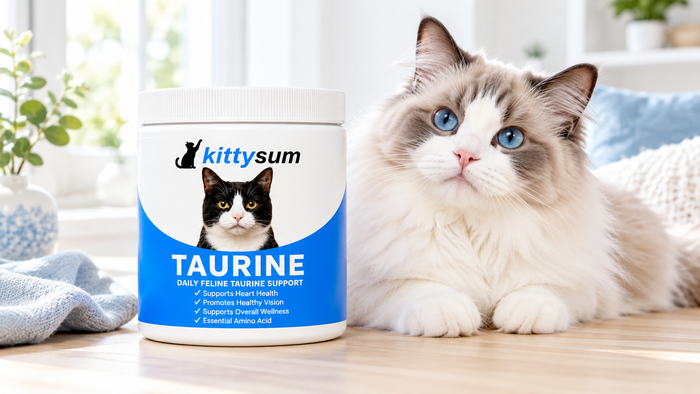
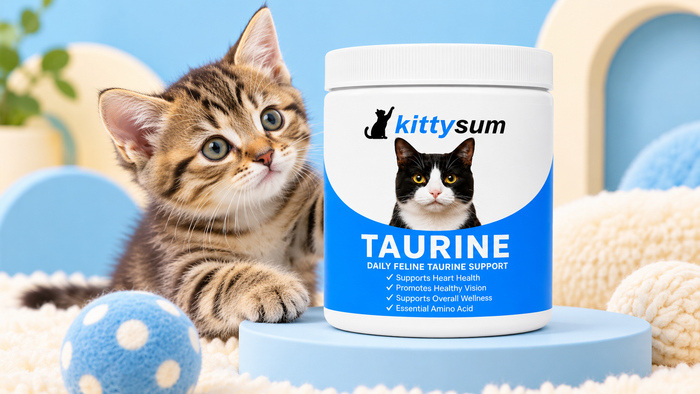
Kittysum Taurine is a daily taurine powder in a 200 g tub with a measuring scoop, blended with chicken liver for a meaty smell. You can read the label and serving guide here. For amounts, see taurine dosage for cats.

Home Monitoring Alongside Taurine for Cats With HCM
Meanwhile, owners can track a cat with HCM at home. For instance, many vets ask owners to count the resting breathing rate.
As a result, problems are caught early. Also, bring your log to every recheck, along with notes on appetite and any supplement you give.
Blood Clots and Emergencies
Unfortunately, HCM raises the risk of blood clots. A clot can lodge where the main artery splits, causing sudden pain and back-leg weakness. In that case, go to an emergency vet at once. Therefore, ask your vet whether your cat needs a clot-prevention medicine. Notably, taurine for cats with HCM does not lower clot risk.
Breeds and Screening
Similarly, some breeds are screened for HCM. For example, gene tests exist for Maine Coons and Ragdolls, and breeders of many breeds use heart scans. Our guides to taurine for Maine Coon cats and taurine for Bengal cats explain how taurine and screening fit together.

Appetite Loss and Taurine for Cats With HCM
Often, cats with heart disease eat less, especially after a crisis or when starting new medicines. As a result, a cat may take in less taurine along with fewer calories. Therefore, offer small, warm, fragrant meals several times a day. Also, tell your vet if your cat eats less than usual for more than a day or two. In addition, ask whether an appetite stimulant or a different food would help. Meanwhile, taurine for cats with HCM can come from a measured powder mixed into a favorite food, if your vet agrees, until appetite returns. Our guide to taurine for picky cats offers more ideas.
HCM With Other Conditions
Commonly, older cats with HCM also have kidney disease or an overactive thyroid. So diets and medicines must work together. For example, a kidney diet may suit one problem while your vet adjusts heart medicines for the other. Still, every complete prescription diet meets the taurine minimum, so taurine for cats with HCM stays covered when the cat eats enough. Our guide to taurine for cats with kidney disease explains that combination, and our guide to taurine for senior cats covers age-related needs.
Daily Life With Taurine for Cats With HCM
Encouragingly, many cats with mild HCM live comfortably for years. In practice, a few habits help.
- Keep stress low: a calm home and familiar routines.
- Give medicines on schedule: use reminders on your phone.
- Feed consistent meals: the same complete food at set times.
- Keep play gentle: short sessions, stopping if breathing quickens.
Likewise, multi-cat homes may need separate feeding spots, so the heart patient eats its full portion. Overall, taurine for cats with HCM is one small, steady part of a calm daily routine.
The Cost of Care
Admittedly, heart scans, rechecks and medicines are the largest costs. By contrast, keeping taurine for cats with HCM covered costs little, because a complete food already provides it. Even when a vet suggests extra taurine, a measured powder adds only a small daily cost. Therefore, spend first on the diagnosis and medicines your vet recommends. Our guide to cheap taurine for cats explains cost-per-day math.
Myths About Taurine for Cats With HCM
- "Taurine reverses a thick heart." It does not; that is DCM, not HCM.
- "Low taurine causes HCM." HCM is mainly genetic or secondary to other diseases.
- "Supplements can replace heart medicine." Never stop medicines without your vet.
- "Cats with HCM should avoid taurine." They still need normal taurine from food.
Clearing up these myths keeps taurine for cats with HCM in perspective.
Common Mistakes With Taurine for Cats With HCM
- Buying a supplement instead of seeing a vet. HCM needs a diagnosis.
- Stopping medicines when the cat seems well. Follow the vet plan.
- Ignoring breathing changes. Count resting breaths.
- Feeding salty treats. Choose heart-friendly options.
- Letting appetite drop unnoticed. Track meals daily.
Avoiding these mistakes keeps taurine for cats with HCM and the rest of the care plan on track.
Questions to Ask Your Vet
- How advanced is my cat's HCM?
- Which medicines are needed, and what side effects should I watch for?
- Does my cat need a lower-salt diet?
- Is a taurine supplement useful for my cat, or is the diet enough?
- What resting breathing rate should prompt a call?
Finally, bring your food label and breathing log. For context, Merck explains the taurine-related heart disease, and the Companion Animals Extension notes retinal changes may appear 5 to 6 months into a deficiency. In addition, a 2015 study found three of seven vegetarian canned diets below the AAFCO minimum, a UC Davis study found cooking lowers taurine, and the VCA supplement guide says the FDA does not review non-drug supplements before sale. Moreover, Merck notes that plant protein contains no taurine.
Keeping nutrition complete during heart care?
Kittysum Taurine is a daily taurine powder blended with chicken liver in a 200 g tub with a measuring scoop, free shipping on orders over $50 and a 30-day return policy. Ask your vet to confirm the amount. Shop Kittysum Taurine →
Key Terms Explained
- HCM: hypertrophic cardiomyopathy, a disease where the heart muscle wall becomes too thick.
- DCM: dilated cardiomyopathy, a disease where the heart muscle becomes thin and weak; low taurine is one cause.
- Echocardiogram: an ultrasound scan of the heart that measures wall thickness and pumping.
- Blood clot (ATE): a clot that can lodge where the aorta splits, often causing sudden back-leg weakness.
- Resting breathing rate: breaths per minute counted while a cat sleeps, used to monitor heart disease at home.
Frequently Asked Questions
Does taurine help cats with HCM?
Taurine does not treat HCM, because HCM is not caused by low taurine. Cats with HCM still need normal taurine from a complete diet.
Can low taurine cause HCM?
No. Low taurine causes a different disease, dilated cardiomyopathy (DCM).
Is a taurine supplement safe for a cat with HCM?
Generally yes, with your vet's agreement, but it should never replace prescribed heart medicine.
What should a cat with HCM eat?
A complete and balanced diet at a healthy weight, with salt moderated if your vet advises.
How do I monitor a cat with HCM at home?
Count the resting breathing rate while your cat sleeps and call your vet if it rises above the limit they set.
References
- VCA Animal Hospitals. Taurine in Cats.
- VCA Animal Hospitals. Lysine.
- Earle KE, Smith PM. Dietary taurine content and plasma taurine in the cat. Br J Nutr. 1991.
- Pion PD, et al. Myocardial failure in cats with low plasma taurine. Science. 1987.
- Spitze AR, et al. Taurine in animal feed ingredients. 2003.
- Kanakubo K, et al. Protein and amino acids in vegetarian pet diets. 2015.
- AAFCO. Cat Food Nutrient Profiles.
- Merck Veterinary Manual. Nutritional Requirements of Small Animals.
- Merck Veterinary Manual. Dilated Cardiomyopathy.
- WSAVA. Selecting a pet food for your pet.
- Companion Animals Extension. Taurine Requirement of Cats.
- AVMA. Dietary supplement law not applicable to products for animals.
- Cornell Feline Health Center. Feline Cardiomyopathy.
- UC Davis Veterinary Genetics Laboratory. Maine Coon HCM test.
This article is for general education and is not veterinary advice. These statements have not been evaluated by the Food and Drug Administration. Kittysum products are not intended to diagnose, treat, cure or prevent any disease.