
Key takeaways
- Taurine for indoor cats comes only from the food in the bowl, since house cats rarely hunt.
- A complete and balanced cat food covers taurine for most indoor cats.
- Homemade diets, very picky eating and heavy calorie cuts can leave gaps.
- Weight control, water intake and play matter as much as the label.
- A measured supplement helps only in specific cases, with vet advice.
Taurine for indoor cats depends entirely on what owners put in the bowl. Unlike outdoor cats, house cats almost never catch prey, so every milligram of taurine comes from their food.
This guide explains how indoor cats get taurine, which foods cover it, how weight, hydration and boredom eating fit in, and when a supplement makes sense. It is written for owners of indoor-only cats who want simple, practical steps.
New to taurine? Start with our guide to taurine for cats.
Table of contents
Why Taurine for Indoor Cats Matters
To begin with, taurine is an amino acid cats must get from animal tissue. In fact, Merck notes that plant protein contains none. Also, VCA Animal Hospitals explains that cats need it for vision, heart muscle function and digestion.
Importantly, low taurine causes serious disease. For example, the landmark 1987 Pion study linked heart failure in cats to low blood taurine, and the Companion Animals Extension says retinal changes may appear 5 to 6 months into a deficiency. Therefore, taurine for indoor cats deserves a quick check of every food you buy.

Why the Bowl Matters for Taurine for Indoor Cats
Originally, cats evolved eating small prey, and a whole mouse provides muscle, organs and other tissues that contain taurine. However, indoor cats rarely hunt anything more than a toy. As a result, they rely completely on their owners.
Fortunately, that also means owners have full control. Because the menu is fixed, small choices add up over months: the label you pick, the portion you measure and the treats you allow. That is why a quick label check pays off for every indoor cat, especially when you switch brands or flavors. Also, keep the bag or can until it is finished, so you can check the label if a question comes up. In short, taurine for indoor cats is easy to get right once you know what to look for on the label.
The Best Foods for Taurine for Indoor Cats
Above all, a commercial cat food labeled complete and balanced is the safest choice. The AAFCO cat food nutrient profiles set a taurine minimum, and complete foods add taurine to meet it.
- Wet food: adds water and is often well accepted.
- Dry food: convenient and covers taurine when complete.
- Mixed feeding: wet meals plus measured dry food in a puzzle feeder.
Moreover, the WSAVA guide suggests choosing foods from makers with qualified nutritionists and strong quality control. Our guide to taurine in dry cat food explains how dry labels work.
Taurine for Indoor Cats: Food Comparison
Below is a quick guide to taurine for indoor cats across common feeding styles.
| Feeding style | Taurine concern | Notes |
|---|---|---|
| Complete wet food | Low | Adds water; serve fresh |
| Complete dry food | Low | Measure portions to control weight |
| Indoor or light formula | Low | Fewer calories, still complete |
| Homemade diet | Moderate to high | Needs a measured taurine source |
| Treats and toppers only | High | Not a complete diet |
In other words, a complete label matters more than brand or price.

Are Indoor Formulas Different?
In general, indoor formulas have fewer calories, more fiber or added ingredients aimed at hairballs. Nevertheless, when labeled complete and balanced, they still meet the taurine minimum. So an indoor formula is a fine choice, but it is not required. Instead, focus on portions first. Consequently, taurine for indoor cats stays covered whichever complete food you pick.
Weight Control and Taurine for Indoor Cats
Unfortunately, indoor cats burn fewer calories, and many gain weight. According to Cornell Feline Health Center, obesity raises the risk of diabetes, arthritis and other problems.
However, cutting portions of a regular food far below the label also cuts taurine. Therefore, ask your vet about a weight-control food rather than simply halving meals. Our guide to taurine for overweight cats explains how to diet safely. In short, taurine for indoor cats and weight control go hand in hand.
Hydration for House Cats
Additionally, many indoor cats drink little, especially on dry food. Meanwhile, low water intake can strain the kidneys and urinary tract. Therefore, try these ideas.
- Offer wet food: it is mostly water.
- Try a fountain: moving water attracts many cats.
- Use wide bowls: some cats dislike whisker contact.
- Place water away from food: cats often prefer it separate.
Overall, good hydration supports the whole body, while taurine for indoor cats supports the heart and eyes.
Boredom Eating Indoors
In particular, indoor cats sometimes eat out of boredom. For instance, a cat may beg or graze all day. As a result, owners add treats and toppers that crowd out complete food. Instead, feed measured meals at set times and use puzzle feeders. Consequently, the cat stays busy, and taurine for indoor cats comes from balanced meals rather than snacks.
Play and Enrichment
Likewise, play keeps house cats fit and calm. The American Association of Feline Practitioners describes the physical and emotional needs of indoor cats, and Ohio State's Indoor Pet Initiative offers enrichment ideas.
- Use wand toys for two or three short sessions a day.
- Add cat trees and window perches for climbing and watching.
- Hide small portions of food for "hunting" games.
- Rotate toys weekly to keep interest high.
In short, an active indoor cat eats better and holds a healthier weight.
Picky Indoor Eaters
Occasionally, indoor cats become very selective. For example, a cat may eat only one flavor or only treats. Therefore, change foods slowly over a week or two, warm wet food slightly and offer meals in a quiet spot. Our guide to taurine for picky cats offers more tips. As a result, your cat eats enough complete food to keep taurine for indoor cats on track.
Homemade Meals for Indoor Cats
Similarly, some owners cook for their cats. However, homemade recipes need a measured taurine source and a full vitamin and mineral mix. Also, a UC Davis study found that cooking lowers taurine in meat, especially boiling.
Our guide to taurine for homemade cat food explains safe amounts. For context, a 1991 Waltham study found cats need at least 39 mg per kg of body weight a day on canned food to keep normal blood taurine.
Treats for Indoor Cats
Admittedly, treats are part of daily life for many house cats. Fortunately, a few rules keep them in check.
- Keep treats under about 10 percent of daily calories.
- Choose meaty treats over starchy ones.
- Use part of the daily kibble as rewards.
- Offer play or brushing as non-food rewards.
Our guide to taurine treats for cats compares options. In short, treats should never replace complete meals, which carry taurine for indoor cats.
When a Supplement Helps
Generally, indoor cats on complete food do not need extra taurine. However, a measured supplement may help in specific cases, with vet advice.
- Homemade diets: recipes without a measured taurine source.
- Very picky cats: cats eating far less complete food than the label suggests.
- Diets: heavy calorie cuts of a regular food.
- Vet concerns: heart or eye findings at a checkup.
VCA describes taurine as relatively safe, with no reports of problems from excess dietary taurine in cats. Even so, VCA warns that supplement quality may vary among makers, and the AVMA reports that the main US dietary supplement law does not apply to animal products.
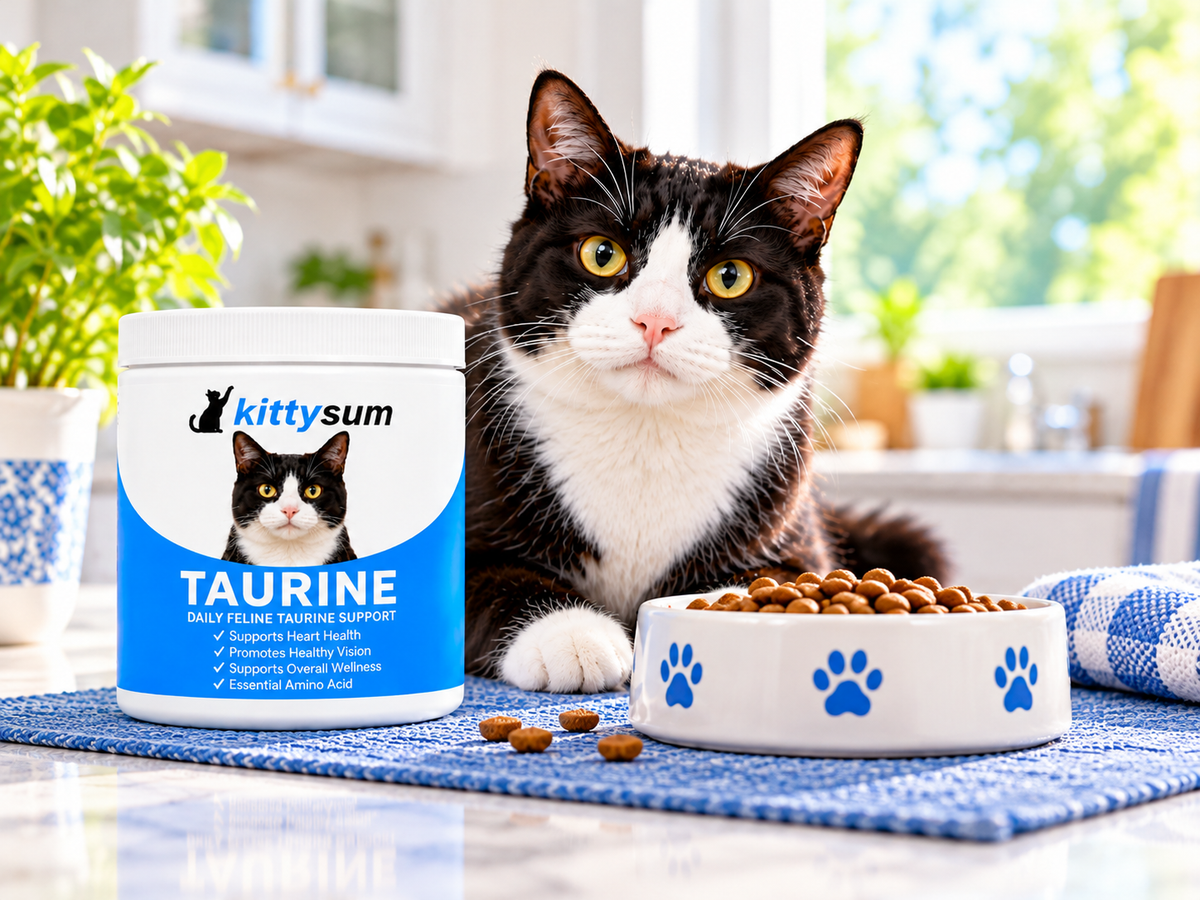
Kittysum Taurine is a daily taurine powder in a 200 g tub with a measuring scoop, blended with chicken liver for a meaty smell. You can read the label and serving guide here. For amounts, see our guide to taurine dosage for cats.

Taurine for Indoor Cats at Every Age
Of course, needs change with life stage. For example, kittens need a complete growth food, adults need steady maintenance and seniors may need diets adjusted for health problems.
- Kittens: see our guide to taurine for kittens.
- Adults: a complete maintenance food with measured portions.
- Seniors: see our guide to taurine for senior cats.
As a result, taurine for indoor cats stays covered from kittenhood to old age.
Warning Signs to Watch
Indeed, indoor cats are easy to observe. Even so, cats hide illness well; therefore, watch for these changes.
- Fast or labored breathing at rest
- Bumping into furniture or wide pupils in daylight
- Low energy or hiding
- Weight loss or reduced appetite
So if you notice these, call your vet promptly. Our guide to taurine deficiency in cats explains the signs in more detail.

Taurine for Indoor Cats in Multi-Cat Homes
In many cases, homes with several cats have one cat that eats too much and another that eats too little. As a result, the shy cat may fall short on complete food. Therefore, feed cats in separate spots, and watch who finishes each bowl. Also, microchip feeders let each cat eat only its own meal. In addition, if one cat needs a supplement, mix it into that cat's portion only. Consequently, taurine for indoor cats reaches every cat in the right amount, and nobody steals extra calories.
A Simple Feeding Schedule
Generally, set meals work better indoors than a bowl that is always full. For example, many owners use a routine like this.
- Morning: a measured wet meal, plus any prescribed supplement.
- Midday: a small dry portion in a puzzle feeder.
- Evening: a second wet meal after a play session.
- Bedtime: a few pieces of kibble as a final "hunt".
Thus, the cat eats its full daily portion in measured amounts. Moreover, a routine makes it easy to notice a skipped meal, which is often the first sign of illness. In short, a schedule keeps taurine for indoor cats steady from day to day.
Moving an Outdoor Cat Indoors
Likewise, many owners bring a once-outdoor cat inside for safety. At first, the cat may miss hunting and eat less. So offer extra play, climbing spaces and window views, and switch foods gradually over about a week. Meanwhile, book a vet checkup to look at weight, teeth, heart and eyes. Later, most cats settle in well. Afterward, taurine for indoor cats comes from the same complete food as any house cat, and a supplement is needed only if your vet advises one. Our guide to taurine for feral cats covers rescued community cats.
Myths About Taurine for Indoor Cats
- "Indoor cats need less taurine." Their need is the same; only calories differ.
- "Every indoor cat needs a supplement." A complete food usually covers taurine.
- "Indoor formulas are required." Any complete food works with proper portions.
- "Treats are harmless extras." Too many crowd out complete meals.
Clearing up these myths keeps taurine for indoor cats simple.
Common Mistakes With Taurine for Indoor Cats
- Halving regular food to slim a cat. Ask about a weight-control food.
- Free-feeding treats. They replace complete meals.
- Skipping water ideas. House cats often drink too little.
- Feeding dog food. It is not made for a cat's taurine needs.
- Cooking without a recipe. Homemade meals need a measured taurine source.
Avoiding these mistakes keeps taurine for indoor cats covered every day.
Questions to Ask a Vet About Taurine for Indoor Cats
- Is my cat's food complete for its life stage?
- What daily portion fits my cat's ideal weight?
- Does my cat need a taurine supplement?
- How can I help my cat drink more water?
Finally, bring the food label to the visit. For context, a 2015 study found three of seven vegetarian canned diets below the AAFCO minimum, and Merck explains the heart disease linked to low taurine. In addition, the VCA supplement guide says the FDA does not review non-drug supplements before sale.
Feeding a homemade or picky indoor cat?
Kittysum Taurine is a daily taurine powder blended with chicken liver in a 200 g tub with a measuring scoop, free shipping on orders over $50 and a 30-day return policy. Ask your vet to confirm the amount. Shop Kittysum Taurine →
Key Terms Explained
- Indoor cat: a pet cat that lives fully inside the home.
- Complete and balanced: a food that meets a standard nutrient profile for its life stage.
- Indoor formula: a cat food made with fewer calories or more fiber for less active cats.
- Enrichment: play, puzzles and climbing spaces that keep indoor cats active.
- Topper: a small amount of food added on top of the main meal.
Frequently Asked Questions
Do indoor cats need taurine supplements?
Usually not, if they eat a complete and balanced cat food. Homemade diets, very picky eating or heavy calorie cuts may call for one.
Do indoor cats need less taurine than outdoor cats?
No. Their taurine need is the same; indoor cats usually need fewer calories.
Is an indoor cat food formula necessary?
No. Any complete food covers taurine; indoor formulas mainly help with calories and hairballs.
Can I halve my indoor cat's food to help it lose weight?
Large cuts of a regular food also cut taurine. Ask your vet about a weight-control food instead.
What are signs of low taurine in indoor cats?
Fast breathing, low energy and vision problems such as bumping into furniture. See your vet promptly.
References
- VCA Animal Hospitals. Taurine in Cats.
- VCA Animal Hospitals. Lysine.
- Earle KE, Smith PM. Dietary taurine content and plasma taurine in the cat. Br J Nutr. 1991.
- Pion PD, et al. Myocardial failure in cats with low plasma taurine. Science. 1987.
- Spitze AR, et al. Taurine in animal feed ingredients. 2003.
- Kanakubo K, et al. Protein and amino acids in vegetarian pet diets. 2015.
- AAFCO. Cat Food Nutrient Profiles.
- Merck Veterinary Manual. Nutritional Requirements of Small Animals.
- Merck Veterinary Manual. Dilated Cardiomyopathy.
- WSAVA. Selecting a pet food for your pet.
- Companion Animals Extension. Taurine Requirement of Cats.
- AVMA. Dietary supplement law not applicable to products for animals.
- AAFP. Meeting the Needs of Indoor Cats.
- Ohio State Indoor Pet Initiative. Environmental Enrichment for Indoor Cats.
- Cornell Feline Health Center. Fat Cats.
This article is for general education and is not veterinary advice. These statements have not been evaluated by the Food and Drug Administration. Kittysum products are not intended to diagnose, treat, cure or prevent any disease.