Key takeaways
- Taurine for picky cats works best as a small amount mixed into a strong-smelling wet food.
- Start with a pinch and build up over a week so the taste never surprises your cat.
- Serve the mixed portion first, while your cat is hungriest.
- Never force-feed or hide powder in every meal at once, as this can cause food aversion.
- A sudden change in appetite needs a vet, not a new trick.
Taurine for picky cats is easiest when your cat never notices it. Many fussy cats walk away from a bowl that smells even slightly different. So the trick is to start small, pick the right food and build up slowly.
This guide shares 7 easy mixing tips, the best foods to use, what to avoid and when a fussy appetite needs a vet instead.
New to taurine? Start with our guide to taurine for cats.
Table of contents
Do Picky Cats Need Extra Taurine?
Taurine is an amino acid cats must get from animal tissue. In fact, Merck notes that plant protein contains none. Also, VCA Animal Hospitals explains that cats need it for vision, heart muscle function and digestion.
VCA says a healthy cat eating a complete food for its life stage does not require supplementation. So a picky cat that eats enough of a complete food is usually covered. However, picky cats often eat small amounts, switch foods often or eat homemade meals. In those cases, taurine for picky cats becomes a real question.
- Homemade or raw diets
- A vet-advised supplement after a heart or eye exam
- Very small meals of a complete food

Why Cats Are Picky About New Tastes
Cats rely heavily on smell to judge food. In fact, a cat with a blocked nose often stops eating. Therefore, a new smell in the bowl can be enough to put a fussy cat off.
Cats also learn food aversions quickly. For example, if a cat feels sick after a meal, it may refuse that food for weeks. Similarly, a bitter or strange taste can teach a cat to avoid the bowl. That is why taurine for picky cats needs a gentle approach.
Powder, Liquid or Chew: Taurine for Picky Cats
Each form has pros and cons for a fussy eater. Indeed, the right form makes taurine for picky cats much easier.
- Powder: mixes evenly into wet food and is easy to start in tiny amounts.
- Liquid: blends into food or water, though flavor and dosing vary.
- Chews or treats: some cats love them, while others refuse them.
- Capsules: hard to give to a picky cat without opening them.
For most owners, then, a powder is the simplest. Moreover, a powder lets you start with a pinch and build up. Our guides to liquid taurine for cats and taurine treats for cats compare the other forms.
7 Easy Mixing Tips: Taurine for Picky Cats
These tips work for most fussy cats. So try them in order.
- Use a strong-smelling wet food. Fish or liver pâté hides new tastes best.
- Start with a pinch. Use a fraction of the full amount on day one.
- Mix it fully. Stir until no powder is visible on top.
- Serve a small portion first. Offer one or two spoonfuls with the powder, then the rest of the meal.
- Warm the food slightly. Body-warm food smells stronger and more inviting.
- Keep the same routine. Use the same bowl, place and time each day.
- Build up slowly. Raise the amount over about a week until you reach the target.
As a result, most cats accept taurine for picky cats without noticing the change. In short, taurine for picky cats is about patience more than tricks.
Best Foods to Hide Taurine for Picky Cats
Some foods hide a powder better than others, and choosing well is half the work of taurine for picky cats. For example:
- Smooth pâté: the texture holds powder evenly.
- Fish-based wet food: its strong smell masks other tastes.
- Lickable cat treats: a small squeeze makes a good carrier.
- Warmed wet food: heat lifts the aroma.
Avoid mixing powder into dry kibble on its own, because it falls to the bottom of the bowl. Instead, use a little wet food as a carrier. Our guide to how to add taurine to cat food shows more mixing methods.

Taurine for Picky Cats: Carrier Food Comparison
Here is a quick guide to common carriers.
| Carrier | Hides taste | Best for |
|---|---|---|
| Smooth pâté | Very well | Most picky cats |
| Chunks in gravy | Moderately | Cats that lick gravy first |
| Lickable treat | Very well | Cats that refuse meals |
| Dry kibble alone | Poorly | Not recommended |
| Water | Poorly | Not recommended for dosing |
In short, taurine for picky cats works best with a smooth, strong-smelling wet carrier.
A First-Week Plan for Taurine for Picky Cats
A slow start prevents refusals. So follow this simple plan for taurine for picky cats.
- Days 1 to 2: a pinch in one spoonful of pâté.
- Next two days: about a quarter of the target amount.
- Days 5 to 6: about half of the target amount.
- From the end of the week: the full amount, if your cat eats well.
If your cat refuses the bowl, go back one step for two days. Then try again. Meanwhile, keep a short log of what your cat ate. As a result, you will see which step works. Our guide to taurine dosage for cats explains how to set the target amount with your vet.
What to Avoid With Taurine for Picky Cats
- Adding the full amount on day one. A sudden taste change often causes refusals.
- Mixing into the whole meal. If your cat refuses it, the whole meal is lost.
- Force-feeding. This stresses cats and can cause lasting aversion.
- Using people food as a carrier. Onions, garlic and many sauces are unsafe for pets, according to the ASPCA.
- Using human taurine products. Doses and extra ingredients are made for people.
Our guide to human taurine for cats explains why human capsules and energy drinks are not a good choice.
Dry Food Eaters and Taurine for Picky Cats
Some picky cats eat only dry food. Naturally, that makes mixing harder, though not impossible.
- First, offer a teaspoon of wet food with the powder before the kibble.
- Next, try a lickable treat as the carrier.
- Then, if your cat refuses both, ask your vet about other options.
Also, most complete dry foods already include taurine. For example, the AAFCO cat food nutrient profiles set a taurine minimum for dry food, and complete dry foods add taurine to meet it. So a cat eating enough of a complete dry food may not need extra. Our guide to taurine in dry cat food explains why.
Multi-Cat Homes and Taurine for Picky Cats
In a home with several cats, one cat may eat another's mixed portion. Therefore, feed the picky cat in its own room or at a separate time. Also, pick up leftover food after 20 to 30 minutes.
As a result, you know exactly how much your picky cat ate. Likewise, the other cats keep their usual diet. In short, separate meals make taurine for picky cats far easier to track.
Choosing a Product for Taurine for Picky Cats
For a fussy eater, the product matters as much as the method. In fact, taurine for picky cats often succeeds or fails on texture and smell. So look for these points.
- Clear mg per serving: you need it to build up slowly.
- Measuring scoop: small, steady portions are easier.
- Fine texture: it blends without grit.
- Accepted taste: a meaty base can help.
- Full ingredient list: every added ingredient should be named.
VCA describes taurine supplementation as relatively safe, with no reports of problems from excess dietary taurine in cats. Even so, AAFCO sets no maximum, so use the label or your vet's amount. VCA also warns that supplement quality may vary significantly among makers, and the AVMA reports that the main US dietary supplement law does not apply to animal products.
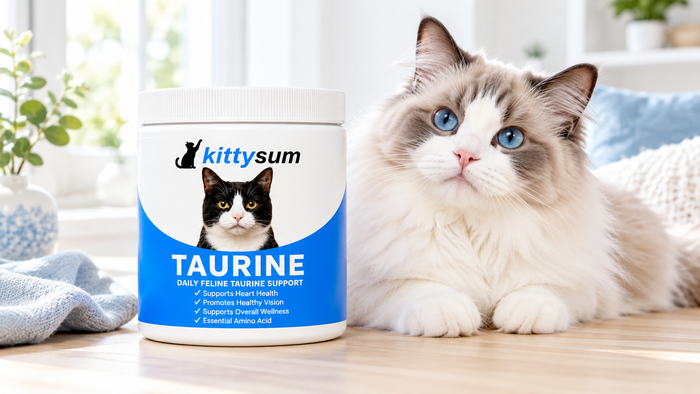
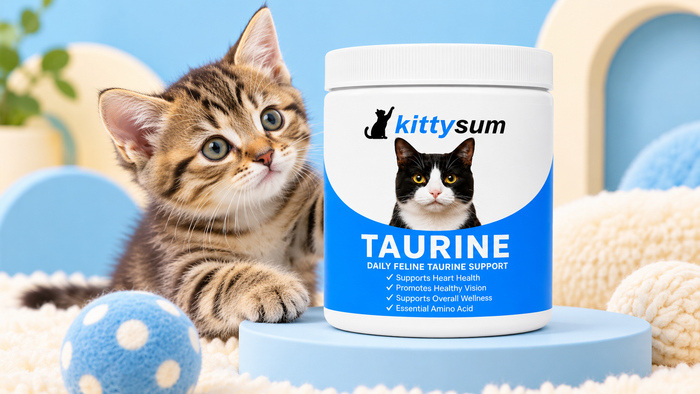
Kittysum Taurine is a daily taurine powder blended with chicken liver for a meaty smell, in a 200 g tub with a measuring scoop. It is made to mix into soft wet food. You can read the label and serving guide here. For a wider comparison, see our guide to the best taurine supplement for cats.

Rotating Flavors Without Losing the Routine
Many picky cats get bored of one flavor. So owners rotate foods, which can make a supplement routine harder. However, a few simple habits keep things steady.
- Keep one carrier constant: use the same pâté for the mixed portion, even if the main meal changes.
- Rotate within complete ranges: switch flavors from foods that are complete and balanced.
- Change one thing at a time: never switch the food and the supplement on the same day.
- Write it down: note each new flavor and how your cat responded.
As a result, your cat still gets variety, while taurine for picky cats stays steady from week to week. Similarly, if a new flavor causes a refusal, you will know exactly what changed. Moreover, a short note in your phone is enough.
Boarding, Travel and Sitters
Routines often break when you travel. For this reason, prepare ahead.
- First, pre-measure daily portions into small labeled bags or pots.
- Next, pack the same carrier food your cat already accepts.
- Then write simple steps for the sitter or boarding staff.
- Finally, ask them to note how much your cat ate.
Consequently, taurine for picky cats keeps going even while you are away. Above all, a stressed cat may eat less in a new place, so tell the sitter to call you if meals are refused.
When a Picky Appetite Needs a Vet
Admittedly, some fussiness is just personality. However, a change in appetite can signal illness. So call your vet if you notice:
- Eating much less for more than a day
- Weight loss
- Drooling, pawing at the mouth or dropping food
- Vomiting, diarrhea or hiding
- Fast or labored breathing at rest
Cats that stop eating can become seriously ill quickly, so taurine for picky cats is never a reason to delay care. Therefore, never wait more than a day or two. In short, a vet visit matters far more than any mixing trick. Dental pain is a common reason older cats become picky, as our guide to taurine for senior cats explains.

Common Mistakes With Taurine for Picky Cats
- Giving up after one refusal. Step back and try again slowly.
- Switching foods every day. Change one thing at a time.
- Hiding powder in cold food. Warm food smells better.
- Guessing the amount. Use a scoop and your vet's target.
- Ignoring appetite loss. Call your vet instead.
Consequently, avoiding these mistakes keeps taurine for picky cats on track.
Questions to Ask Your Vet About Taurine for Picky Cats
- Does my cat's diet already cover taurine?
- Is a supplement needed, and how much?
- Could pain or illness explain the picky eating?
- Which carrier food suits my cat's health?
Bring a short food log to the visit, so your vet can judge taurine for picky cats in one look. For context, a 1991 Waltham study found cats need at least 39 mg per kg of body weight a day on canned food. Also, a UC Davis study found that cooking lowers taurine in meat, and a 2015 study found three of seven vegetarian canned diets below the AAFCO minimum. In addition, the landmark 1987 Pion study linked heart failure in cats to low blood taurine, Merck explains the heart disease involved.
Likewise, the Companion Animals Extension says retinal changes may appear 5 to 6 months into a deficiency. Finally, see the WSAVA guide for diet advice, and note the VCA supplement guide says the FDA does not review non-drug supplements before sale.
Have a fussy eater?
Kittysum Taurine is a daily taurine powder blended with chicken liver in a 200 g tub with a measuring scoop, free shipping on orders over $50 and a 30-day return policy. Ask your vet to confirm the amount. Shop Kittysum Taurine →
Key Terms Explained
- Picky eater: a cat that refuses new foods, flavors or textures.
- Palatability: how appealing a food tastes and smells to a cat.
- Pâté: a smooth wet food that hides powder well.
- Food aversion: a dislike a cat learns after a bad experience with a food.
- Complete and balanced: a food that meets a standard nutrient profile for its life stage.
Frequently Asked Questions
How do I give taurine to a picky cat?
Mix a pinch into a small portion of warm, strong-smelling pâté, serve it first and build up over about a week.
Can I mix taurine powder into dry food?
It tends to fall to the bottom of the bowl. Use a spoonful of wet food or a lickable treat as a carrier instead.
What if my cat refuses food with taurine?
Go back to a smaller amount for two days, then try again. Never force-feed, and call your vet if your cat eats much less.
Does taurine change the taste of food?
Some cats notice a new taste or smell. Starting small and using a strong-smelling wet food usually hides it.
Do picky cats need a taurine supplement?
Most cats eating enough of a complete food get enough taurine. Ask your vet if your cat eats very little or eats a homemade diet.
References
- VCA Animal Hospitals. Taurine in Cats.
- VCA Animal Hospitals. Lysine.
- Earle KE, Smith PM. Dietary taurine content and plasma taurine in the cat. Br J Nutr. 1991.
- Pion PD, et al. Myocardial failure in cats with low plasma taurine. Science. 1987.
- Spitze AR, et al. Taurine in animal feed ingredients. 2003.
- Kanakubo K, et al. Protein and amino acids in vegetarian pet diets. 2015.
- AAFCO. Cat Food Nutrient Profiles.
- Merck Veterinary Manual. Nutritional Requirements of Small Animals.
- Merck Veterinary Manual. Dilated Cardiomyopathy.
- WSAVA. Selecting a pet food for your pet.
- Companion Animals Extension. Taurine Requirement of Cats.
- AVMA. Dietary supplement law not applicable to products for animals.
- ASPCA. People Foods to Avoid Feeding Your Pets.
This article is for general education and is not veterinary advice. These statements have not been evaluated by the Food and Drug Administration. Kittysum products are not intended to diagnose, treat, cure or prevent any disease.